





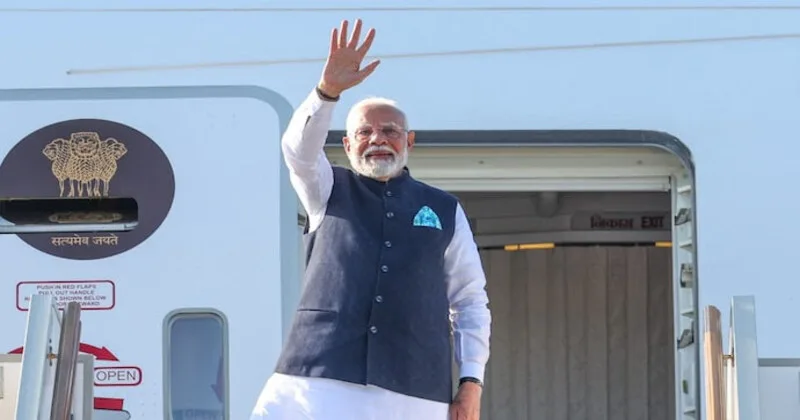
Prime Minister Narendra Modi’s visit to the United Kingdom marks a defining moment in India’s economic diplomacy, coming at a time of considerable global uncertainty and transformation. Against the backdrop of shifting geopolitical alliances, economic disruptions stemming from supply chain reconfigurations, and ongoing conflicts such as the Russia-Ukraine war, the India-UK Free Trade Agreement (FTA) negotiations have emerged as a key bilateral initiative with far-reaching implications. The Prime Minister’s visit is expected to provide critical momentum to the FTA, signalling India’s intent to deepen economic engagement with major Western economies while safeguarding its strategic and developmental interests.
India and the United Kingdom share a long-standing relationship that spans historical, cultural, educational, and economic dimensions. Over the past decade, this relationship has evolved into a strategic partnership grounded in shared democratic values, mutual economic interests, and converging geopolitical goals. Since the announcement of the India-UK Comprehensive Strategic Partnership in 2021 and the launch of the Enhanced Trade Partnership (ETP), both nations have pursued a more ambitious economic engagement. The proposed FTA is the centrepiece of this renewed vision, promising to unlock significant economic opportunities for both countries.
The India-UK FTA is aimed at reducing trade barriers, enhancing market access, and fostering investment across a range of sectors including pharmaceuticals, information technology, financial services, textiles, and automobiles. For India, the agreement is expected to open up the UK market for its labour-intensive exports while facilitating greater inward investment from British firms. According to official estimates, the FTA could boost India’s exports to the UK by up to $10 billion annually and create thousands of new jobs in key sectors. Sectors such as textiles, leather, gems and jewellery, and pharmaceuticals stand to gain substantially, especially if tariff and non-tariff barriers are eased. In particular, Indian pharmaceutical companies have long struggled with regulatory hurdles in the UK and broader EU markets. A streamlined FTA would enable greater access to generic Indian medicines, benefiting both economies.
Prime Minister Modi’s visit comes at a time when India is actively recalibrating its trade strategy to secure resilient and diversified global value chains. The pandemic-induced disruptions exposed the vulnerabilities of over-reliance on a few supply partners, prompting a global rethink on trade dependencies. For India, the goal is clear: to position itself as a reliable, democratic, and competitive alternative in the global manufacturing and services ecosystem. The FTA with the UK, a G7 economy with deep historical and institutional linkages to India, fits squarely into this ambition. The agreement also aligns with India’s broader goal of becoming a $5 trillion economy, leveraging trade partnerships to drive growth, create employment, and foster innovation.
In the midst of global economic volatility, including inflationary pressures, energy price fluctuations, and regional conflicts, India has emerged as a relatively stable and high-growth economy. With a projected GDP growth rate of over 7 per cent in 2025, India is currently one of the fastest-growing major economies in the world. This growth is underpinned by domestic policy reforms, infrastructure development, digital transformation, and an expanding consumer base. The FTA with the UK would amplify these trends by attracting foreign investment, enabling technology transfers, and facilitating cross-border collaboration in high-value sectors such as fintech, green energy, defence manufacturing, and research and development.
From a geopolitical perspective, the FTA carries implications that transcend trade. It is part of India’s strategic manoeuvring within the larger Indo-Pacific and transatlantic frameworks. As the global order becomes increasingly multipolar, India has sought to deepen its economic ties with like-minded democracies. The UK, after Brexit, is actively seeking to redefine its global trade relations and sees India as a pivotal partner in its “Global Britain” strategy. This convergence of interests provides a rare window of opportunity. For the UK, securing a trade agreement with India, a large and growing market, is a priority. For India, it offers a chance to lock in favourable trade terms with a developed country, gain access to advanced technologies, and attract British investment in sectors aligned with India’s developmental priorities.
Crucially, the FTA negotiations have not been without challenges. Issues such as rules of origin, labour mobility, services liberalisation, and tariff concessions have required careful negotiation. The question of easier visas for Indian professionals and students, for instance, remains a politically sensitive topic in the UK, while India has sought stronger safeguards for its small and medium enterprises (SMEs) and agricultural interests. Yet, the mutual benefits of the agreement have kept both parties committed to ironing out differences. Prime Minister Modi’s visit is expected to provide the political impetus required to resolve these outstanding issues and push the agreement towards finalisation.
The timing of the visit is significant for another reason: it comes at a time when India is actively expanding its global trade footprint through FTAs with other key partners. After concluding trade agreements with the UAE and Australia, and pursuing talks with the European Union and Canada, the India-UK FTA represents a crucial milestone in this evolving trade architecture. It signals India’s readiness to play a more assertive role in global trade and economic governance. More importantly, it shows a shift in India’s trade posture—from protectionism towards proactive engagement, with a focus on securing strategic and economic gains.
The political symbolism of the visit should not be overlooked. At a time when global institutions are struggling to adapt to new challenges, the India-UK partnership reflects a renewed trust in democratic, bilateral diplomacy. Prime Minister Modi’s personal diplomacy and ability to build rapport with global leaders have played a key role in elevating India’s international stature. His visit to the UK is likely to reinforce this trend, strengthening India’s image as a confident, open, and globally integrated power. For the Indian diaspora in the UK—one of the most influential and economically significant diasporas globally—the visit also reaffirms cultural and people-to-people ties, further consolidating the bridge between the two nations.
Economically, the FTA offers several specific benefits that could cushion India against global headwinds. Amidst concerns of a global slowdown and rising protectionism, bilateral agreements like the one with the UK provide trade certainty, supply chain stability, and policy alignment. They allow India to reduce over-dependence on any single region and diversify its export markets. This is especially important given the ongoing disruptions in Europe due to the war in Ukraine and the economic slowdown in China. Additionally, increased UK investment in Indian sectors such as renewable energy, healthcare, and infrastructure could support India’s efforts toward energy transition and sustainable development, aligning with its COP26 commitments and green growth objectives.
The FTA is also likely to benefit India’s services sector—a traditional strength. With easier market access, Indian IT, legal, accounting, and consultancy firms could tap into British clients and expand their footprint. For Indian students, smoother pathways to UK universities and post-study work opportunities would enhance education and mobility prospects. These gains are not only economic but also socio-cultural, reinforcing the human capital advantage that India brings to the global stage.
In conclusion, Prime Minister Narendra Modi’s visit to the United Kingdom represents a critical juncture in India’s external economic engagement. The India-UK Free Trade Agreement, if concluded and implemented effectively, could become a cornerstone of India’s broader strategy to navigate the global economic landscape amidst turbulence and transition. It would cement India’s position as a key player in the liberal, rules-based trade order, while delivering tangible benefits to its economy, businesses, and citizens. As India aspires to greater economic self-reliance coupled with global integration, the FTA with the UK stands as a powerful testament to how diplomacy, development, and trade can converge to shape a resilient and forward-looking future.













Comments