





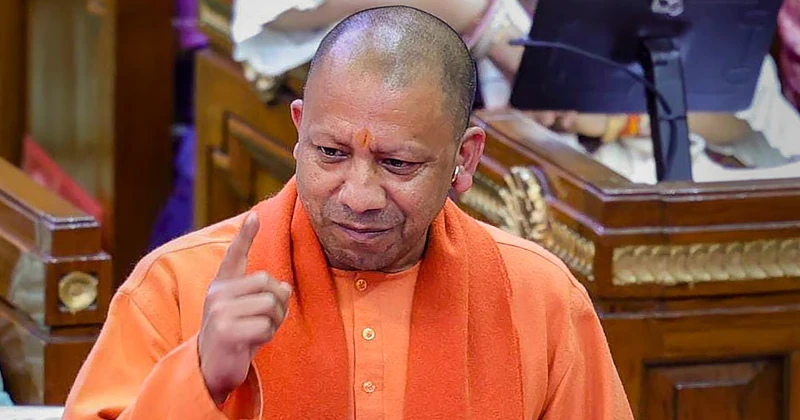
Uttar Pradesh Chief Minister Yogi Adityanath has launched a long-overdue initiative to grant legal land ownership rights to over 10,000 Hindu families displaced from Bangladesh during the traumatic years surrounding the 1971 Liberation War.
These families victims of religious persecution, genocide, and displacement have been living in a state of uncertainty and legal invisibility for over six decades in Pilibhit, Rampur, Bijnor, and Lakhimpur Kheri districts. Though allotted land on paper between 1960 and 1975, they have never been granted formal legal rights due to administrative chaos, outdated laws, and institutional apathy.
Now, under the strong leadership of CM Yogi Adityanath, the government has decided to end this historical injustice once and for all. The Chief Minister has ordered immediate action to regularise and formalise land ownership for these long-marginalised Hindu refugee families who fled Islamic persecution in Bangladesh and found refuge in Bharat.
“This is not just a matter of land transfer. This is a question of justice, humanity, and national responsibility,” CM Yogi said during a high-level meeting. “These people are not outsiders. They are sons and daughters of Bharat who fled horrific violence. It is our moral duty to restore dignity to their lives.”
Between 1960 and 1975, during and after the Partition and 1971 Bangladesh War, thousands of Hindu families fled the brutal atrocities of the Pakistani army and Islamist militias in East Pakistan. They were temporarily rehabilitated by the Indian government and resettled in UP but their legal status was never resolved.
Although some were allotted plots in villages across Pilibhit, Bijnor, Rampur, and Lakhimpur Kheri, the process remained incomplete. Many never received land documents; some plots remained under the Forest Department, while others were tangled in legal disputes due to clerical errors, lack of mutation, and missing records.
As generations passed, families built homes, cultivated land, and integrated into society — yet remained without land rights, social security, or legal protection. For over 60 years, successive governments ignored or avoided the issue. But now, under CM Yogi’s leadership, the situation is being tackled with unprecedented urgency and empathy.
Officials informed the Chief Minister that much of the legal confusion stemmed from the repeal of the Government Grants Act in 2018. The lack of a legal pathway to confirm or validate old allotments had created a deadlock. But CM Yogi refused to accept this as an excuse. “If the law is gone, we will find another way. The law exists to serve the people, not to trap them in misery,” he said.
He directed officers to identify all such families, verify long-term physical possession, and use existing legal mechanisms to grant ownership certificates and update revenue records. He made it clear that every displaced Hindu family that has tilled the land for years and built a home must be given title and dignity.
CM Yogi’s initiative reflects a vision of governance that combines decisiveness with sensitivity. Unlike previous governments that relegated these refugees to the margins, the Yogi administration is treating their plight as a national wound that must be healed.
“We cannot treat this as mere policy. These are people who lost everything due to religious persecution. Bharat gave them shelter, but not justice. We must now correct that wrong,” CM Yogi stated.
This landmark decision follows the spirit of the Citizenship Amendment Act (CAA), which aimed to protect persecuted minorities from Pakistan, Bangladesh, and Afghanistan. By focusing on land rights and rehabilitation, CM Yogi is turning legal protection into tangible relief on the ground.
Officials confirmed that thousands of families have been living on allotted lands for decades, growing crops and raising children — yet their names never made it to revenue records. Meanwhile, some of the original allottees no longer live in the villages, and in some cases, the land has been illegally encroached upon or remains disputed.
The government’s current push involves:
- Surveying and verifying legitimate claimants.
- Resolving disputes involving forest land or overlapping allotments.
- Updating revenue records and granting formal ownership certificates.
- Ensuring legal aid and administrative support for families who lack documentation.
Social groups, refugee welfare organisations, and local communities have welcomed the move as a long-overdue corrective. Hindu refugee families see this as a “new dawn” after decades of being treated as stateless within their own homeland.
“For 50 years, we farmed this land, built a house, sent our children to school, but the government never gave us documents. Today, CM Yogi has made us feel seen. We are no longer refugees — we are citizens,” said a refugee elder in Pilibhit with tears in his eyes.
During a recent ‘Janta Darshan’ in Lucknow, CM Yogi heard grievances from over 50 citizens, including issues of land, education, health, and legal disputes. He personally assured assistance and fast-track resolution, directing officials to act without delay. In one case, he arranged a motorised tricycle for a differently-abled person on the spot underscoring his government’s hands-on, people-first approach.
With the decision to grant land rights to 10,000 displaced Hindu families from Bangladesh, Yogi Adityanath has corrected a 60-year-old injustice that had faded into the pages of bureaucratic history. In doing so, he has reaffirmed Bharat’s moral duty to its own people — those who came seeking refuge from bloodshed and were forgotten.











Comments