





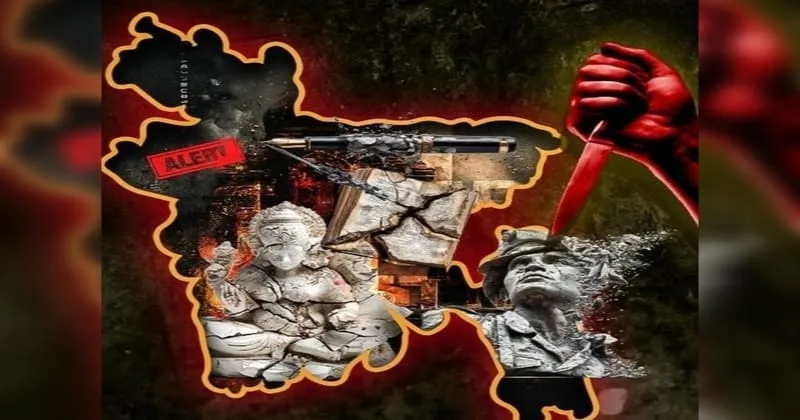
Recent months have witnessed a concerning escalation of actions in Bangladesh that appear to target and diminish Indian cultural elements, particularly those linked to the Hindu minority. This has included incidents of vandalism, destruction of religious sites, and attacks on cultural centres, sparking strong condemnation from India and raising alarms about the safety and cultural preservation of Hindu communities in the neighbouring nation.
These acts of destruction are not isolated, often emerging amidst broader political unrest and a perceived rise in extremist sentiments. The targeting of Hindu temples and institutions, along with Indian cultural centres, signals a disturbing trend that impacts bilateral relations and the cultural fabric shared between the two countries.
This report documents 10 significant incidents between August 2024 and July 2025 in Bangladesh, during the tenure of the interim government led by Chief Adviser Muhammad Yunus following the fall of the Sheikh Hasina government. These incidents highlight the vandalism, destruction, and restrictions imposed by Islamist mobs on cultural properties and heritage sites, particularly those belonging to minorities.
India’s protest halts demolition of Satyajit Ray’s ancestral home in Bangladesh
An old and dilapidated building in Mymensingh, believed to be the ancestral home of Satyajit Ray and his grandfather Upendra Kishore Ray Chowdhury, faced imminent demolition by the Bangladeshi administration. The authorities had initiated the demolition drive, citing the structure’s unsafe condition due to a lack of maintenance. Their plan was to replace it with a modern concrete facility where Sishu academy’s activities for children could be conducted.
However, the move quickly drew sharp condemnation and intervention from India. The Indian government formally lodged a strong protest, urging a reconsideration of the demolition and advocating for the building’s renovation and preservation as a heritage site. West Bengal Chief Minister Mamata Banerjee also appealed for the preservation of this culturally significant property. In response to the diplomatic pressure, the Bangladeshi High Commission in Delhi announced that the demolition process has been halted and a committee has been formed to review the situation.
The building holds immense cultural significance, widely regarded as a symbol of the Bengali cultural renaissance. This is due to its direct association with three generations of eminent literary figures: Upendra Kishore, Sukumar, and Satyajit Ray. While this particular building in Mymensingh served as their secondary residence, their main ancestral home, in Katiadi upazila in Masua village (Kishoreganj district), was renovated in 2012 by the Bangladesh Tourism Corporation during Sheikh Hasina’s administration at a cost of BDT 5.9 million (approximately Rs47.2 lakh). Both residences were reportedly in a dilapidated state before interventions.
Rabindranath Tagore’s ancestral home vandalised in Bangladesh amidst Islamist mob attack
In a deeply disturbing incident that has drawn strong condemnation, the historic ancestral home and museum of Nobel laureate Rabindranath Tagore, known as ‘Rabindra Kachharibari’, in Sirajganj, Bangladesh, was subjected to a violent attack and extensive vandalism by an Islamist mob.
The destruction reportedly began after a dispute erupted between a motorcycle parking attendant and an official, which quickly escalated. Enraged, the mob unleashed its fury on the heritage site, causing significant damage to the auditorium, windows, doors, and furniture.
The Bangladeshi government has initiated an investigation into the incident. So far, five individuals, including the main accused Md Shahnewaz, have been arrested, and cases have been filed against 50-60 people. A three-person investigation committee has also been formed. However, the incident has sparked outrage in India. The Indian government has strongly condemned the attack and demanded swift action from the Bangladeshi authorities.
The ‘Rabindra Kachharibari’ holds immense cultural and historical significance. It was in this very house that Rabindranath Tagore composed many of his renowned works, including “Amar Shonar Bangla” – the national anthem of Bangladesh. The site serves as a vital centre for Bangladesh’s cultural identity and Tagore’s literary legacy, underscoring the severe implications of such an attack on shared heritage.
Islamist pressure leads to Islamisation of UNESCO-recognised Bengali New Year tradition in Bangladesh
In a move signalling a disturbing shift under the interim government led by Muhammad Yunus, Bangladesh’s cherished Bengali New Year (Pohela Boishakh) tradition, particularly the ‘Mangal Shobhajatra’ procession, has reportedly undergone Islamisation. This comes in the wake of the fall of the Sheikh Hasina government and increasing pressure from Islamist extremist organisations and certain political factions, who have vocally opposed the ‘Mangal Shobhajatra’ and other Hindu-linked cultural events as “un-Islamic.”
Bowing to this extremist pressure, the Yunus government, in April 2025, officially renamed the ‘Mangal Shobhajatra’ to ‘Barshavaran Ananda Shobhajatra’. Furthermore, the Bangladeshi administration has reportedly initiated a process to remove traditional symbols, floats, and folk masks that are prominent in the procession, declaring this decision as part of a “new Bangladeshi social policy.”
The Bengali New Year (Pohela Boishakh) has long been a powerful symbol of Bangladesh’s cultural diversity, secular heritage, and multi-religious coexistence. The ‘Mangal Shobhajatra’ procession, in particular, is renowned for its traditional elements such as the ‘Ananda Bail’ (joyful bull), masks of Maa Durga, and folk motifs, all of which beautifully reflect Bangladesh’s rich multi-cultural identity.
In a testament to its universal value, UNESCO inscribed the ‘Mangal Shobhajatra’ on the Representative List of the Intangible Cultural Heritage of Humanity in 2016. This recent Islamisation of a UNESCO-recognised tradition raises serious concerns about the future of cultural pluralism and minority heritage in Bangladesh.
Islamist mob torches historic home of Hindu Singer Rahul Ananda in Bangladesh
In a horrifying act of violence, the 140-year-old historic home and cultural hub of renowned Bangladeshi folk singer Rahul Ananda in Dhanmondi, Dhaka, was set ablaze by an Islamist mob.
The attack reportedly began with the mob issuing death threats to Rahul Ananda and his family. Fearing for their lives, Ananda, along with his wife and children, fled their home and sought refuge at a secure location. The rioters then looted their belongings before setting fire to the house, which also housed the over 3000 rare musical instruments.
Rahul Ananda’s residence was not merely a house; it was a vibrant centre of musical practice and cultural identity, known as the ‘Joler Gaan ‘ music group’s cultural hub. French President Emmanuel Macron had even visited this very home in September 2023, underscoring its international significance. This iconic symbol of Bangladesh’s musical and cultural heritage now lies in ashes.
Indira Gandhi Cultural Centre in Dhaka torched by Islamist mob
In a shocking act of vandalism, the Indira Gandhi Cultural Centre (IGCC) in Dhaka, Bangladesh, has been attacked and set ablaze by an Islamist mob. The entire complex was engulfed in flames, leading to significant destruction.
Established in March 2010 and named after former Prime Minister Indira Gandhi, the center was operated by the Indian Council for Cultural Relations (ICCR). It served as a vital hub for cultural exchange between India and Bangladesh, housing over 21,000 books, a gift shop, an archive, and hosting classes in yoga, music, and dance (including Kathak and Manipuri).
The centre held immense symbolic importance, representing the strong cultural ties between India and Bangladesh. It was named in recognition of Indira Gandhi’s decisive role in liberating East Pakistan and creating Bangladesh in 1971. Its destruction marks a severe blow to the cultural relations between the two nations.
Islamist mob attacks and torches 135-year-old Maharaja Bir Chandra library in Bangladesh
In a grievous act of cultural vandalism, the 135-year-old Maharaja Bir Chandra Library in Cumilla, Bangladesh, was attacked and set ablaze by an Islamist mob. The mob, reportedly incited by local mischief-makers, first set fire to the ground floor of the library. They then moved to the upper floors, where they tore and plundered valuable books and historical documents. The library housed a collection of over 5,000 books, including some rare manuscripts more than 200 years old.
The Tipra Motha party, a prominent political group, has strongly condemned the attack, its leader Pradyot Bikram Manikya Deb Barma stated that it clearly demonstrates that the perpetrators “have no respect for our heritage.”
The Maharaja Bir Chandra Library, established in 1889, was an integral historical and cultural landmark of Cumilla. It contained a vast collection of invaluable historical, religious, and literary texts. Beyond serving as a center for the town’s educational and cultural pursuits, it was also considered a significant symbol of Bengali heritage. Its destruction represents a tragic loss of shared cultural memory and history.
Historic ISKCON centre forcibly closed in Bangladesh
The ISKCON Namahatta Centre in Shibchar, Bangladesh, a vital hub for the Hindu Bhakti tradition, has been forcibly shut down due to pressure from local Muslim extremist groups. During the incident, Bangladeshi police arrived at the scene and reportedly compelled ISKCON devotees to board a vehicle and leave the premises.
This event follows closely on the heels of a separate incident on November 25, 2024, when Dhaka Metropolitan Police detained prominent figures from ISKCON and the Bangladesh Jatiya Hindu Mahasanga (BJHM), including Chinmoy Krishna Das, from Hazrat Shahjalal International Airport in Dhaka.
The ISKCON Shibchar Centre was a renowned venue for Hindu devotional practices in Bangladesh. It regularly hosted Namahatta programmes, Kirtans, Satsangs, Bhandaras (community feasts), and various other cultural events. Its closure represents a significant blow to religious freedom and the vibrant Hindu cultural landscape in Bangladesh.
Bangabandhu Sheikh Mujibur Rahman’s residence vandalised and torched in Dhaka
In a deeply concerning act of destruction, the residence of Bangabandhu Sheikh Mujibur Rahman, a monumental figure in Bangladesh’s history, was attacked and set ablaze. The perpetrators, reportedly an Islamist mob, including elements from the ‘Anti-discrimination Students Movement’ and other local groups, used bulldozers, rods, hammers, and other tools to demolish the building. This act was carried out under the guise of the “Bulldozer March” campaign, targeting the building’s identity as a ‘linguistic symbol.’
The mob devastated the building’s interior, damaging walls, the roof, furniture, and artworks. A fire was also set, turning most of the museum into ruins.
The Indian government has strongly condemned this attack on a significant cultural site, describing it as a painful blow to the historic ties between India and Bangladesh.
The vandalised residence served as the former home and museum of Sheikh Mujibur Rahman, where he declared Bangladesh’s independence in 1971. It stands as a paramount symbol of Bangladesh’s national identity, political history, and cultural heritage. The destruction of such a pivotal landmark represents a severe assault on the nation’s historical memory.
Sufi festival cancelled in Bangladesh due to Islamist opposition
A significant cultural festival celebrating the 134th death anniversary of the revered Sufi saint, philosopher, and Baul mystic Lalon Fakir, was cancelled due to protests from Hifazat-e-Islam and other Islamist organisations. The event, organised by the Madhupur Lalon Sangha, was scheduled to take place on February 12 at the Tangail district, Madhupur Upazila bus stand premises.
Following the fall of the Sheikh Hasina government (on August 5, 2024), Bangladesh has witnessed a concerning surge in attacks by extremist groups on Sufi sites. Between August 2024 and July 2025, at least 50 Sufi sites have reportedly been vandalised.
Lalon Fakir (also known as Fakir Lalon Shah) is considered a towering figure in Bengali culture, Sufi philosophy, and the Bhakti movement. He advocated for “humanity” above all divisions of caste, religion, sect, and class, making his philosophy a symbol of communal harmony and universal love. The cancellation of his anniversary celebration underscores a growing threat to pluralistic cultural expressions in Bangladesh.
Bangabandhu Sheikh Mujibur Rahman’s statue toppled by protesters in Dhaka
During recent student-led anti-government protests, a statue of Bangabandhu Sheikh Mujibur Rahman located at the ‘Mrityunjay Prangon’ in Bijoy Sarani, Dhaka, was forcefully toppled and vandalised by a Muslim mob.
The agitated crowd reportedly climbed onto the statue and used ropes and a crane to bring it down, causing significant damage. The Indian government and the Indian Ministry of External Affairs have strongly condemned the “statue-vandalism” incident, describing the attack on this cultural and historical heritage as “hurtful” to India.
Sheikh Mujibur Rahman, revered as “Bangabandhu” (Friend of Bengal) and the principal leader of Bangladesh’s independence movement, holds immense national importance. The toppling of his statue is seen as a prominent example of symbolic violence targeting Bangladesh’s national heritage and political identity.
The incidents documented between August 2024 and July 2025 paint a stark picture of a deepening cultural crisis in Bangladesh, particularly impacting its minority communities and shared heritage. From the vandalism and burning of Nobel laureate Rabindranath Tagore’s ancestral home and the historic Maharaja Bir Chandra Library, to the arson attack on the Indira Gandhi Cultural Centre, these acts demonstrate a disturbing trend of destruction targeting symbols of intellectual, literary, and international cultural exchange.
The forcible closure of the ISKCON Namahatta Centre highlights a direct assault on religious freedom and the vibrant Bhakti tradition. Furthermore, the Islamisation of the UNESCO-recognised ‘Mangal Shobhajatra’ and the cancellation of the Lalon Fakir festival due to extremist pressure underscore a worrying erosion of Bangladesh’s secular and pluralistic cultural identity. Even the statue of Bangabandhu Sheikh Mujibur Rahman, a national icon, was not spared from mob violence.
These events, often carried out by Islamist mobs and at times seemingly influencing government decisions, reflect a growing intolerance towards non-Islamic cultural expressions and a concerted effort to reshape Bangladesh’s diverse heritage. The repeated targeting of Hindu-linked sites and figures, alongside broader cultural symbols, raises serious concerns about the future of minority rights and the preservation of shared historical legacies in the nation.
















Comments