





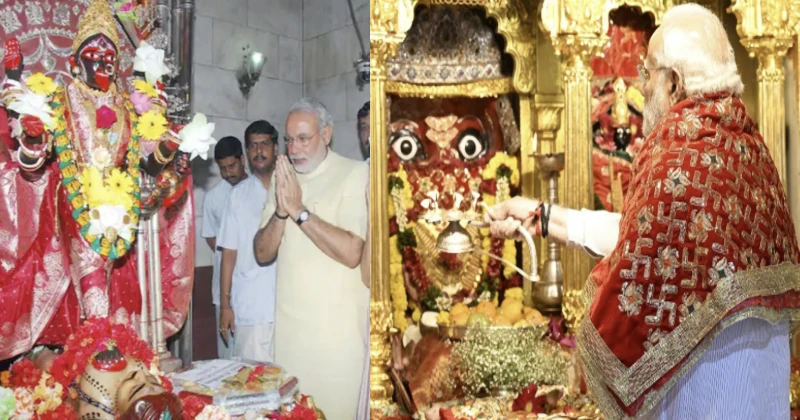
A false narrative is circulating in certain sections of the media and political discourse that Prime Minister Narendra Modi has only recently begun invoking the name of Maa Kali for political gain. This baseless claim not only insults the spiritual legacy of one of Bharat’s most revered deities, but also undermines years of the Prime Minister’s documented reverence for Maa Kali and his consistent efforts to restore and preserve the country’s sacred Shaktipeeths.
One of the most significant examples of PM Modi’s devotion to Maa Kali predates his tenure as Prime Minister. For over 500 years, the sacred Maa Kali Mandir atop the Pavagadh Hill in Gujarat, one of the revered Shaktipeeths, remained without its symbolic dhwaja (flag) due to the existence of an illegally constructed mosque during the Sultanate era. Successive governments and bureaucracies failed to address this desecration.
The latest propaganda against PM Modi claims he has only recently started invoking Maa Kali's name.
Let’s bust this lie with facts. #Thread1- In Pavagadh, for over five centuries, no dhwaja was hoisted atop the Maa Kali Mandir, a Shaktipeeth, due to an illegally constructed… pic.twitter.com/Vj9Z7ynO1P
— Political Kida (@PoliticalKida) July 20, 2025
It was Narendra Modi, as Chief Minister of Gujarat, who took the bold step to initiate the restoration of the Mandir’s sanctity. He declared his intent to reinstall the dhwaja and revive the Mandir’s cultural and spiritual glory. True to his word, after becoming Prime Minister, he oversaw the completion of this restoration. In June 2022, Modi himself hoisted the sacred flag atop the Mandir, breaking a five-century-old historical wrong and marking a defining moment in the cultural reclamation of Bharat’s sacred geography.
Claims that PM Modi’s recent references to Maa Kali are politically motivated fall apart under scrutiny. His personal and spiritual connection with the goddess spans well over a decade — a timeline corroborated by several documented Mandir visits and public gestures of reverence.
- 2010: During his official visit to West Bengal as Gujarat Chief Minister, Narendra Modi made it a point to begin his journey by visiting the Dakshineswar Kali Mandir in Kolkata, one of the holiest shrines associated with Maa Kali and Saint Ramakrishna Paramhansa.
- 2013: PM Modi returned to the Dakshineswar Mandir before launching his national campaign for the 2014 general elections — a symbolic reaffirmation of his spiritual grounding.
- 2015: As Prime Minister, Modi became the first Indian PM to visit the Dakshineswar Kali Mandir, where he performed Aarti and offered prayers. This was not a media stunt, but an act of deep-rooted faith.
- 2021: In a historic moment, PM Modi visited the Jeshoreshwari Kali Mandir in Satkhira district, Bangladesh, one of the 51 traditional Shaktipeeths. His prayers at this Mandir during his official diplomatic tour reflected his desire to protect and revive Indic spiritual ties beyond modern political borders.
- 2024: PM Modi visited the Ujjaini Mahankali Mandir in Secunderabad, Telangana, further demonstrating his continued personal devotion to Maa Kali.
What the opposition and detractors label as “recent” is, in fact, a longstanding pattern of reverence, cultural revival, and fearless reclamation of Bharat’s spiritual identity. Unlike many politicians who selectively visit Mandirs for optics, PM Modi has consistently elevated Bharat’s civilisational values, linking national identity with sacred heritage.
His efforts to revive sacred pilgrimage routes, restore ancient Mandirs, and bring international attention to India’s spiritual architecture go far beyond Maa Kali Mandirs — they form a key part of the broader Dharmic renaissance that the Prime Minister has advocated since assuming office.
The false narrative that PM Modi invokes Maa Kali only for votes not only fails the test of history, but also exposes a deeper discomfort among some political groups with Bharat’s civilisational roots. For decades, India’s cultural symbols were either ignored or actively derided by elite opinion-makers. PM Modi’s unapologetic embrace of Sanatan Dharma and his public devotion to Maa Kali challenge this status quo.
By invoking the goddess, he does not play to the gallery he restores dignity to a cultural ethos that had long been suppressed under the garb of secular tokenism. His track record, backed by tangible acts of Mandir restoration, public worship, and cultural revival, makes it clear: his devotion to Maa Kali is not a campaign tool it is a cornerstone of his personal dharma and national vision.











Comments