





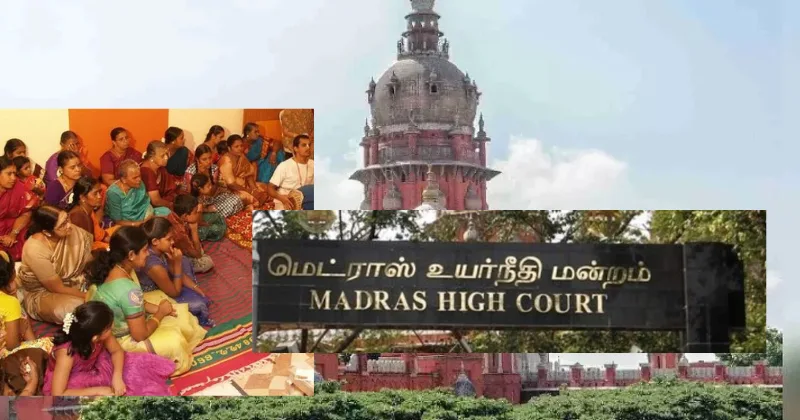
The Madras High Court on July 16 stated that using a residential property for congregational chanting (Nama Sankeerthanam) requires prior permission from the District Collector, and ordered that such activities at a residence in Chromepet be halted until approval is granted.
A single bench of the Madras High Court, Justice Anand Venkatesh, said: “Namasankeerthanam, devotees chanting the names of Bhagwan in a religious gathering, cannot be allowed at a residential premises without the approval of the District Magistrate.”
The court was hearing a petition filed by Prakash Ramachandran, a resident of Krishnamachari Street in Radha Nagar, Chromepet, Chengalpattu district. He stated that his neighbour, T.S. Subramanian, had allowed the Global Organisation for Divinity (GOD) to conduct regular Nama Sankeerthanam sessions at a residential property, thereby causing disturbance to other residents.
The petitioner sought a writ of mandamus directing the respondents — namely, the District Collector of Chengalpattu, the Inspector of Police at Chitlapakkam police station, and the Commissioner of Tambaram Corporation — to take action against the private respondents. The petitioner alleged that the private respondents were running a prayer hall and creating nuisance for neighbours without obtaining prior permission from the District Collector.
Justice Anand Venkatesh, in his order dated 16th July, stated: “T.S. Subramanian has flatly given his opinion about the Nama Sankeerthanam that is being conducted at the subject premises. What sounds divine to the fifth respondent is causing nuisance to the petitioner. It is further stated by the fifth respondent that he has the consent of all other neighbours to conduct the Nama Sankeerthanam. In the considered view of this Court, whenever a residential premises is attempted to be converted into a prayer hall, it requires the permission of the District Collector. This position of law has been reiterated in various orders passed by this Court.”
The court added: “Counsel for the private respondents stated that they have already submitted an application before the District Collector seeking permission, and the same is pending. It is quite evident from the above submission that, till date, no permission has been granted by the District Collector. Therefore, until such permission is obtained, the fifth respondent cannot convert the residential premises into a prayer hall. If any prayers are conducted, the same should be confined inside the house without causing nuisance to anyone. Furthermore, by inviting large crowds for prayer, the street cannot be clogged with vehicles, which once again causes nuisance to road users and neighbours. This shall be kept in mind by the fourth and fifth respondents. The second respondent shall ensure that no nuisance is caused by the fourth respondent (Global Organisation for Divinity – GOD) and the fifth respondent, and that they do not convert the residential premises into a prayer hall. Until permission is granted by the District Collector, the fourth and fifth respondents shall not use the residential premises as a prayer hall. This shall be ensured by the second respondent.”
In January 2024, the same judge, Justice Anand Venkatesh, while hearing a petition filed by L. Ganapathy challenging an order of the Assistant Commissioner who had rejected permission for bhajan and annadanam on 22nd January at a marriage hall, remarked: “Singing bhajans, uttering Rama Nama, or conducting annadanam in private halls is not prohibited and would not require police permission.”
According to Law Street Journal, the judge observed: “The stand taken by the State Government and the Police makes it quite clear that conducting the function, considering the auspicious occasion — singing bhajans, uttering Rama Nama, and conducting annadanams — is not per se prohibited or restricted. It must be borne in mind that all this will be done in a responsible and pious manner today, without giving rise to any law and order problem. No misinformation or disinformation must be permitted to be spread, and this must be kept in mind by all parties concerned. Ultimately, everyone must remember that bhakti towards God is meant for peace and happiness, not to disturb the equilibrium prevailing in society.”











Comments