





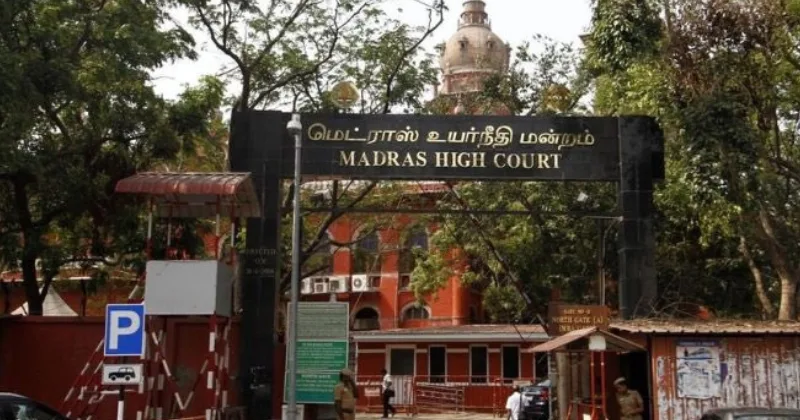
In yet another far-reaching verdict, the Madras High Court has stated that “if they are restricted entry, it will amount to an actionable wrong/offence and the concerned person can be sued or prosecuted therefor.”
A Venkatesan filed a petition bringing to the notice of the court the prevalence of caste-based discrimination, stating that Scheduled Caste (SC) persons are being prevented from entering the Puthukudi Ayyanar Temple in Udayarpalayam Taluk.
The petitioner sought the issuance of a writ of mandamus directing the respondents — the District Collector, Ariyalur; Revenue Divisional Officer, Udayarpalayam Division; and Assistant Commissioner, HR and CE, Ariyalur — to permit the petitioner and his community members to enter the Arulmigu Puthukudi Ayyanar Temple and participate in the Temple Car Festival to be held from July 16 to July 31.
The petitioner stated that the Ayyanar Temple in Puthukudi village has existed for several decades and has traditionally been worshipped by villagers of all castes and sects. However, in 2019, a group attempted to hijack the temple administration by deciding to construct a new temple on the premises. He added that SC members had also contributed funds towards this, but were subsequently denied entry into the temple. This led to multiple complaints being filed with the police and revenue officials. The complaints could not be pursued for quite some time due to the pandemic.
The petitioner further alleged that “the offending group – Ezhu Vagairaya (Seven Groups) – demolished all statues and stone structures that had been placed by the SC residents on the temple premises. Even a large statue of Ayyanar bearing the name of the Scheduled Caste donor was removed and dumped into the temple well. An iron gate was installed at the temple, and SC devotees were made to worship from outside the gate. Despite such discrimination, government officials did not make any corrective intervention, fearing law and order issues.”
Justice Anand Venkatesh, in his order dated July 17, directed the Ariyalur Superintendent of Police (SP) to ensure that SC persons are not prevented from entering the temple. He also instructed two officials to initiate appropriate action in accordance with the law if anyone prevents a section of people from entering the temple. The court ordered the police and revenue departments to ensure that law and order is not disturbed.
When the court was informed that the temple is not under the control of the HR and CE Department, the judge stated: “If a temple is permitted to be visited by the general public, it assumes the character of a public temple. In such an event, irrespective of the caste or community of the devotees, they must be permitted to offer their prayers to God. Caste and community are creations of human beings, and God is always considered to be neutral. That apart, preventing a person from offering prayers on the basis that they belong to the Scheduled Caste community is an affront to the dignity of persons who are discriminated against based on their caste.”
The court further stated: “This can never be permitted in a country governed by the rule of law. Moreover, Section 3 of the Tamil Nadu Temple Entry Authorisation Act, 1947, makes it abundantly clear that notwithstanding any law, custom or usage to the contrary, every Hindu, irrespective of the caste or sect to which they belong, shall be entitled to enter any Hindu temple and offer worship therein. If they are restricted entry, it will amount to an actionable wrong/offence, and the concerned person can be sued or prosecuted therefor.”
The court pointed out that “the Act came into force after a long struggle by many leaders who wanted to ensure that persons are not prevented from entering temples based on their caste. The Act was brought into force as a policy decision by the State Government to remove the disabilities imposed on certain classes of Hindus against entry into Hindu temples in the State.”
The judge concluded: “In view of the above discussion, there shall be a direction to respondents 2 (SP) and 4 (RDO) to ensure that all classes of Hindus are permitted to enter the temple and participate in the festival. If anyone prevents them from participating, action shall be taken in accordance with law. It shall be ensured that no law and order problem is created.”
Numerous Hindu organisations, including the RSS and VHP, have repeatedly called upon society to eradicate untouchability and ensure unrestricted entry of SC/ST communities into temples across the country — a practice that unfortunately still persists. These organisations continue to work towards resolving such issues.










Comments