





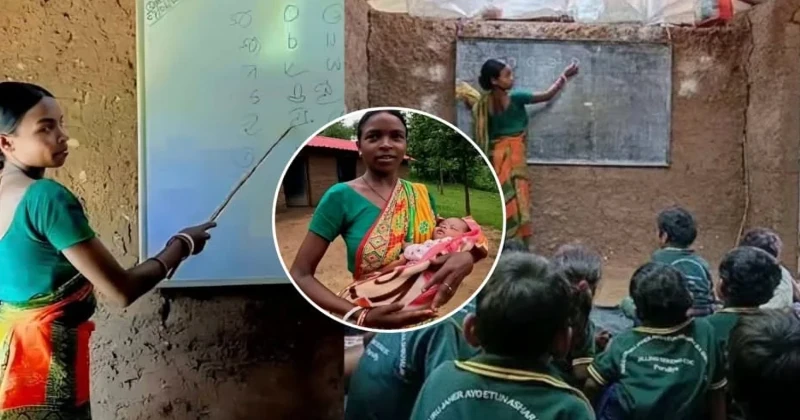
As the first golden light pours over the rugged Ayodhya Hills of West Bengal, a silent miracle takes place in the forgotten village of Jiling Sereng. Barefoot, wide-eyed children, notebooks pressed to their chest, navigate through twisting trails and dusty paths to a destination that was never on any map. They don’t go to a state school. They stride towards a tiny mud hut with a tin roof. Inside, holding one chalk in one hand and a child in the other, is Malati Murmu, 30, tribal, self-educated, volunteer, and unfazed.
It isn’t merely a school. It’s a movement based on belief, driven by one woman’s determination, and fueled by a community that had almost given up hope.
When the System Fell Silent, She Spoke
When Malati came to Jiling Sereng after her marriage in 2019, she had not planned to be a teacher. As with many women, she was entering the subdued tempo of rural domesticity, child-rearing and taking care of domestic work. But what she witnessed unnerved her: children lounging in the fields, adolescents with calloused hands from chopping wood, and a school building left in ruins. Education, here, was a phantom.
“There was a school,” Malati recalls, “but it was a building. No one came.”
She started with what she had room at home and had studied herself in Class 12. A handful of children showed up initially, hesitant, laughing. Before long, the word spread like morning fog, and the class expanded.
A School Built with No Funds, Only Faith
By 2020, with the government school shut due to the pandemic and online classes a cruel joke in a place where smartphones were used more for light than learning, the need for Malati’s school became urgent. The villagers, many of them day labourers and woodcutters, stepped in. They helped her build two thatched classrooms from mud, tin, and resilience.
Now, 45 children sit cross-legged daily on the earthy ground learning to read and write in Santhali, their native language, with the Ol Chiki script, a script which they can see themselves.
The lessons now incorporate Bengali, English, mathematics, and even science. The children, mostly first-generation learners, beam with pride when they spell out their own names or read from worn-out books.
A Mother, A Teacher, A Revolutionary
Malati instructs with her baby tied up in a cloth at her side. She has a sitter occasionally attend classes. She begins the day by sweeping the muddy floor of the classroom, laying out a few mats, and determining if the blackboard, a painted board of wood, is still functional.
She doesn’t get a salary. There are no government grants, no NGO money coming in regularly. “We don’t ask for anything,” Malati replies with subdued dignity. “Only that the children come.”
Asked how she balances school and motherhood, she smiles, “I am a mother to them all.
Her power is not only as a teacher but as an interpreter of her people’s hardships. She’s one of them, tribal, poor, left behind by a system which neglected to keep them in mind. And so her school flourishes. It uses their language, literally and metaphorically.
Learning Beyond the Book
Malati’s teaching goes beyond textbooks. She talks about hygiene, respect, equality, and questions old superstitions. “Education is not just about passing exams,” she says, “it’s about opening the mind.”
She has become a counsellor, a guide, and a mentor. Villagers who once doubted her now trust her with their children’s future. Mothers who never went to school themselves sit beside their daughters and listen in awe.
An Oasis in a Desert of Neglect
Jiling Sereng and the hamlets around it are isolated from development, bad roads, unstable electricity, and decaying schools. The closest high school is 25 kilometers away, in Baghmundi. For kids here, that’s not only a long way to walk, it’s not safe.
The nearby government school already has teachers, but only in rotation. “Sometimes nobody comes at all,” Banka (Malti’s husband) says. During the lockdown during Covid-19, it closed completely. That was the last straw. “Education came to a halt, and nobody cared,” he states. “Except my wife.”
A Story the Nation Must Listen To
Malati Murmu’s tale is not only a motivating anecdote. It is India’s unseen backbone reflected. The areas our systems overlook, our policies miss, and our maps tend to erase are the areas where unseen heroes emerge.
She did not wait for change. She became the change.
In a degree-and-designation-obsessed world, Malati has none. But she does have a school founded on hope, a classroom that rings with laughter, and a community learning to dream once more.
In a broken clay hut under a tin roof, in a village where the government didn’t extend, the future is being built, one child at a time. And at the center of it all stands Malati Murmu, chalk in hand, baby on hip, and a fire in her heart.
Her path is not only one of survival but of peaceful revolution. Malati Murmu’s effort highlights the revolutionary power of education that hears people and respects their cultural identity. It is a testament to how deeply ingrained community-driven initiatives can empower those who have been left behind for so long.














Comments