





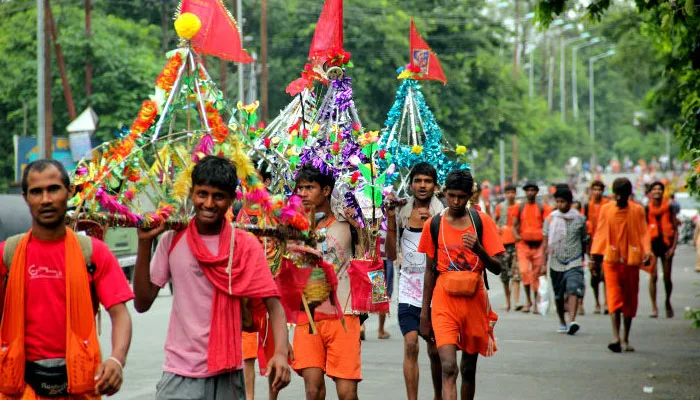
Each year, as the monsoon clouds sweep across the Indian sky, rivers swell, and roads fill with saffron. The air resounds with chants of “Bol Bam!” and the scent of incense and sweat. This is the time of the Kanwar Yatra, one of the largest annual religious gatherings in the world. To many outsiders, especially in selected narratives, it is often misunderstood as chaotic or disruptive. But walk even a few steps with the yatris, and a different truth emerges, a truth soaked in faith, sacrifice, and transformation.
This is not a story of vandalism. It is a story of Dharma.
Sumit: The Athlete Who Carried 61 Kilos of Faith
Sumit is not your ‘typical’ Kanwariya, at least not by how the media tends to stereotype them. At 20, he is already made a mark as a national-level basketball player, having participated in the nationals six times. He is smart, educated, and runs a digital marketing business in partnership with a multinational company.
He weighs 57 kilograms. But this year, he walked carrying a Kanwar weighing 61 kilograms, heavier than his own body. Why would someone from such a privileged background undergo this physical trial?
His answer is simple: “This gives me peace. I am doing this for the well-being of my family. I believe in Shiva. He is our protector.”
कांवड़ यात्रा में जाने वालों की ‘योग्यता’ पर सवाल उठाने वाले इन 20 साल के कांवड़ यात्री से मिलिए। इस बार अपनी समझ को उनके संकल्प और योग्यता के वजन से तोलकर देखिए। @Anurragmishra
पूरी ग्राउंड रिपोर्ट जल्द ही हमारे यूट्यूब चैनल पर-
OpIndia YouTube चैनल- https://t.co/icCNY4Igj5 pic.twitter.com/ipaO1AcynV— OpIndia.tv (@OpIndia_tv) July 16, 2025
When a journalist asked about the perception of Kanwariyas as hooligans or mischief-makers, Sumit did not flinch.
“It’s not true,” he said. “Many people from well-educated and well-to-do families come for the Kanwar Yatra. This is a matter of faith. Anyone who doubts this should walk with us and see the struggle, then they will understand.”
Sumit’s voice speaks for thousands like him, professionals, students, homemakers, businessmen, all united not by class or caste, but by Bhakti.
Prakash Choudhary: One Man, One Mission, One Yatra at a Time
Where Sumit represents the youth’s devotion, Prakash Choudhary stands as a beacon of quiet endurance. A humble taxi driver from Indore, Madhya Pradesh, Prakash has no entourage, no viral reels, just calloused feet and unwavering Shraddha.
This year, he is walking from Gangotri to Rameshwaram, the length of the Indian subcontinent, alone. His yatra had already stretched past 33 days when Organiser met him at a temple.
His life, too, is not without a burden.
A former bodyguard, a failed entrepreneur, a man supporting a wife on dialysis and a school-going daughter, he finds peace on foot, in his Kanwar Yatra.

“I begin my day with worship and walk until it’s time to rest. I don’t stay in hotels or homes. Only temples and ashrams. If there are none, I find shelter under trees or porches. I eat satvik food, no onion, no garlic. Sometimes only fruits. I carry a small packet of biscuits for emergencies,” he said, his voice as firm as his stride.
And yet, when Organiser asked how he stays motivated, his reply held the weight of a thousand prayers: “Back home, my life is filled with struggles. But during the yatra, I feel peace. It’s a kind of peace I can’t put into words.”
Faith in Action, Not in Display
Both Sumit and Prakash represent the spectrum of Indian society, different in age, background, and profession, but unified in purpose. Their yatras are not about spectacle, but about offering, not about show, but about surrender.
When people call Kanwariyas hooligans, it is not just offensive, it is a profound misunderstanding of Dharma. As Prakash puts it, “That’s not hooliganism, it’s their joy. If someone dances, sings, or chants loudly, it’s out of devotion. Not destruction.”
In fact, the majority of yatris practice incredible restraint. They walk for days, often barefoot, sleep on the ground, endure blisters, dehydration, and harsh terrain, not for any material gain, but for a spiritual offering. They carry Gangajal from sacred rivers and walk to Jyotirlingas, offering their prayers for family, society, and the country.
Obstacles Only Strengthen Resolve
Prakash recounted challenges he faced during his journey: “Some areas had no food, only non-vegetarian stalls. Sometimes I was offered money by kind strangers, thinking I was a sadhu. I never took it. Recently I heard about Kanwariyas being attacked just for carrying flags, like in Bahraich. But this won’t stop us. My own daughter waits for me at home, but Mahadev is watching over her while I walk.”
The yatra, as both Sumit and Prakash show us, is a transformational journey. It reveals the true India, one of hospitality, innocence, and shared spirituality. From Gangotri to Haridwar, Ujjain to Rameshwaram, it is the land that walks with them, feeds them, shelters them, and blesses them.
More Than a Pilgrimage
To call the Kanwar Yatra a mere religious event is to miss the bigger picture. It is a people’s movement rooted in Dharma, in a spiritual longing that cuts across boundaries. It’s about Shraddha (faith), Tapasya (penance), and Seva (service). It is about reconnecting with the land, the rivers, the deities, and oneself.
And perhaps that is why every year, lakhs join in, not because they are poor or illiterate, but because they are seekers. Some seek peace, others penance. But all walk the same path. All chant the same name, Mahadev.

The Real India Walks Here
As I watched Prakash disappear down the hot road toward the Chhattisgarh border, he turned briefly, smiled, and waved. His journey was far from over. But his resolve had no fatigue.
“I want to do another yatra next year too,” he had said. And I believe he will.
In that smile, in that unshaken resolve, lies the truth of Kanwar Yatra, not just as a pilgrimage, but as a living testament of Dharma, reminding us that no matter the hurdles, no matter the noise, faith will always find a way.

















Comments