





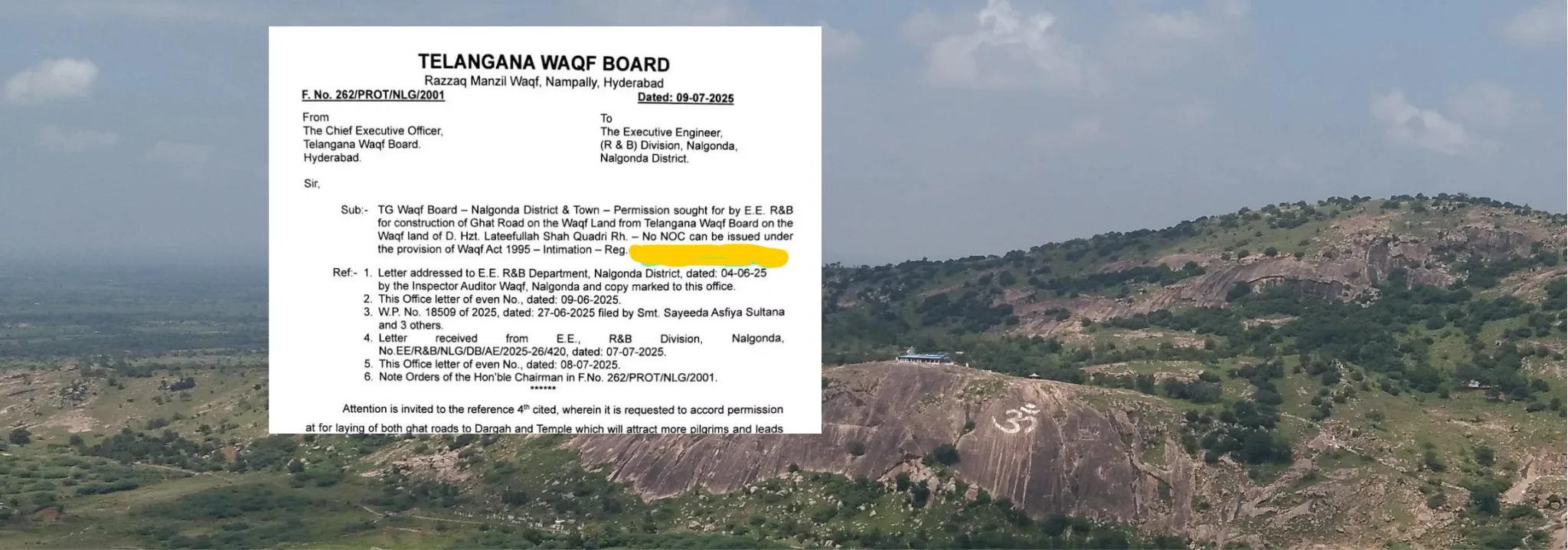
The Telangana Waqf Board has once again sparked controversy by stalling a major public development project, this time a Rs 140 crore ghat road to the ancient Durga Devi Temple and BrahmamGari Math atop Brahmamgaru Gutta, a sacred hillock revered by local devotees for centuries in Nalgonda.
The road, proposed by Roads and Buildings Minister Komatireddy Venkat Reddy, and initiated under the orders of the District Collector on July 6, was intended to ease access for pilgrims and boost local tourism. But thanks to Waqf Board intervention, the ambitious temple development has been abruptly halted.
The project, which had received departmental clearances and even reached the tendering stage, has now been put on indefinite hold after the Waqf Board claimed ownership of the land and refused to issue a No Objection Certificate (NOC).
In a letter dated July 9, 2025, the board’s CEO cited the Waqf Act, 1995, arguing that the land is Waqf property and cannot be used for public infrastructure without explicit permission.
Earlier, Maulana Ehsanuddin, an Islamic religious leader, and attended by Razioddin, the MIM Nalgonda District President, MA Hafiz Khan, a local community leader, Advocate Masood Ali, Syed Ibrahim, a local representative, and Jilani, held a press conference raising objections to the temple ghat road project.
Critics say this is a classic case of religious obstructionism, where claims over disputed land are being weaponised to block development around Hindu temples. More importantly, the move has laid bare the Congress government’s policy of minority appeasement, where Waqf Board diktats appear to override public interest and democratic planning.
Despite the project’s clear focus on improving connectivity to a religiously significant site and boosting the local economy, the Waqf Board accused the R&B Department of violating “due process” by initiating the tender without their clearance.
Even more disturbingly, local Islamist groups and minority leaders have backed the board’s obstruction, with demands now surfacing to allot 530 acres of nearby Waqf land exclusively to minority families — a communal demand that has further polarised the debate.














Comments