





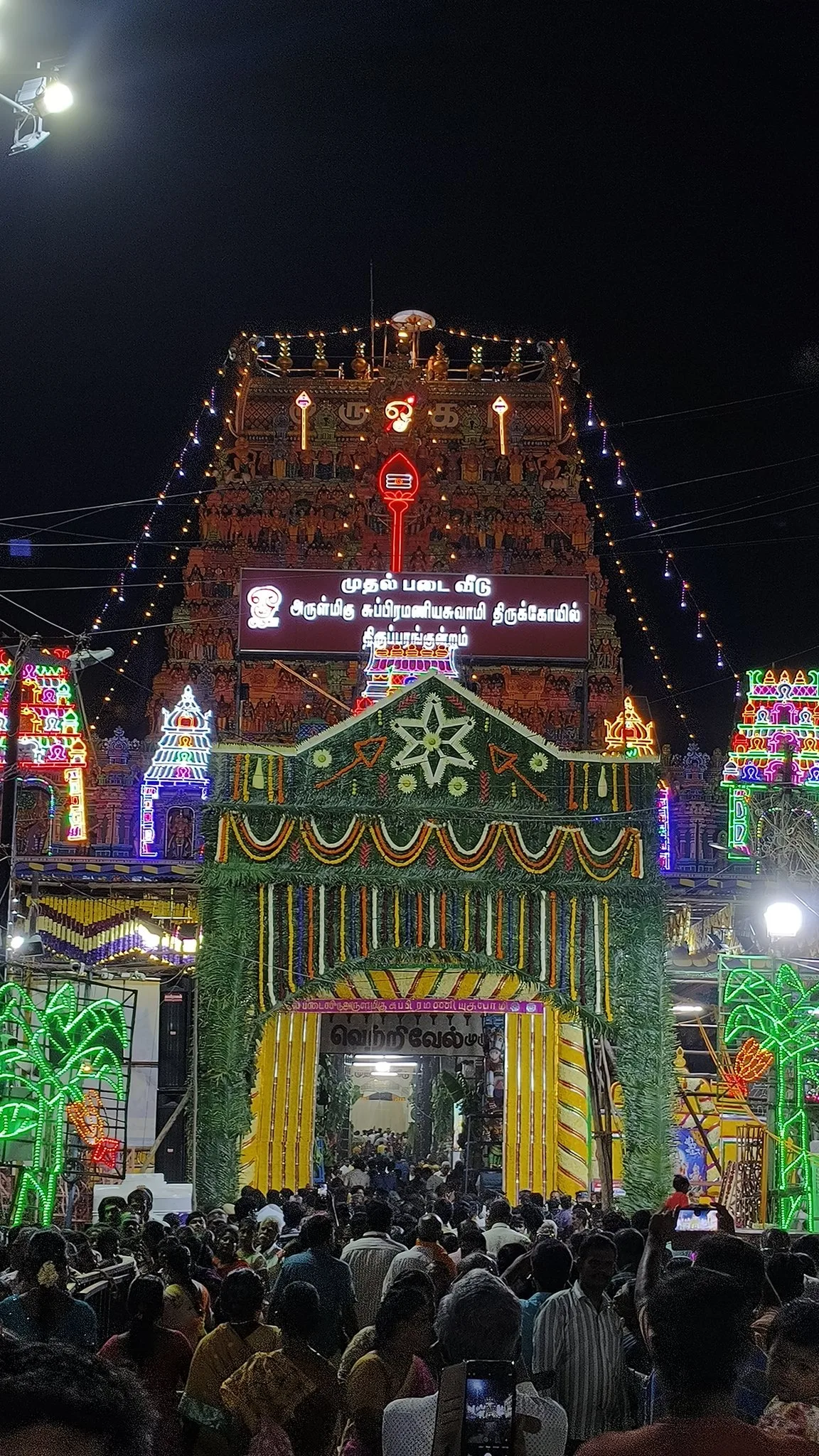
After a gap of nearly 16 years, lakhs of devotees from far and near witnessed the grand Kumbabhishekam of the Thiruparankundram Subramaniya Swamy Temple in Madurai, Tamil Nadu, on 14 July — a sacred ritual believed to purify and energise the deity, traditionally held once every 12 years.
This temple, one of the six abodes of Lord Murugan and second in rank, is managed by the Tamil Nadu Hindu Religious and Charitable Endowments (HR&CE) Department. Following the completion of renovation work, dates were fixed for the grand consecration ceremony. The event began with Yagasala pujas, which commenced days in advance, and was attended by Vedic pandits. The holy water was poured on the kalasams (sacred pots) of the Rajagopuram and other deities at the pre-fixed muhurtham by Sivachariars. Lakhs of devotees attended the event.
The organisers installed 26 giant LED screens around the temple premises for devotees to witness the proceedings. Additionally, 10 drones were deployed to sprinkle holy water over the assembled devotees. Renovation work, including restoration of the Rajagopuram and kalasams, was carried out ahead of the event.
The rituals began at 3 am, with the main Kumbabhishekam ceremony followed by the Maha Deepa Aradhana and a grand procession in the evening. The procession deity from the Madurai Meenakshi Sundareswarar Temple was brought to the 16-Kal Mandapam at Thiruparankundram on Sunday evening.
Thiruparankundram is the sacred site where Lord Murugan is believed to have married Deivanai, daughter of Indra, after his victory over the demon Surapadman. It houses a rock-cut cave shrine, believed to have been built during the Pandya dynasty. The main deity, Lord Subramanya, is enshrined deep within a natural rock cave, depicted in a rare seated posture with Deivanai, unlike most Murugan temples, where he is shown standing.
Tamil Nadu Minister for HR&CE P. K. Sekarbabu, Minister for Commercial Taxes and Registration P. Moorthy, Thiruparankundram MLA V. V. Rajan Chellappa, and Madurai Collector K. J. Praveen Kumar were present. As the Deeparadhana was performed, devotees, with folded hands, chanted “Arohara” and offered prayers.
Only a week earlier, on 7 July, the Kumbabhishekam of Lord Murugan at Thiruchendur was held, drawing over six lakh devotees. That day saw the consecration of a dozen temples, a once-in-12-years religious event, celebrated with fervour.
The large turnout at these Kumbabhishekams and other temple festivals effectively debunks the long-peddled claim by Dravidian parties that Tamil Nadu is “EV Ramasamy Naicker’s soil”. The fervour reaffirmed that the land is, in fact, the abode of sages, Alwars, saints, and divine poets like Avvaiyar, Thiruvalluvar, and Siddhars (immortal souls).
The June 22 Lord Murugan Devotees’ Conference, which saw over six lakh disciplined devotees assemble, was a powerful display of their faith and a silent assertion to protect Thiruparankundram from external encroachments. This confluence of devotees happened despite deliberate obstructions from the DMK government and its allies — VCK, Dravidar Kazhagam, the Left, and Makkal Adhikaram (a frontal organisation of a Naxal outfit), who filed repeated petitions. The state police also attempted to block the gathering.
There have been claims from sections of the Muslim community to rename the hill as “Sikandar Hill”, allegedly after a Sultanate chieftain who died in Madurai. However, according to government records, he was buried in the city — not atop the hill, which is now a tourist destination. Sikandar is believed to have died at his paramour’s house, where he was interred. Hindu Munnani and other Hindu organisations are engaged in a legal battle to prevent the site from being wrongly claimed as Waqf property.
This struggle is increasingly seen as another Ayodhya-, Kashi- or Mathura-type movement — a determined attempt to save a sacred Murugan site from the sinister designs of minority appeasement politics pursued by parties like the Congress, DMK, Left, SP, TMC, NCP (Sharad Pawar), Shiv Sena (Uddhav Thackeray faction), and others.













Comments