





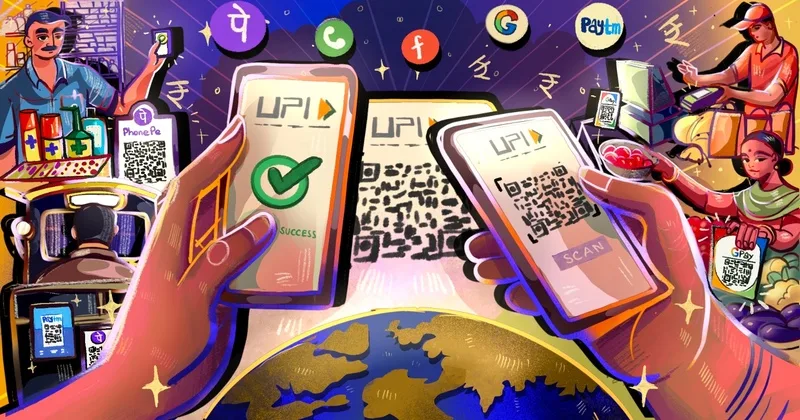
In a remarkable display of digital payment dominance, Bharat’s Unified Payments Interface (UPI) achieved a significant milestone in May 2025, surpassing global giant Visa with over 65 crore daily transactions. This makes UPI the fastest-growing payment system, expanding four times faster than its competitors. It processed an astounding Rs25 lakh crore, a figure 12 times greater than all card payments combined, cementing its position as the backbone of India’s digital economy by powering 85 per cent of the nation’s digital payments. This phenomenal growth has propelled India’s global share in digital transactions to an impressive 48.5 per cent
What is UPI?
Developed by the National Payments Corporation of India (NPCI), UPI is a real-time payment system designed for instant fund transfers between bank accounts. Users can initiate payments via mobile using a unique UPI ID or by scanning a QR code, eliminating the need for extensive bank details. Operating 24×7, UPI offers a secure and seamless way to transfer money, pay bills, and check account balances all through a single mobile application.
When was UPI introduced in India?
UPI was officially launched in India on April 11, 2016. Its introduction was a collaborative effort by the NPCI, with strong support from the Reserve Bank of India (RBI) and various Indian banks. The primary objective was to facilitate instant, secure, and cashless mobile-based payments across the country.
Global expansion: Trinidad and Tobago adopts UPI
UPI’s influence is now expanding beyond India’s borders. On July 5, 2025, Trinidad and Tobago made history by becoming the first Caribbean nation to adopt Bharat’s UPI system. This strategic move aims to strengthen digital co-operation between the two countries. Alongside UPI, both nations have also committed to implementing other integral components of IndiaStack solutions, including DigiLocker, e-Sign, and Government e-Marketplace (GeM). While the full adoption of UPI is still underway in Trinidad and Tobago, this marks a crucial step in significantly expanding India’s digital footprint on the global stage.
This report provides a comprehensive timeline of UPI’s journey from 2016 to 2025, detailing 34 key milestones. It covers the platform’s major achievements, significant technical upgrades, exponential transaction growth, and expanding global footprint.
The birth of Unified Payments Interface (UPI) in 2016
April 11, 2016 marked the beginning of a digital payment revolution in India with the piloting of the Unified Payments Interface (UPI). Initially launched with 21 banks, UPI officially went public on August 25, 2016. Developed by the National Payments Corporation of India (NPCI) and regulated by the Reserve Bank of India (RBI), UPI’s core objectives were to simplify digital transactions, promote cashless payments, and enable 24×7 fund transfers. The system quickly gained traction, experiencing rapid growth from 93,000 transactions in August to 1.99 million by December of the same year.
From 4.2 million to 145.5 million: UPI’s explosive growth in 2017
November 1, 2017, highlighted UPI’s accelerating momentum. Reports from October 2017 confirmed a significant surge in transactions. Beginning the year with 4.2 million transactions worth Rs1,700 crore in January 2017, UPI closed December 2017 having processed an astonishing 145.5 million transactions, amounting to Rs13,144 crore. This phenomenal growth was largely attributed to the widespread adoption of the Bharat Interface for Money (BHIM) app, launched in late 2016 but gaining significant traction, particularly in rural areas, throughout 2017. Furthermore, the expansion of the UPI ecosystem saw over 50 Indian banks, including major players like SBI, ICICI, HDFC, and Axis, integrating their own apps.
UPI crosses 400 million monthly transactions for the first time in 2018
By October 1, 2018, UPI solidified its position by crossing the 400 million monthly transaction mark for the very first time. In September 2018, UPI recorded 405.87 million transactions worth Rs59,835.36 crore, a substantial 30% increase from the previous month. Of this, 16.33 million transactions (worth Rs7,064.86 crore) were processed through the BHIM app. This surge was significantly boosted by the launch of UPI 2.0 and the Supreme Court’s Aadhaar ruling. UPI concluded 2018 on a high note, achieving a record 620 million transactions in December, bringing the annual total to an impressive 3 billion. The transaction value in December reached Rs1.02 lakh crore, an 18% rise from November, marking UPI’s strongest growth period since its inception in 2016.
UPI records 10.78 billion transactions worth Rs18.36 lakh crore in 2019
As December 2019 concluded, UPI demonstrated unprecedented scale, recording 1.31 billion transactions in that month alone. This brought the yearly total to a staggering 10.78 billion transactions, representing an approximate 1.87x growth compared to 3.7 billion in 2018. In terms of value, UPI processed Rs2.02 lakh crore in December 2019 and a monumental Rs18.36 lakh crore for the entire year, marking a 2.13x jump from Rs5.85 lakh crore in 2018, according to NPCI data.
UPI transactions soar 191 per cent in 2019, hitting 10.78 billion
By January 6, 2020, further analysis confirmed the immense surge in UPI usage during 2019. UPI transactions skyrocketed by 191% to 10.78 billion, a significant leap from 3.71 billion in 2018. The total transaction value mirrored this growth, rising by 217 per cent to Rs18.36 lakh crore. December 2019 alone accounted for 1.31 billion transactions, comprising 12 per cent of the annual total with Rs2.02 lakh crore transacted. This rapid expansion was largely fueled by various cashback offers and the increasing adoption of popular payment applications like Google Pay, PhonePe, and Paytm.
UPI crosses Rs4 trillion in monthly transactions for first time in December 2020
By December 2020, UPI reached an unprecedented milestone, recording 2.23 billion transactions valued at Rs4.16 trillion. This represented a 1% increase in volume and a significant 6.4% rise in value from the previous month. The market was largely dominated by Google Pay and PhonePe, which collectively held over 80% of the UPI market share. In November 2020, Google Pay led in transaction volume with 960 million transactions, while PhonePe topped the charts in value, processing Rs1.75 trillion. The UPI ecosystem also saw a new entrant as WhatsApp Pay received NPCI’s approval in November 2020, further broadening its reach.
India tops global digital payments in 2020 with 25.5 billion transactions
December 2020 also marked a historic achievement for India on the global stage. According to a report by ACI Worldwide and GlobalData, India emerged as the world leader in digital payments for 2020, processing a staggering 25.5 billion real-time transactions. India’s share in global instant payments volume stood at 15.6%, and 22.9% for other electronic payments. Despite this digital leap, paper-based payments still constituted a significant 61.4% share in the domestic market. Globally, mobile wallet adoption hit a record 46%, up from 40.6% in 2019, with countries like Brazil, Mexico, and Malaysia also showing rapid growth in digital payment usage.
UPI ends 2021 with record Rs8.26 lakh crore transactions in December
December 2021 saw UPI conclude the year at an all-time high. As per NPCI data, the platform recorded a colossal Rs8.26 lakh crore in transaction value and 4.56 billion transactions during that month alone. Throughout the entirety of 2021, UPI processed 38.74 billion transactions worth Rs71.46 lakh crore, marking an astounding 105% increase in volume and 130% rise in value compared to 2020. This immense surge was primarily driven by the escalating digital adoption in the wake of the second COVID wave and a boom in festive shopping.
UPI transactions jumped 90 per cent in 2022, totaling Rs125.94 lakh crore
The growth trajectory of UPI continued unabated into 2022. By December 2022, UPI had processed over 74 billion transactions, amounting to a staggering Rs125.94 lakh crore. This represented a 90 per cent increase in transaction volume and a 76 per cent rise in value from 2021. The platform’s growth accelerated significantly since it first crossed 1 billion transactions in October 2019. In the July-September quarter of 2022 alone, UPI commanded the digital payments landscape with 19.65 billion transactions worth Rs32.5 lakh crore, out of a total of 23.06 billion digital payments.
UPI crosses 100 billion transactions in 2023, records Rs182 lakh crore in value
December 2023 marked another monumental year for UPI as it crossed the 100 billion transactions milestone, processing approximately 118 billion transactions throughout the year. This was a substantial 60% increase from the 74 billion transactions recorded in 2022, according to NPCI. The total transaction value for the year reached an impressive Rs182 lakh crore, up 44% from Rs126 lakh crore in the previous year. December 2023 alone contributed significantly, with 12.02 billion transactions worth Rs18.23 lakh crore, showcasing year-on-year growth of 42% in volume and 54% in value.
UPI hits 172 billion transactions worth Rs247 lakh crore in 2024
In 2024, UPI continued its exponential growth, achieving a major milestone of 172 billion transactions by December. This represented a robust 46 per cent increase in volume from 2023. The transaction value also saw a substantial jump of 35 per cent, reaching Rs247 lakh crore, up from Rs183 lakh crore. December 2024 alone witnessed 16.73 billion transactions worth Rs23.25 lakh crore, with both figures showing an per cent increase from November. Daily transactions hit an impressive 540 million. Additionally, the IMPS (Immediate Payment Service) system also experienced an 8% monthly growth, processing 441 million transactions valued at Rs6.02 lakh crore.
UPI surpasses Visa, becomes world’s largest real-time payment system in May 2025
By May 2025, India’s UPI had cemented its status as a global leader, officially overtaking Visa in daily transaction volume. On June 2, 2025, UPI processed over 65 crore (650 million) transactions, surpassing Visa’s 63.9 crore. With a consistent monthly growth rate of 5-7 per cent and an annual growth rate of 40 per cent, UPI is now expanding four times faster than Visa. This unprecedented scale means UPI now leads globally in both transaction volume and value, having processed an astounding Rs25 lakh crore in May 2025 alone, a figure 12 times greater than all card transactions combined in India. UPI currently powers an overwhelming 85 per cent of India’s digital payments, thereby boosting India’s share in global digital payments to a dominant 48.5 per cent.
India dominates global fast payments with UPI’s exponential growth
An International Monetary Fund (IMF) report from July 2025 reveals that India has emerged as the global leader in fast payments, propelled by the remarkable growth of its Unified Payments Interface (UPI). Since its launch in 2016, UPI has transformed into the world’s largest retail fast payment system, now handling an astounding over 18 billion transactions every month.
This surge in digital payments is directly contributing to a consistent decline in cash usage, evident in the steady decrease in ATM withdrawals. The IMF underscores UPI’s interoperability as a critical factor in this significant shift towards digital transactions. The report also advises policymakers to ensure the system remains open and competitive as the platform continues its expansion, fostering a healthy environment for future innovation and adoption.
Technical and policy upgrades in UPI: A journey of innovation
The Unified Payments Interface (UPI) has seen continuous technical and policy enhancements since its inception, steadily evolving to offer a more robust, secure, and user-friendly digital payment experience.
UPI 1.0: The genesis of real-time mobile payments (April 2016)
The revolution in Indian digital payments began on April 11, 2016, with the launch of UPI Version 1.0 by the National Payments Corporation of India (NPCI). This foundational version allowed for real-time, 24×7 money transfers through a single mobile application linked to multiple bank accounts. It introduced pivotal features like Push (send) and Pull (request) transactions using a Virtual Payment Address (VPA), eliminating the need to share sensitive bank details. Security was a core focus, implemented through two-factor authentication and a UPI PIN setup requiring a debit card and One-Time Password (OTP). Beyond financial transactions, UPI 1.0 supported non-financial services such as PIN changes and dispute resolution, and also facilitated QR code-based payments and merchant integration. The system was designed for Android (API 23+) and iOS (17+) platforms, ensuring seamless onboarding for customers and active participation from Payment Service Providers (PSPs), banks, merchants, and NPCI.
UPI 2.0: Enhancing security, flexibility, and trust (August 2018)
Building on the success of its initial version, UPI Version 2.0 was rolled out on August 16, 2018. This upgrade brought significant enhancements aimed at improving user experience, security, and financial flexibility. Key new features included the ability to link overdraft accounts, enabling users to initiate one-time mandates for scheduled payments, and providing invoice verification before completing transactions. To bolster merchant authenticity, UPI 2.0 introduced signed intent and QR code authentication. Furthermore, it raised the transaction limit beyond Rs1 lakh for specific use cases. The overarching goal of UPI 2.0 was to foster greater trust, transparency, and convenience, particularly for merchant payments, thereby strengthening India’s burgeoning digital payment ecosystem.
UPI Lite: Revolutionising micro-payments with offline capabilities (September 2022)
In a move to simplify small-value transactions, the Reserve Bank of India (RBI) launched UPI Lite in September 2022. This innovative feature acts as a simplified wallet within existing UPI applications, enabling small-value transactions (up to Rs1,000 per payment and a daily limit of Rs4,000) without requiring a UPI PIN. UPI Lite offers faster, PIN-free payments and notably, can even work offline using Near Field Communication (NFC). It also streamlines the process by requiring no KYC or additional fees. Users can easily add funds from their bank accounts to their UPI Lite wallet and make payments via QR code, UPI ID, or phone number. The system supports refunds and ensures secure, quick, and convenient micro-payments, proving especially useful in areas with limited internet connectivity.
BHIM 3.0: Smart payments with advanced analytics and in-app merchant checkout (April 2025)
The latest significant upgrade, BHIM 3.0, was launched by NPCI BHIM Services Limited (NBSL) in April 2025. This major enhancement is designed to significantly improve user experience, financial tracking, and merchant integration. Optimised for low-connectivity areas and available in over 15 Indian languages, BHIM 3.0 introduces a suite of advanced features including spend analytics, bill reminders, UPI Lite support, expense splitting, shared family expenses, and personalized payment suggestions. A standout feature is BHIM Vega, an in-app payment solution for merchants that allows for seamless checkout experiences without requiring users to switch between different applications. With these user-friendly features and business-focused tools, BHIM 3.0 aims to significantly boost its market share and compete effectively with leading private UPI players like PhonePe and Google Pay.
Unified payments interface: Expanding its global footprint
The Unified Payments Interface (UPI) is rapidly expanding its reach beyond India, forging partnerships and integrations to become a truly global payment system. This expansion facilitates smoother cross-border transactions, remittances, and enhanced convenience for users worldwide.
Bhutan: The first international adoption of UPI QR (July 2021)
On July 13, 2021, Bhutan marked a significant milestone by becoming the first country to adopt India’s UPI QR code standard. BHIM-UPI services were launched through a virtual event, strengthening digital ties between India and Bhutan under India’s Neighbourhood First Policy. This integration enables seamless, cashless payments for Indian tourists and traders in Bhutan, building upon the earlier RuPay card interoperability following PM Modi’s 2019 visit. The launch through the BHIM app marks a new era in cross-border fintech co-operation.
Malaysia: Enabling UPI remittances (August 2021)
On August 4, 2021, Malaysia’s Merchantrade Asia collaborated with NPCI International Payments Ltd (NIPL). This partnership was established to facilitate sending remittances from Malaysia to India via UPI, simplifying cross-border fund transfers for individuals and businesses.
Southeast Asia: UPI QR payments across 10 countries (September 2021)
NIPL significantly broadened UPI’s international presence on September 14, 2021, by signing a deal with Liquid Group, a prominent cross-border digital payments provider. This agreement allows for the acceptance of QR-based UPI payments in 10 countries across North and Southeast Asia, including Malaysia, Thailand, the Philippines, Vietnam, Singapore, Cambodia, Hong Kong, Taiwan, South Korea, and Japan, greatly enhancing convenience for travelers and businesses.
Nepal: First foreign country to deploy UPI platform (February 2022)
On February 17, 2022, Nepal achieved the distinction of becoming the first foreign country to fully deploy UPI as a payment platform for its domestic digital transactions. This move, announced by the National Payments Council of India, aims to bolster Nepal’s digital economy by providing an interoperable real-time system for person-to-person (P2P) and person-to-merchant (P2M) payment transactions as a digital public benefit.
United Arab Emirates (UAE): UPI’s middle eastern launch (April 2022)
UPI officially launched in the United Arab Emirates on April 21, 2022, through strategic partnerships forged by NIPL with LuLu Financial Holding, Mashreq Bank, and Network International. The implementation of UPI payments in the UAE was primarily facilitated via Mashreq’s NeoPay, providing Indian travelers and residents with a familiar and efficient payment method.
United Kingdom: Paving the way for UPI acceptance (August 2022)
On August 18, 2022, NPCI International Payments Limited (NIPL) signed a Memorandum of Understanding (MoU) with PayXpert, a significant step towards enabling the acceptance of UPI payment solutions across the United Kingdom, opening doors for Indian visitors and the diaspora.
Oman: Seamless RuPay and UPI remittances (October 2022)
A significant MoU was signed between the Central Bank of Oman and NPCI International Payments Limited on October 4, 2022. This agreement is set to enable the use of Indian RuPay cards and the UPI platform in Oman, facilitating seamless digital remittances that will particularly benefit Indian workers and professionals residing there.
Europe: UPI & RuPay acceptance via worldline (October 2022)
NIPL expanded its reach into Europe on October 11, 2022, by partnering with France-based Worldline. This collaboration aims to extend the acceptance of UPI and RuPay payments by merchants across Europe, leveraging Worldline’s QR code infrastructure. The initial rollout of Indian payment methods is slated for the BENELUX countries (Belgium, the Netherlands, and Luxembourg) and Switzerland.
Singapore: Instant, low-cost remittances via PayNow link (February 2023)
A landmark linking of India’s UPI with Singapore’s fast payment system, PayNow, occurred on February 21, 2023. This interlink enables faster and lower-cost remittances between the two countries, significantly benefiting the Indian diaspora in Singapore, particularly migrant workers and students, by allowing them to make quick and affordable fund transfers.
Russia: Integrating UPI, RuPay, and SPFS for cross-border payments (April 2023)
On April 18, 2023, India and Russia signed a crucial agreement to integrate India’s UPI and RuPay with Russia’s MIR and Fast Payments System (FPS) for seamless cross-border payments. The deal also includes the adoption of Russia’s SPFS financial messaging system, an alternative to SWIFT, to facilitate transactions amidst ongoing sanctions. This initiative aims to resolve pending payment issues and boost bilateral trade, with the RBI forming a working group to implement the framework.
France: UPI launch at Eiffel Tower (February 2024)
The Unified Payments Interface (UPI) was formally launched at the Eiffel Tower in Paris on February 2, 2024, during the Indian Republic Day reception. This enables tourists visiting the iconic monument to conveniently book their trips using India’s payment mechanism, marking a symbolic and practical expansion into a major European tourist destination.
UAE: NRIs can now use UPI with international mobile numbers (February 2024)
In a significant step towards financial inclusion, NRIs (Non-Resident Indians) can now access UPI using international mobile numbers, starting with those from the UAE, as of February 2024. This removes the previous requirement for an Indian SIM card. Following PM Modi’s UAE visit in February 2024, this development allows NRIs with NRE/NRO accounts to transact using popular bank apps like BHIM, iMobile, and FedMobile. UAE-based Indians can now easily pay bills, send money, and shop using UPI, enhancing cross-border digital access and deepening India’s fintech reach globally.
Sri Lanka: Expanding global footprint (February 2024)
India’s Unified Payments Interface (UPI) was officially launched in Sri Lanka on February 12, 2024. This adds Sri Lanka to the growing list of countries where the payment system is either directly acceptable or linked to their own fast-payments network, further solidifying UPI’s global footprint.
Mauritius: Embracing UPI and RuPay for cross-border transactions (February 2024)
On February 12, 2024, UPI and RuPay services were officially launched in Mauritius. This significant development allows Indians visiting Mauritius to use UPI for payments, providing a familiar and convenient transaction method. Conversely, Mauritians traveling to India will also be able to utilise UPI. The extension of RuPay services further enables Mauritian banks to issue RuPay cards, facilitating settlements in both India and Mauritius and fostering deeper financial connectivity between the two nations.
Qatar: NIPL partners with QNB for UPI payments (July 2024)
On July 11, 2024, NPCI International Payments Limited (NIPL) announced its partnership with Qatar’s QNB to enable UPI-based QR code payments in the country. This initiative is particularly beneficial for the increasing number of Indian tourists and professionals in Qatar, allowing them to make seamless digital transactions. It significantly enhances convenience and promotes cashless cross-border payments, supporting the growing ties between India and Qatar.
Cyprus: NPCI signs MoU with Eurobank for UPI launch (June 2025)
Further expanding its European footprint, NIPL, the international arm of NPCI, signed a Memorandum of Understanding (MoU) with Eurobank of Cyprus on June 16, 2025. This partnership aims to introduce UPI services in Cyprus, facilitating convenient cross-border transactions. This move will benefit both Indian tourists visiting Cyprus and Cypriot businesses, further solidifying the global presence of India’s cutting-edge digital payment ecosystem.
Trinidad & Tobago: First Caribbean nation to adopt UPI (July 2025)
In a landmark decision on July 5, 2025, during Prime Minister Modi’s visit, Trinidad and Tobago officially adopted India’s UPI system, making it the first Caribbean nation to do so. This move signifies a major step in boosting digital cooperation between the two countries. Alongside UPI, both nations also agreed to implement other India Stack solutions, including DigiLocker, e-Sign, and GeM. While the full implementation of UPI is underway, this adoption marks a pivotal moment in expanding India’s digital footprint across the globe.
The Unified Payments Interface (UPI) has rapidly evolved from its 2016 inception into a global phenomenon, as highlighted by the IMF’s July 2025 report positioning India as the leader in fast payments with over 18 billion monthly transactions. This success is underpinned by continuous technical and policy upgrades, from UPI 1.0’s foundational real-time transfers to UPI 2.0’s enhanced security and flexibility, UPI Lite’s micro-payment efficiency, and BHIM 3.0’s advanced analytics and merchant tools.
Simultaneously, UPI’s global expansion has been remarkable. Starting with Bhutan in 2021, it has steadily reached key regions through partnerships for remittances in Malaysia, QR payment acceptance across 10 Asian countries, full platform deployment in Nepal, and significant launches in the UAE, UK, Oman, and across Europe with Worldline. Recent milestones in 2024 and 2025 further solidify its international footprint, including direct linkages with Singapore’s PayNow, integration with Russia’s payment systems, a symbolic launch at the Eiffel Tower, the enablement of UPI for NRIs with international numbers, and strategic adoptions in Sri Lanka, Mauritius, Qatar, Cyprus, and Trinidad & Tobago.
UPI’s journey illustrates a powerful blend of domestic innovation and strategic international collaboration, positioning it as a pivotal force in the future of global digital payments.
















Comments