





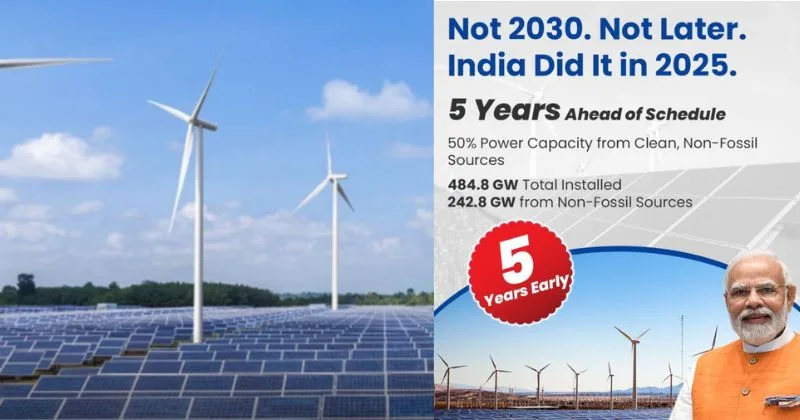
It has been merely a month when India, for the first time has secured a place among the top 100 out of 193 countries ranked for their progress in achieving the Sustainable Development Goals (SDGs) June 2025. After this success of Government efforts, On July 14, 2025 report reflects that India has reached a remarkable milestone in its clean energy journey, by making non-fossil fuel energy sources as 50.08 per cent of its total installed electricity capacity sources.
This historic achievement is five years ahead of the 2030 Paris Agreement targets of SDG-7, which refers to clean and renewable energy for citizens. According to official figures from India’s total electricity capacity stands at 484.82 GW, with 242.8 GW derived from non-fossil sources. Nuclear energy has generated electricity of 8.78 GW, while 234 GW was generated by the renewable energy that includes Hydro, Solar, Wind and other forms of sources.
Clean Energy Growth took decades in the making
This remarkable transition didn’t happen overnight. Just 18 months ago, non-fossil capacity was at 43.82% (186.46 GW) and by November 2024 it has increased to 46.3 per cent (213.70 GW). The biggest leap came during the year of 2024–25, when nearly 29.5 GW of renewable energy including more than 23 GW of solar, 4 GW of wind, 11.6 GW of bioenergy and 5.1 GW of small hydro were added by April 2025. This change has uproar in the clean energy punch behind the record growth to 50.08 per cent capacity share.
This milestone is not possible without the policies and Government nations first policy. Experts credit India’s aggressive strategy to a series of well-designed policies and focused programs under the visionary leadership of PM Shri Narendra Modiji, the initiative laid by PM are PM‑KUSUM which has revolutionized solar farming, powered pumps and generating green energy adoption in agriculture.
PM Surya Ghar: Muft Bijli Yojana started in Februrary 2024, has seeded rooftop solar more than 1 crore households, creating a electricity generation of residential and power grids.
National Wind – Solar Hybrid Policy introduced in May, 2018 has helped in developing solar parks and bioenergy initiatives, which helps to scale up integrated and diversified renewable generation.
These programs were complemented by regulatory support where waivers on interstate transmission, charges and subsidy were provided to the entities. Union Minister for New and Renewable Energy, Pralhad Joshi Ji, through his tweet across the nation declares:
“In a world seeking climate solutions, India is showing the way. Achieving 50% non-fossil fuel capacity five years ahead of the 2030 target is a proud moment for every Indian. Prime Minister Shri Narendra Modi’s leadership continues to drive Bharat’s green transformation paving the path towards a self-reliant and sustainable future.”
In a world seeking climate solutions, India is showing the way.
Achieving 50% non-fossil fuel capacity five years ahead of the 2030 target is a proud moment for every Indian.
Hon'ble PM Shri @narendramodi ji’s leadership continues to drive Bharat’s green transformation — paving… pic.twitter.com/ydzWErWQNC
— Pralhad Joshi (@JoshiPralhad) July 14, 2025
At a recent summit in Mumbai, Joshi Ji also added that wind energy remains “central to achieving these goals. Wind energy is not a component of our renewable energy strategy, but it is at the heart of it and at the centre of Atmanirbhar Bharat,” illustrating the government’s vision tying sustainability to self-sufficiency.
Beyond the Capacity: Imperative Integration
Take Gujarat’s solar‑powered village of Modhera, which runs 24/7 off solar panels and a 15 MWh battery backup, proving energy to houses. Expert suggests that India needs increase the capacity to 336 GWh of storage by 2030. Earlier 82 GWh solar energy production was projected by 2026, but government moves of introducing $627 million for battery storage scheme and a $2.1 billion manufacturing incentive package has helped ins generation of 116.25 GW Solar energy. Governments effort on Renewable energy projects has supported robust transmission networks such as the Green Energy Corridors, battery storage, AI-based forecasting and smart energy dispatch systems to match grid demand to maintain stability.
This clean energy boom isn’t confined to urban areas only. Over 2.86 crore households have benefited from electrification under Saubhagya schemes, boosting consumption by 45.8 per cent since 2014 while shrinking power shortages from 4.2 per cent to just 0.1 per cent in 2024–25. Programs like KUSUM have brought solar pump-driven irrigation to rural farms, thus reducing costs and improving farmer’s income.
With 50 per cent non-fossil capacity, India joins the ranks of global clean-energy leaders by competing with developed countries in installed renewable capacity. Financial viability and supports from government has strengthens the solar and wind energy installation, which has now become cheaper than coal plants and other non-renewable energy sources.
Charting the Road Ahead
India’s energy ambitions extend well past this landmark moment. Under its five Panchamrit climate framework announced at COP26, PM Modiji has announced the country aims for 500 GW of non-fossil capacity by 2030 and net‑zero emissions by 2070. Other was meeting 50 per cent of energy requirements from renewable energy by 2030.
To achieve net zero emission there are significant hurdles. Coal still provides a vital backbone for electricity generation, despite falling capacity share from nearly 60 per cent to under 50 per cent, as coal-fired electricity continues to dominate daily supply. Expanding offshore wind energy through a Rs. 7,453 crore VGF scheme and exploring the hydrogen-fuelled energy options. By expanding storage, smart grids, ensuring equitable access across urban and rural areas and managing coal’s role dependency on coal can be easily reduced. The government track record acknowledges that an India will be successful in reducing coal consumption necessary by 2032 to ensure reliable power.
The subsequent phase has to consider not only increasing the capacity but also quality, equity and resilience in the availability of clean energy. One of the key objectives will be to double the per capita clean electricity use, particularly in rural areas. Developing a digitally interconnected electricity grid that is capable of managing high penetration of renewables, handling of the load fluctuations and two-way power flows system.
Energy storage will be a key player for future. Expanding Battery Energy Storage Systems (BESS) and pumped hydro storage is essential for 24*7 power availability, while adopting the circular practices of recycling solar panels, wind turbine blades and batteries, which will ensure sustainable use of materials. Parallelly green hydrogen is set to play an important role in achieving sustainability.
Technology will be the important paradigm in this journey. Artificial Intelligence (AI) will emerge as the spine of India’s renewable infrastructure by assessing the changing demand or forecasting, predictive maintenance and grid management. AI-based platforms will enable rooftop solar, electric vehicles and smart meters to interact within energy marketplaces, make consumers to become active energy producers or ‘prosumers’.
The world is watching and analysing India’s ability to sustain this energy transition, which will serve as a model for emerging economies on how to balance growth with sustainability.
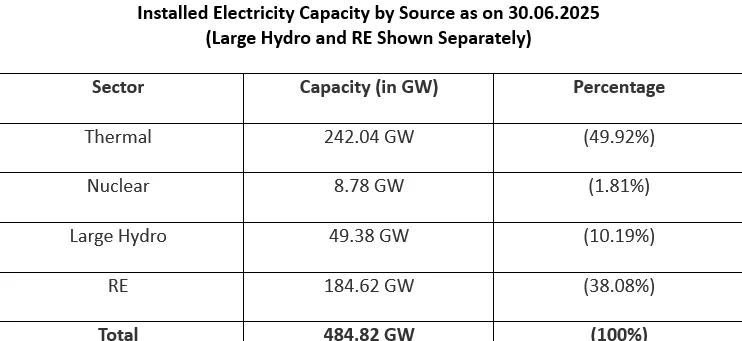
India’s achievement of 50.08 per cent non-fossil fuel electricity capacity five years ahead of schedule is not just a statistical triumph; it is a powerful declaration of intent and a blueprint for other emerging economies. As outlined in its ‘Panchamrit’ climate framework at COP26, India’s ambitions extend further, targeting 500 GW of non-fossil capacity by 2030 and net-zero emissions by 2070.














Comments