





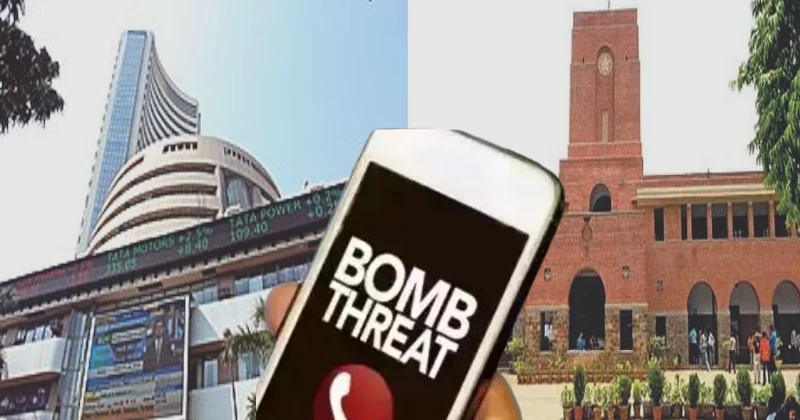
A coordinated wave of bomb threats sent shockwaves across three major Indian cities on July 15 morning, with educational institutions, financial hubs, and a revered religious site becoming targets of an apparent cyber-terror campaign. The University of Delhi’s St Stephen’s College, St Thomas School in Dwarka, the Bombay Stock Exchange (BSE), and the Golden Temple in Amritsar all received chilling threat emails, triggering mass evacuations, intense security drills, and national concern.
The first major alert came from the heart of Delhi, where two premier educational institutions — St Stephen’s College under Delhi University and St Thomas School in Dwarka — were targeted.
At around 9 AM, an alarming e-mail reached the administration of St Stephen’s College. The message claimed that four IED bombs and two packets of RDX had been planted within the college premises, including in the library, and warned that the explosives were set to detonate by 2 PM. A similar threat email was simultaneously received by St Thomas School, Dwarka.
Authorities moved swiftly. Students and faculty from both institutions were evacuated immediately as a massive emergency response operation began. The Delhi Police Bomb Disposal Squad, Dog Squad, Fire Department personnel, and Special Cell units cordoned off both campuses and began a meticulous search operation. As of now, no suspicious object or explosive has been recovered from either site. Officials confirmed that investigations are ongoing, and cyber forensic teams have been deployed to trace the origin of the threat e-mails.
The scare in Delhi follows a disturbing threat received on July 14 by the Golden Temple, also known as Darbar Sahib, in Amritsar. An email sent to the Shiromani Gurdwara Prabandhak Committee (SGPC) threatened to blow up the Langar Hall, the community kitchen that serves free meals to thousands daily.
The SGPC, which is the apex religious body of Sikhs, lodged a complaint with the Punjab Police. Security at the shrine — a global spiritual and cultural icon — has since been heightened, with central and state agencies coordinating efforts to assess and neutralize any threats.
This incident marks a deeply unsettling attempt to terrorise a sacred space, coming amid heightened religious sensitivities and a fragile socio-political climate in Punjab.
In a third, equally serious case on Tuesday morning, the Bombay Stock Exchange (BSE) in Mumbai received a bomb threat email claiming four RDX bombs had been planted in the building and would explode at 3 PM. The threat, attributed to an email ID named “Comrade Pinarayi Vijayan”, forced an immediate deployment of the Mumbai Police Bomb Squad and evacuation drills.
The BSE building, located at the financial epicentre of India, was searched thoroughly. While no suspicious items were found, the incident has triggered panic in the financial sector and raised questions about India’s digital vulnerability and cyber surveillance mechanisms.
Mumbai Police have registered a case against unknown persons under the newly implemented Bharatiya Nyaya Sanhita (BNS) sections 351(1)(b), 353(2), 351(3), and 351(4). The case is being investigated by the Mata Ramabai Ambedkar Marg Police Station.
Security experts say the timing, language, and coordination of the bomb threats across multiple high-profile targets suggest a deliberate psychological warfare strategy — aimed not only at triggering panic but also at testing India’s emergency response systems.
“These aren’t mere prank emails. When threats target educational institutions, a sacred religious site, and the country’s financial capital — all within a 24-hour window — it suggests a well-planned disruption tactic. The objective may be fear, chaos, or diversion,” said a senior official with India’s counter-terrorism unit.
















Comments