





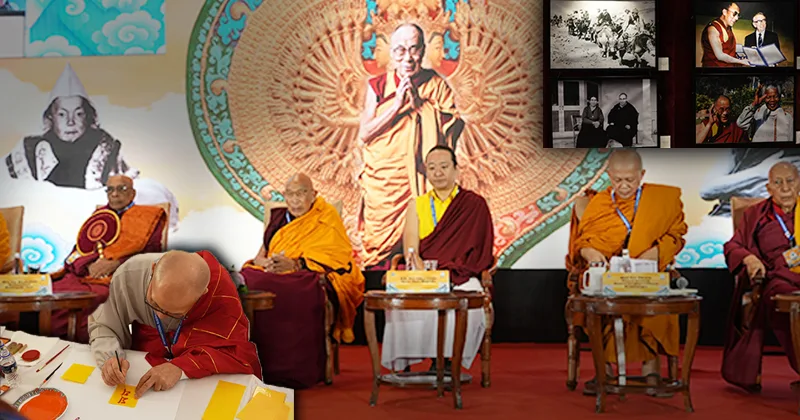
Over 500 global participants, including eminent Buddhist scholars, monks, researchers, and spiritual leaders, gathered at an international conference in New Delhi to commemorate the 90th birth anniversary of His Holiness the 14th Dalai Lama. Organised by the International Buddhist Confederation (IBC), the conference focused on three key themes central to His Holiness’s lifelong vision: the relevance of Buddha Dharma in the 21st century, the integration of quantum physics and neuroscience with Buddhist thought, and the future of Tibetan Buddhism and cultural preservation.
Delivering the keynote address, His Holiness the 43rd Sakya Trizin Gyana Vajra Rinpoche highlighted the universal values championed by the Dalai Lama – compassion, ethical living, and interfaith harmony. The event opened with a special message from His Holiness, read by Most Venerable Prof. Samdhong Rinpoche, reiterating his unwavering commitment to secular ethics, Tibetan cultural preservation, and the fusion of ancient Indian wisdom with modern education systems.
Buddhism, Science, and Ethics: A Modern Confluence
Dr Alexander Berzin, Harvard scholar of Indian and Sanskrit studies, elaborated on the Dalai Lama’s practice centred on bodhichitta, emptiness, and the oneness of humanity. These, he noted, underpin His Holiness’s four major commitments: secular ethics in education, promotion of religious harmony, protection of Tibet’s culture and environment, and integration of ancient Indian mind science into curricula.
Expanding on the link between science and Dharma, Dr. Lobsang Tenzin Negi of Emory University discussed how the Dalai Lama’s dialogues with neuroscientists have helped establish the field of contemplative science. “Programs like SEE Learning and CBCT embody His Holiness’s vision of embedding compassion and emotional resilience into global education,” he remarked.
On the panel exploring science and spirituality, Prof. Ceon Ramon from the University of Washington introduced attendees to how quantum and superluminal physics can be used to understand better Buddhist concepts like the luminous nature of the mind, suggesting that Buddhist and scientific paradigms can mutually illuminate fundamental questions of consciousness and causality.
A Call for Ethical Education
Assoc. Prof. Edi Ramawijaya Putra from Indonesia emphasised the need for educational reforms that go beyond intellect to nurture moral and emotional intelligence. “Educating the heart, not just the mind, must become the global standard,” he said, echoing the Dalai Lama’s long-standing advocacy for compassion-based education.
Tibetan Buddhism at a Crossroads
Addressing concerns about Tibetan Buddhism’s future under Chinese state control, Kate Saunders, UK-based co-founder of Turquoise Roof and Tibet Watch, described China’s policies as a “protracted war” against Tibetan religious identity. Her presentation included findings from new research revealing how Beijing’s reincarnation politics and atheistic state doctrine are attempting to erode centuries-old Tibetan systems that combine spiritual and political authority.
“At a time of global instability, preserving Tibetan Buddhism is not only a cultural imperative but a civilizational necessity,” Saunders said, warning that the suppression of Tibetan traditions threatens a unique model of ethical leadership and inner resilience that humanity urgently needs.
A Unanimous Declaration
In a powerful joint declaration issued at the close of the day-long deliberation, the attendees collectively reaffirmed their allegiance to the values espoused by His Holiness. “From the highlands of Tibet to the corners of the world, His Holiness’s teachings transcend borders,” the statement read. It emphasised the global impact of the Dalai Lama’s teachings and his pivotal role in revitalising Tibetan Buddhism and championing non-violence and harmony.
The declaration also strongly backed His Holiness’s assertion that the continuation of his reincarnation must be a matter decided solely by the Tibetan people, free from foreign interference. “This is a vital step in preserving Tibetan culture and religious freedom,” it noted.
The conference concluded with remarks from Most Ven. Nicholas Vreeland (USA) and Most Ven. Phrarat Vajarasuttiwong Arayawangso (Thailand) praised the Dalai Lama’s enduring role as a spiritual and moral compass in an age marked by uncertainty and division.











Comments