





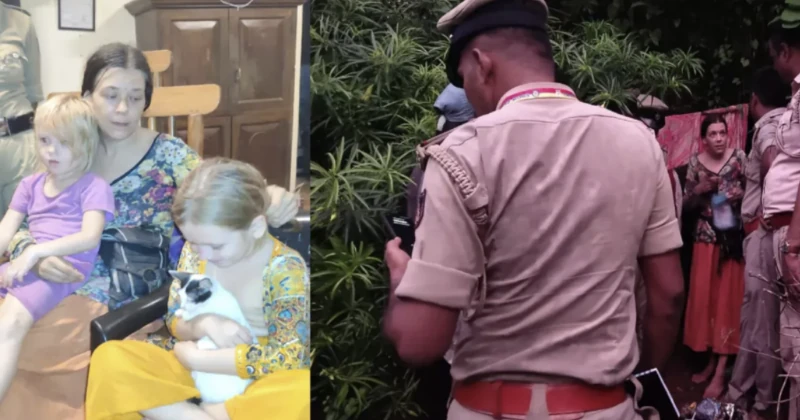
In a remarkable incident that underscores India’s enduring allure as a land of deep spirituality, Gokarna police rescued a Russian woman and her two young children from a forest cave on Ramatirtha Hill near the mandir town of Gokarna. The woman, identified as Nina Kutina alias Mohi (40), was found living in seclusion with her six-year-old daughter Preya and four-year-old daughter Ama. Their stay, inspired by devotion to Hindu practices and the quest for peace through meditation, came to light when local police noticed signs of habitation in an otherwise dangerous area.
Inspector Sridhar S.R. and his team were on routine patrol at around 5 PM when they spotted clothes hanging outside a forest cave on Ramatirtha Hill — an area prone to landslides and home to wild animals, including venomous snakes. Suspecting an unauthorised stay, the team carefully inspected the cave and found the Russian mother and her children living in the wilderness. When questioned, Nina Kutina explained that she had come to India years ago on a business visa and was staying in Goa before moving to Gokarna. Drawn to India’s ancient spiritual traditions, she had chosen the natural cave as a makeshift ashram to worship Hindu deities and meditate among nature’s tranquillity.
Inside the cave, the police found photos of Hindu gods placed reverently by Nina. Despite the harsh forest surroundings, Kutina believed the solitude of the hill and the raw closeness to nature brought her spiritual solace. Her story echoes that of countless foreign pilgrims, seekers, and spiritual wanderers who, for centuries, have come to India — the cradle of timeless philosophies like yoga, meditation, and the pursuit of moksha — hoping to find answers not offered by materialistic life elsewhere.
However, the very setting that promised peace also posed life-threatening risks. The Ramatirtha Hill had witnessed landslides in the past, and the presence of wild animals made it unsafe, especially for small children. The police team patiently explained the risks to Kutina, convincing her to leave the cave for her children’s safety.
Honouring India’s compassionate approach to such seekers, the local police and women police staff helped relocate the family to a safer environment. With the assistance of Yogaratna Saraswati Swamiji, head of the Shankar Prasad Foundation, a respected NGO and spiritual centre in Bankikodlu village near Kumta, the woman and her children were taken to an ashram. Here, she could continue her spiritual practices in a safe and supportive atmosphere, which itself reflects India’s tradition of welcoming spiritual travellers and offering them refuge and guidance.
However, the police soon discovered that Kutina’s visa had expired long ago — back in April 2017. Initially reluctant to reveal her passport and visa details, she finally admitted they might have been lost in the cave or forest. Gokarna police, along with forest department officials, launched a search operation and recovered the documents near the cave. The records confirmed that Kutina had overstayed her visa for several years, despite an interim visit to Nepal.
With due respect to India’s immigration laws and under international protocols, the authorities decided to repatriate her and her children to Russia. Until then, they have been kept safe at a government-run Women and Child Welfare Department shelter in Karwar. The local police have coordinated with the Bengaluru FRRO (Foreigners Regional Registration Office), and the family will be presented there under the protection of female police personnel for the completion of the deportation process.
This unusual but moving episode highlights how India’s spiritual magnetism continues to draw people from across the world. While the law must take its course, Nina Kutina’s devotion to Hindu worship and meditation is a testament to the profound cultural soft power India still holds in the 21st century. From ancient sages to modern yogis and foreign seekers like Kutina, the country’s sacred hills, mandirs, forests, and caves have long offered a sanctuary for those in pursuit of inner peace.
Even today, Gokarna remains one of India’s beloved spiritual havens, attracting pilgrims, sadhus, and seekers to its serene beaches, ancient mandirs, and mystical hills. This incident also shows how local communities, police, and ashrams continue to embody the Indian spirit of Atithi Devo Bhava — treating guests as gods — while ensuring safety, compassion, and the rule of law go hand in hand.










Comments