





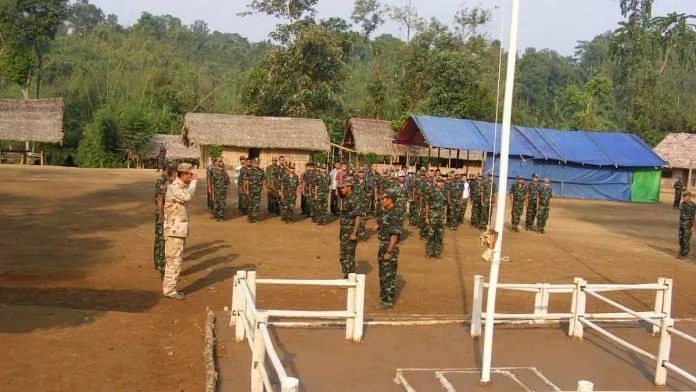
In a major and highly coordinated cross-border operation, the Indian Army reportedly carried out a series of drone strikes early Sunday early morning on insurgent camps belonging to ULFA-Independent (ULFA-I) and the National Socialist Council of Nagaland-Khaplang (NSCN-K) inside Myanmar’s Sagaing Region, close to the India-Myanmar border.
Sources in the Indian army revealed that the drone attack on the camps of the Northeastern insurgency groups were carried out in the wee hours of 13th July located deep inside the Naga self administered areas. For a long period these areas were used by the rebel groups of Northeast for their operations. The operation, as per the sources, was conducted using over 100 unmanned aerial vehicles (UAV), which is considered as one of the biggest aerial attacks on NE insurgency group camps by the Indian army. Several top insurgency leaders might have been killed in the attack, the sources said.
ULFA (I) on target
The primary target of the attack was the ULFA (I) led by Paresh Baruah, 779 base camp. The camp was located in Waktham Basti where at least 5 cadres of the militant group were present at the time of the strike. The numbers of casualties in the drone attack was not confirmed by either side. But the precision attack by the Indian army caused heavy damage to the militant camp which was confirmed by the army sources.
A more intense strike reportedly focused on Hoyat Basti, home to ULFA-I’s Eastern Command Headquarters (ECHQ). It is here that speculation is mounting over the possible killing of Nayan Medhi alias Nayan Asom, one of ULFA-I’s most senior and influential commanders. Known for his role as a strategist and military trainer, Nayan Asom’s death, if confirmed, would represent a major blow to the outfit’s operational capabilities.
NSCN(K) camps hit
The strikes didn’t stop at ULFA-I. Multiple positions held by the NSCN(K) were also targeted during the operation. The security forces are still accessing the damage in the militant camps, but it is believed that multiple casualties took place in the NSCN (K) camps as it houses numbers of militant caders.
The areas in the dense forest of Myanmar have been providing safe shelter to NE militants groups for many decades. Groups like ULFA-I and NSCN(K), have many camps in these areas. The strike by the Indian army indicated its strategic shift in counterinsurgency doctrine, focusing on precision attacks using drones for maximum damage on enemy sites.
Super input
The Indian army intelligence had proper inputs on the locations of the militant camps deep inside the Myanmar territory. It is believed that a rebel group in Myanmar was in close coordination with the Indian army for the strike, providing valuable inputs. It is believed that the precision drone attacks on the camps of NE militant groups is a bold move by India to neutralise the cross-border security threats.
A message of zero tolerance
The strikes come at a time when Northeast India is once again grappling with security concerns and sporadic insurgent activities, especially in the border regions of Upper Assam and Arunachal Pradesh. Analysts say the drone operation sends a clear message of zero tolerance to groups that continue to operate from foreign soil while destabilising internal peace.
For now, the hills and forests of Sagaing lie silent in the wake of the early morning blitz—but the ripples of Sunday’s drone strikes are expected to echo far and wide across insurgent corridors, diplomatic channels, and the broader security landscape of the Northeast.
More details are awaited as agencies assess the outcome of the mission.










Comments