





After the abrogation of Article 35-A on August 5/6, 2019, and whittling down of Article 370, most Kashmir based politicians have been trying to build a narrative that these can and will be restored. Knowing well that it is not possible till at least mid 2029 when the term of the present National Democratic Alliance (NDA) government led by the BJP is over. Theoretically, restoration of these articles to pre-August 2019 status will mean mustering a two-thirds majority in Parliament, in both Houses meaning the Lok Sabha and the Rajya Sabha.
In trying to build up this narrative, the attempt of the Peoples Democratic Party (PDP) is to instigate ruling National Conference (NC) cadres to take a belligerent posture against party leadership. Some NC leaders trying to unsettle Chief Minister Omar Abdullah find this demand of theirs as a good stick to beat him with. Peoples’ Conference (PC) leader Sajjad Gani Lone, Engineer Rashid and CPM legislator Yusuf Tarigami also find it a useful political tool.
With this thing in mind, most of these political leaders, cutting across party lines, are instigating the people to seek July 13 as a public holiday. PDP leader Mehbooba Mufti spoke about the restoration of public holidays on July 13 and December 5 (birthday of NC founder Sheikh Mohammad Abdullah). Why are these leaders bent on instigating common Kashmiris against the Lieutenant Governor Manoj Sinha by articulating this demand? Well, if truth be told, Mr Sinha has scant respect for this bunch of leaders whom he holds responsible for most of the bloodshed that Jammu & Kashmir witnessed earlier for over three decades.
Let’s see what is the most important change that these leaders are seeking and which is cornerstone of their narratives. It is the restoration of so-called “special status’’ of J&K which led to classification of Indian citizens into Permanent (PRs) and Non-Permanent Residents (NPRs). A section of these leaders calls Indian citizens coming to J&K as tourists as also seeking jobs as “cultural invaders’’ and those changing “demographics of J&K’’.
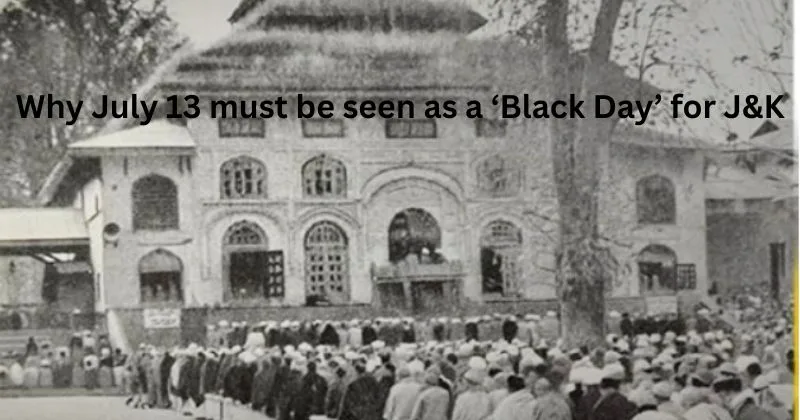
Let’s see why they want July 13 to be declared as a public holiday as it was in the pre-August 2019 period. They want it to be marked as a “Martyrs’ Day’’ to commemorate those who died on July 13, 1931, in Srinagar. Who were those people who died on that day and how did they die?
Well, it is said that 22 common Kashmiris (Muslims all) died when they were fired upon by Dogra (Hindu) soldiers as they had gathered at a location where an open trial of one Abdul Qadeer was being held in Srinagar city. Who was this Abdul Qadeer and why was he being tried, that too in an open court and why had people gathered at that spot?
Abdul Qadeer was being tried for treason and instigating common citizens to rise up against the Dogra Hindu ruler of the day, Maharaja Hari Singh, and overthrow him. In one of his speeches, Abdul Qadeer, pointing to the buildings on Hari Parbat, inhabited by Dogra rulers and their soldiers, said these should be burnt down. He also said that this was possible only if all Kashmiris rose up against the Maharaja and deposed him. This incendiary speech of Abdul Qadeer had led to his arrest and subsequent trial for treason which was and is punishable to this day with death in most nations across the world.
An interesting thing to be noted about this whole episode regarding Abdul Qadeer’s speech arrest and subsequent trial is that Qadeer was not a Permanent Resident having a State Subject. Incidentally, the first of State Subject notification had been issued by Maharaja Hari Singh over four years before the July 13, 1931, episode on April 20, 1927. So, all the subjects of the kingdom of Jammu & Kashmir, including what is now Pakistan Occupied Jammu Kashmir (POJK), Gilgit-Baltistan and other areas, knew about these rules well.
This fact of Qadeer being a foreigner, an Afghan in the service of a British officer, is suppressed and never told by Kashmiri leaders. In their emotive speeches in the past, many Kashmiri leaders termed those who died in the police firing on July 13, 1931, as martyrs. Not rebellious subjects of Maharaja Hari Singh who were supporting a foreign national who was instigating a rebellion against a sovereign ruler. These leaders never told their audiences that Qadeer was not a State Subject.
These leaders thus project Abdul Qadeer, a real villain and a foreigner, as a hero but suppress the fact that he was following an Islamist agenda against a legitimate Hindu ruler whose family had ruled J&K since March 1846. The main grouse and the reason was that Maharaja Hari Singh was popular among his citizens and a benign as also progressive ruler by standards prevalent at that time.
It needs to be stated here that the Maharaja allowed entered of dalits into all temples, including Raghunath temple of Jammu, which was set up by his family decades earlier. Contrary to the practice of most royal households, he ploughed land in person to convey the importance of cultivating lands, favoured widow remarriage and promoted such progressive steps. All such good deeds of the Maharaja were sought to be put in the dustbin by most Kashmiri leaders to try to portray him as a villain.
“Suppressio very, suggestio falsi” is what these Kashmiri political leaders pursuing divisive politics are doing. It is a Latin legal maxim that can be loosely translated as “suppressing truth, suggesting falsehood”. It essentially means that despite knowing facts, the speaker/s intentionally withholding relevant information and that amounts to a false statement. This principle is often used in law where a party’s deliberate silence or omission of material facts is considered as misleading as directly stating something false. Most of Kashmiri leaders who lament an end to the concept of Permanent Residents, sidestep the fact of Abdul Qadeer being a foreigner.
This maxim which means suppressing truth to suggest falsehood. Both are equally wrongful and meant to mislead to cause illegal gain through that falsehood. In everyday life, stating the truth is integral to gaining trust of the people one is dealing with. However, in Kashmir, most politicians have misled the masses into believing what is untrue for close to a century. Post-2019, those untruths and falsehoods are getting unravelled layer by layer, year by year, event by event. This process is likely to continue in the near future as well.
Many false gods of Kashmir society are thus bound to fail and fall in public esteem.










Comments