





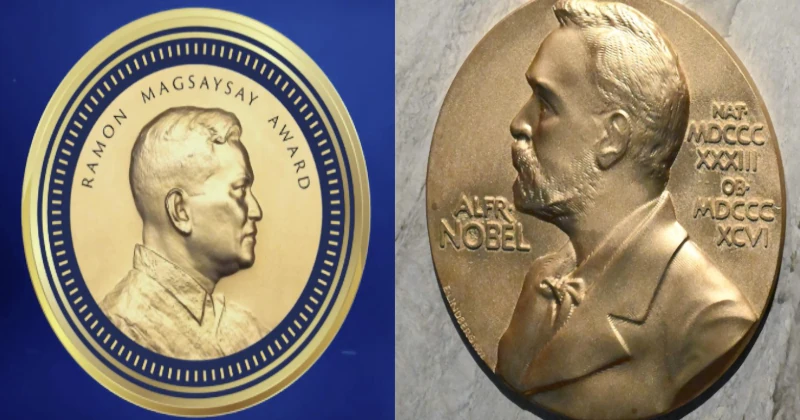
The recent eagerness of Donald Trump to secure the Nobel Peace Prize, including reported lobbying efforts and even recommendations from countries such as Pakistan, reveals a growing perception that such global honours are less about achievement and more about strategic image-building. Trump cited the Abraham Accords as a historic milestone and has actively encouraged allies to nominate him, highlighting how prestigious international recognitions have become a form of political capital in perception warfare. Beyond the Nobel, other global awards, such as the Sakharov Prize for Freedom of Thought (EU), the UNESCO/Guillermo Cano World Press Freedom Prize, and the Right Livelihood Award (Sweden), have also come under scrutiny for reflecting the geopolitical preferences of Western liberal regimes.
These prizes often serve a dual purpose, rewarding ideological conformity and penalising sovereign divergence. In the theatre of global diplomacy, recognitions such as the Nobel Peace Prize and the Ramon Magsaysay Award have long crossed the boundary of apolitical appreciation. They function as potent instruments of geopolitical signalling, soft power projection, and ideological engineering. Whether it’s amplifying dissent in non-aligned democracies, legitimising regime change agendas, or branding reformists in adversarial states as peace icons, these awards have increasingly been weaponised as tools of global narrative warfare, strategically cloaked in the language of peace, human rights, and humanitarianism.
These awards, while founded on admirable principles, often lose credibility when they exhibit patterns of selective recognition, ignore internal contradictions in Western systems, and are used to politically elevate dissenters in adversarial states while shielding allies from scrutiny. This reflects a consistent Western soft power strategy of using recognition as moral leverage in global diplomacy, especially against emerging nationalist, multipolar, or culturally rooted states, such as India.
The Nobel Peace Prize: A Geopolitical Instrument
The long history of the Nobel Peace Prize and similar awards reveals a recurring pattern of ideological endorsement, geopolitical signalling, and strategic narrative construction. Far from being impartial recognitions of peace efforts, many of these awards have become symbols of Western soft power influence, frequently serving to reward reformers aligned with liberal worldviews while subtly delegitimising sovereign regimes or nationalist movements.
In 1973, the Nobel Peace Prize was awarded to Henry Kissinger and Le Duc Tho for their role in the Paris Peace Accords during the Vietnam War. The irony, however, was unmistakable. Kissinger was widely criticised for ordering secret bombings in Cambodia, and Le Duc Tho declined the award, calling the peace “illusory”. This moment exposed the Nobel as a political tool, not a moral beacon.
Similar symbolic posturing occurred in 1989, when the award went to the Dalai Lama, shortly after the Tiananmen Square massacre. The timing was seen as a direct rebuke to Chinese authoritarianism, deepening Sino-Western tensions and internationalising the Tibet issue. A year later, in 1990, Mikhail Gorbachev received the Nobel Prize for ending the Cold War. Still, many in Russia saw it as a Western celebration of Soviet surrender, with his reforms of glasnost and perestroika triggering economic chaos and the USSR’s collapse.
The Nobel’s habit of prematurely sanctifying political figures was again evident in 1991, when Aung San Suu Kyi was celebrated for her resistance to Myanmar’s military junta, signalling a normative push for Western-style democracy. However, decades later, her silence on the Rohingya genocide led to widespread calls to revoke her award, highlighting how such recognitions often fail to anticipate complex future realities. In 2001, the Nobel Prize was jointly awarded to the United Nations and Kofi Annan, a decision framed as a celebration of multilateralism in the post-9/11 era. However, the UN’s inability to prevent the US-led invasion of Iraq just two years later raised questions about whether the prize was being used to legitimise global institutions serving Western interests.
The most criticised Nobel in recent history was perhaps that of Barack Obama in 2009, awarded barely 10 months into office. While the Nobel Committee cited his “vision for a world without nuclear weapons,” critics questioned the logic, especially as his administration later presided over drone strikes, the Libyan intervention, and a surge in Afghanistan. Obama himself admitted in 2020, “I’m not sure I deserved it.” In 2010, jailed Chinese dissident Liu Xiaobo received the Peace Prize, prompting a harsh response from Beijing, which saw it as a Western ideological intrusion. China froze diplomatic ties with Norway and banned public prize celebrations, an unprecedented diplomatic backlash triggered by an award. In 2014, the prize was jointly awarded to Malala Yousafzai. Malala’s recognition served to project a moderate Islamic face amid US drone warfare criticism in Pakistan.
When Donald Trump nominated himself for the Nobel Peace Prize in 2020, citing the Abraham Accords between Israel and Gulf nations, it wasn’t merely about ego; it was a strategic manoeuvre. In an age where awards translate into international credibility, Trump sought to cement his statesman image and reframe global opinion, particularly as he faced domestic and international criticism. Although the nomination did not materialise into an award, the episode highlights how global prizes are viewed by leaders as geopolitical assets, especially in a multipolar world where narrative legitimacy is as crucial as military power.
In 2023, the Nobel Peace Prize was awarded to Narges Mohammadi, an Iranian activist jailed for protesting Iran’s hijab laws. While her courage is undeniable, the timing of the award, amid renewed tensions between the West and Iran over nuclear negotiations, made it hard to separate the honour from its strategic geopolitical undertones. Observers noted that the award served to undermine Iran’s theocratic regime and lend moral weight to Western criticisms of Tehran’s domestic policies.
The nomination of Donald Trump further highlighted the politicisation of awards. Citing the Abraham Accords between Israel and Gulf nations, Trump actively lobbied for recognition, even receiving endorsement from Pakistan. The spectacle itself underscored how global awards have become a currency in political branding, particularly in contested democracies.
India’s Civil Society as a Battlefield
The 2021 anti-CAA protests in India marked a turning point in how international platforms engage with domestic political movements. Bilkis Dadi, the face of the Shaheen Bagh sit-in, was included in TIME magazine’s “100 Most Influential People” list and was even informally promoted for the Nobel Peace Prize. While supporters praised her symbolic resistance, critics flagged the global amplification of her image as part of a coordinated foreign media campaign to project domestic protests as global moral struggles.
Similarly, Greta Thunberg, a multiple-time nominee for the Nobel Peace Prize, came under scrutiny for her support of the Indian farmers’ protest. Her now-infamous tweet, accompanied by a downloadable “toolkit,” inadvertently revealed an organised foreign PR effort aimed at amplifying unrest. Subsequent investigations revealed connections to transnational activist networks and ideologically aligned campaign groups that were working to shape perceptions of India’s internal policy matters.
The Ramon Magsaysay Award, established in 1957 by the Rockefeller Brothers Fund and administered with support from the Philippine government, was originally envisioned as a counterbalance to communist and nationalist ideologies sweeping Asia. Created at the height of the Cold War, the award aimed to promote liberal-democratic ideals under the banner of “selfless service.”
In India, several figures have been recipients of the Ramon Magsaysay Award; over time, their activism has increasingly aligned with anti-establishment or even anti-national narratives. These recognitions, while appearing apolitical, have often functioned as gateways into a Western-designed civil society ecosystem that rewards dissent against nationalist governments, particularly those asserting cultural or strategic sovereignty.
Medha Patkar (2001) led the Narmada Bachao Andolan, which, while raising legitimate environmental concerns, became a rallying point for blocking infrastructure and dam development projects, eventually feeding into a broader anti-growth narrative that questioned the state’s development mandate. The movement was repeatedly leveraged to obstruct the progress of the dam, which had the potential to transform water and power availability in drought-prone regions of Gujarat, Madhya Pradesh, and Maharashtra. The NBA narrative was frequently cited by left-leaning intellectuals, foreign-funded NGOs, and Western environmental groups as proof of India’s alleged disregard for human rights, providing fodder to Modi’s political opponents in both domestic and international circles. This movement served to politically target Modi’s leadership at a critical time when he was gaining national traction.
Arvind Kejriwal, awarded in 2006 for RTI activism, became a central figure in the 2011 anti-corruption movement but later transitioned into politics through the AAP, which has since been embroiled in multiple controversies. The 2011 anti-corruption movement led by Anna Hazare was widely hailed as a civic awakening. However, behind the scenes, a nexus of foreign-funded NGOs and global civil society platforms played a significant role in organising the protest ecosystem. Prominent among them was Kabir, an NGO run by Arvind Kejriwal and Manish Sisodia, which received funding from the Ford Foundation, an institution historically linked with US soft power initiatives. Other actors received support from organisations like the Open Society Foundations (founded by George Soros), known for promoting liberal democratic transitions in non-Western states. This foreign financial and ideological input raised serious concerns about the co-optation of genuine movements into externally influenced political campaigns.
Most concerning has been the AAP’s tacit support for radical elements during major protests and electoral campaigns. In Punjab, several AAP leaders and affiliates were accused of giving space to Khalistani separatist sympathies and sharing platforms with anti-national actors, a concern raised during both the 2017 and 2022 assembly elections. Kejriwal himself was criticised for siding with agitators during the Shaheen Bagh protests and for AAP’s ambiguous stance on the CAA and NRC, which many believed emboldened identity-based separatist politics.
Other recipients, such as Harsh Mander (2002) and Sandeep Pandey, have also drawn attention. Mander has consistently used international platforms to critique Indian constitutional institutions and the judiciary, often framing internal law enforcement as “fascist” or “majoritarian”, language that finds echo in Western human rights reports. Sandeep Pandey, who was awarded in the same year, was expelled from IIT-BHU after allegations of teaching anti-national content and making public statements deemed inflammatory and misaligned with national interests.
Collectively, these individuals, though initially celebrated for civil courage or governance innovation, have often been co-opted into a narrative ecosystem against “democratic mandate.” They become nodes in a broader network of foreign-funded activism, where awards and recognitions are not just honours, but strategic instruments that provide international legitimacy to opposition narratives. As a result, these figures are frequently highlighted during mass mobilisations, media protests, and international lobbying, not merely for their past achievements, but for their potential in challenging the current political order.
PM Modi’s Strategy Against Award-Driven Subversion
After assuming office in 2014, the Modi government recognised the strategic role of foreign-funded NGOs, Western recognitions, and global civil society campaigns in shaping India’s internal discourse. The government moved swiftly to curtail this influence through a multi-layered approach. At the heart of this effort was a sweeping crackdown on the Foreign Contribution Regulation Act (FCRA). Between 2014 and 2021, over 20,000 NGOs had their FCRA licenses revoked due to violations or suspicious inflows. A 2015 Intelligence Bureau report, “Impact of NGOs on Development”, noted that several such organizations were intentionally slowing down India’s economic progress, especially in critical sectors like infrastructure, energy, mining, and nuclear development, all flagged under the guise of “people’s rights” and “environmental justice.”
But the Modi government didn’t just dismantle hostile networks; it reoriented the narrative architecture. The strategy was twofold: block external validation of dissent and build indigenous mechanisms for recognition. Government-linked institutions began promoting homegrown achievers through platforms like the Padma Awards, which saw a major transformation post-2014, prioritising unsung grassroots workers, traditional knowledge holders, tribal innovators, social workers, and non-elite contributors. This shift not only democratised recognition but also neutralised the ideological monopoly of foreign honours, such as the Ramon Magsaysay Award or foreign think-tank-backed prizes, which had long been used to validate civil society actors hostile to Indian national interests.
Further, the state supported Bharatiya-rooted NGOs, think tanks, and educational platforms that promoted constitutional nationalism, Indic knowledge systems, and development with accountability. Institutions such as the Indira Gandhi National Centre for the Arts (IGNCA), IIT Gandhinagar’s Indian Knowledge Systems Centre, and Deendayal Research Institute (DRI) began receiving support to reclaim intellectual and cultural discourse from ideological gatekeeping.
Crucially, the government tightened diplomatic responses to foreign meddling. Whether it was rejecting biased human rights reports, rebutting celebrity-backed toolkit campaigns, or calling out UN bodies interfering in domestic legislation, India began asserting its right to internal sovereignty with unprecedented confidence. By combining legal, cultural, and narrative control mechanisms, the Modi government successfully curbed the soft power offensive that utilised global recognitions as weapons, reasserting India’s sovereign right to define its trajectory without external ideological interference.
In the evolving landscape of global perception warfare, awards such as the Nobel Peace Prize, Ramon Magsaysay Award, and various UN-INGO-backed recognitions are no longer just badges of merit; they are carefully deployed instruments of strategic influence. Whether it is to legitimise reformers aligned with liberal internationalist ideals, delegitimise nationalist or culturally rooted regimes, or promote agenda-specific policymaking in areas such as climate, gender, or human rights, these honours have become tools in a larger geopolitical playbook. Even global media platforms now operate in synergy with this ecosystem, amplifying select voices while muting others, thereby creating an asymmetry of narratives that disproportionately shapes global opinion against sovereign assertiveness.
As India asserts its cultural civilizational identity and pursues an independent development model, it must remain alert to this weaponisation of recognition. The challenge is not in opposing merit-based honours, but in recognising when such awards are being selectively used to empower dissent, manufacture opposition, or subtly undermine internal democratic processes. To preserve its narrative sovereignty and resist ideological encirclement, India must continue to build indigenous frameworks of validation, promote homegrown achievers, and engage with the world on its terms, not through lenses manufactured abroad, but through a confident and conscious assertion of national interest, cultural pride, and geopolitical clarity.











Comments