





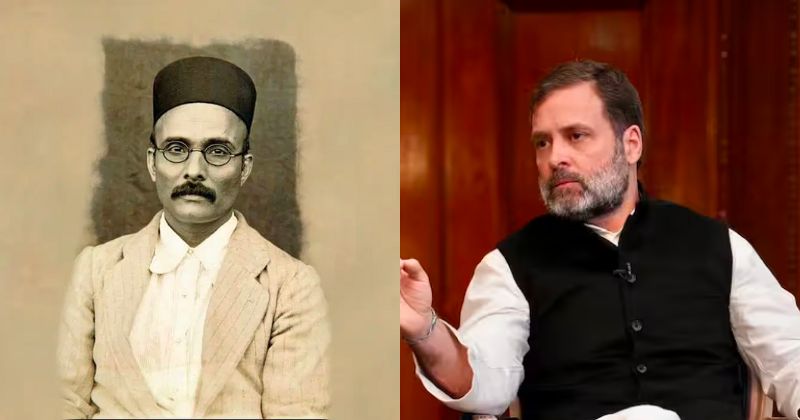
The criminal defamation case filed against Congress leader Rahul Gandhi over his remarks against freedom fighter Veer Vinayak Damodar Savarkar, a special court in Pune on Friday (July 11) recorded Gandhi’s ‘not guilty’ plea, marking the commencement of a formal trial under Section 500 of the Indian Penal Code (IPC).
Gandhi, however, did not appear personally before the court. Instead, his legal counsel, Advocate Milind Pawar, submitted an application seeking permission for the plea to be recorded through the lawyer’s representation. The plea was accepted by Special Judge Amol Shinde, who then proceeded to explain the charges and formally read out the content of the alleged defamatory statement in court.
“No, I do not plead guilty”: Gandhi’s Counsel
When asked if Gandhi would plead guilty, Advocate Pawar, on his behalf, responded, “No, I do not plead guilty.”
This response now paves the way for a full-fledged criminal trial, where Gandhi will face judicial scrutiny for his alleged remarks against one of India’s most prominent freedom fighters.
The case was filed by Satyaki Savarkar, a family member of Veer Savarkar, who alleges that Gandhi intentionally defamed the revered leader during a public address in the UK.
The 2023 London speech and the complaint
The core of the complaint revolves around a speech delivered by Rahul Gandhi on March 5, 2023, while addressing the Overseas Congress in the United Kingdom. During his speech, Gandhi allegedly made wild and defamatory statements about Savarkar, accusing him of writing a book in which he allegedly described assaulting a Muslim man and enjoying it, an incident the complainant vehemently denies ever having existed.
According to Satyaki Savarkar, the comments were deliberately false and malicious, made with the intent to harm Savarkar’s reputation and cause mental agony to his family.
Despite being made abroad, the speech’s impact was felt in India, the complaint argues, because it was broadcast and widely circulated across Indian media and social platforms, particularly in Pune, where the defamation case is now being heard.
Evidence submitted in court
The complainant has submitted a YouTube link to Gandhi’s London speech, along with multiple media reports covering the remarks as evidence. The submission aims to prove that Gandhi knowingly made factually incorrect and damaging statements about Savarkar.
Satyaki has argued that nowhere in Savarkar’s writings does any such description exist, asserting that Gandhi fabricated the story to tarnish the legacy of the revolutionary.
Demands and legal provisions invoked
The defamation complaint invokes Section 500 of the Indian Penal Code, which deals with punishment for defamation, and Section 357 of the Code of Criminal Procedure (CrPC), which enables courts to order compensation to victims of criminal offences.
Satyaki Savarkar has demanded the maximum punishment under the defamation law and requested that the court impose substantial compensation for the alleged damage caused to Savarkar’s name and dignity.
Advocate Milind Pawar appeared on behalf of Rahul Gandhi. Advocate Sangram Kolhatkar represented the complainant, Satyaki Savarkar.
Judge Shinde explained that, as per the complaint and evidence submitted, the court finds sufficient grounds to initiate trial under Section 500 IPC, which carries a maximum punishment of two years imprisonment, a fine, or both.
With the plea recorded and trial now set to begin, Rahul Gandhi may be summoned to appear in person at subsequent hearings. If found guilty, the Congress leader may face criminal sentencing and monetary penalties.












Comments