





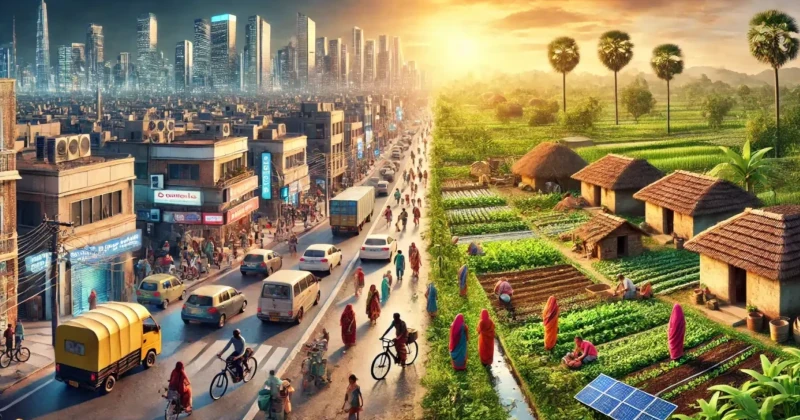
A well-known venture capitalist and one of India’s leading tech-entrepreneurs had a mild face-off on ‘X’ recently. The controversy centred on the way forward for cities with congested infrastructure, such as Bengaluru. In response to the latter’s suggestion that the way forward was development focused on rural India, the former claimed that no developed economy is predominantly rural and that we need to “wean our people off the land and into cities”. Any other plan can only be part of a “Gandhian fantasy”. These views are similar to those of the Hon’ble Judge of the Kerala High Court, who, while dealing with a case regarding the delimitation of local body seats, called for the scrapping of constitutional recognition for Gandhi’s idea of the village due to the supposed complexity in dealing with contemporary issues like waste management. Whether fantasy or not, the idea that development should not lead to urbanisation was distinctly Gandhian and was defeated by two competing ideas that became the mainstay of post-independent India’s policy-making. One is, of course, the economic development model, which saw factories and dams as the new temples of India. The other is the Ambedkarite criticism of village life, which argues that it lacks the conditions for equality, supported by the sceptical writings of scholars such as M.N. Srinivas and Andre Beteille.
Technocrats will determine whether emulating the economic models of developed countries, which evolved under different circumstances, societies, and historical periods, is suitable for India today. The increased emphasis we see today on skill development and vocational training may be seen as a restoration of respect for Gandhi’s ‘lokavidya’ as opposed to the disproportionate prestige attached to other forms of education. It may help reduce the rural-urban economic divide at least in terms of talented manpower. The NEP, 2020, makes the promotion of ‘Lokvidya’ a specific goal. Beyond such technocratic matters, the significance of the rural-urban divide for democracy itself needs greater study. The quality of our democracy is the bedrock for all development, including economic progress. One can have the best technological equipment from the city to clean the village’s waste, as the Hon’ble Judge from Kerala feels is necessary. However, whether the decision to do so should include the participation of the villagers is a different question altogether.
The same developed countries whose models we have been trying to emulate have seen a surge of populism in recent times. These political developments have been seen as a result of pent-up resentment among communities, which went undetected or ignored in the practice of representative democracy and became easy fodder for divisive politics. As political philosopher Charles Taylor writes, regions like “the rust belts of the United State and France…have been devastated by decades of deindustrialization, neoliberal fiscal policies and political neglect that the (local communities) find themselves lacking the resources to effectively respond to their present and future challenges.” Taylor points out that no amount of transfer of material resources to these regions will help because industries and technology of a particular kind have shaped not just incomes and skills but also “the prevailing images of what it means to be a worker or what is means to care for your family”. So communities that are not close to such industrial and technological developments lose “their self-esteem or their sense of self-worth, on both the individual and collective level.” They become “passive victims in an anonymous machine.” The way forward, according to Taylor, is rebuilding communities from the bottom up, as seen in the efforts of some citizens’ councils in Austrian villages and citizen assemblies in Ireland. In India, too, initiatives of individual Sarpanches and local leaders have transformed villages, stemming population flight and increasing participatory democracy. These examples are few and far between because the consensus is in favour of urbanisation.
The question of participation and deliberation in democracy is related to the urban-rural divide in a significant way. Ashis Nandy best captures the psychology of the Indian villager’s aspiration for a city life in his book on Indian cinema-“the anonymity and atomization in a city are doubly seductive in a society scarred by socio-economic schisms and cultural hierarchies…to lose oneself in the city is to widen one’s freedom.” Conversely, “all initiatives in the village, including remedies for social discrimination and institutionalized violence must originated in the city…(and) executed in the village.” This psychological result of the modern-colonial enterprise has rendered the city incapable of sustaining participatory or deliberative democracy, as the allure of “anonymity and atomization” disincentivises cooperation. Urban civil society has proved incapable of providing meaningful direction to governance. One only needs to look at polling percentages in urban local body polls, especially among the relatively affluent, to gauge the levels of public apathy.
On the other hand, there have been numerous studies on how Gram Sabhas foster democratic values. When practised over long periods with the right kind of state intervention, they can reduce inequality and make a more lasting difference to social schisms than mere escape to the “anonymity” of urban life. In one such study, Paromita Sanyal and Vijayendra Rao say, though state-level policy makes a lot of difference, Gram Sabhas can “become a…space where people make demands, transgress boundaries, defend positions, campaign, instruct, inform, entertain and where mutual respect becomes an institutionalised practice.” This will sound too messy for the urban Indian. More importantly, the panchayat systems, even in states that showed great potential, are under increasing stress partly because, as an expert points out, “The consistent trend of urbanisation has meant that the policy focus of development has shifted to India’s cities and towns.”
As a lawyer, I have always wondered why, in a country with just one lawyer for every 1800 people, as opposed to one for every 200 in a country like the US, we need a bar council entrance exam to filter the number of enrolling lawyers. The answer is simply that most fresh law graduates want to work in big cities. This is completely understandable considering the priority of career opportunities. Doctors, who provide essential services, are often required to work in rural areas. The deeper question is how this skewed model of development has affected citizens’ self-perception.
Acharya Vinobha Bhave may be accused of exaggeration when he says, “when village disputes are referred to a city court and settled by city people, the proper name for it is slavery of servitude or dependence.” However, any city lawyer who interacts with a village client who is forced to come to them at great cost for a better opportunity at justice will vouch for the sense of alienation and helplessness the client feels.















Comments