





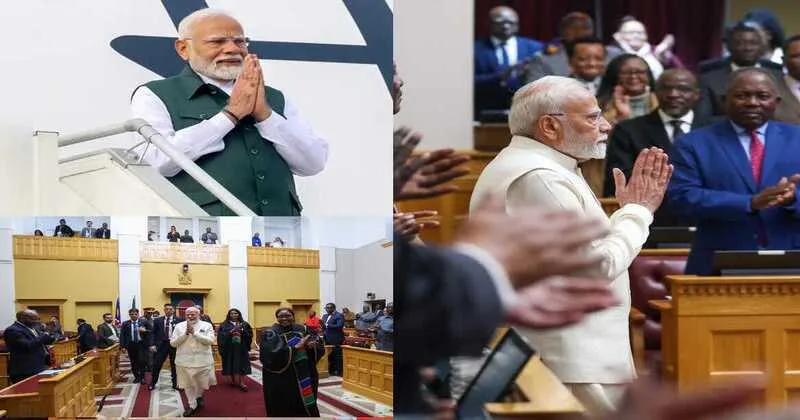
Prime Minister Narendra Modi on Wednesday departed for New Delhi, concluding his first official visit to Namibia, also marking the final leg of his five-nation tour that spanned Ghana, Trinidad & Tobago, Argentina, Brazil, and Namibia. The Ministry of External Affairs described the journey as “a highly productive & successful 5-nation tour,” in a post on X.
This visit marked the third-ever prime ministerial visit from India to Namibia, and during the final day of his trip, Prime Minister Modi addressed a special Joint Session of the Namibian Parliament, a gesture that significantly elevated the stature of his visit.
One of the major highlights of the visit was the announcement that Namibia would adopt India’s Unified Payments Interface (UPI) later this year. This development follows a UPI technology licensing agreement signed in April last year between the National Payments Corporation of India (NPCI) and the Bank of Namibia. Following the bilateral talks between Modi and Namibian President Netumbo Nandi-Ndaitwah, both sides reaffirmed their commitment to expanding cooperation in key sectors and accelerating digital transformation.
President Dr. Netumbo Nandi-Ndaitwah and I reviewed the full range of India-Namibia relations during our talks today. Cooperation in areas such as digital technology, defence, security, agriculture, healthcare, education and critical minerals figured prominently in our… pic.twitter.com/PdpLFc2U29
— Narendra Modi (@narendramodi) July 9, 2025
The discussions between the two leaders covered a broad spectrum of areas, including digital technology, defence, security, agriculture, healthcare, education, and critical minerals. A major outcome of the talks was the signing of four significant agreements, including a Memorandum of Understanding (MoU) on establishing an Entrepreneurship Development Centre in Namibia, and another on collaboration in health and medicine. Additionally, Namibia officially joined two India-backed global initiatives: the Coalition for Disaster Resilient Infrastructure (CDRI) and the Global Biofuels Alliance.
The CDRI aims to strengthen infrastructure resilience against climate-related and natural disasters, bringing together governments, international organisations, and the private sector. Meanwhile, the Global Biofuels Alliance focuses on promoting sustainable biofuel solutions as part of the global clean energy transition.
After the meeting, Prime Minister Modi highlighted the key areas of cooperation in a social media post, stating, “Cooperation in areas such as digital technology, defence, security, agriculture, healthcare, education and critical minerals figured prominently in our discussions.” He also emphasized the importance of boosting linkages in trade, energy, and petrochemicals, and expressed appreciation to Namibia for its support in Project Cheetah.
At the invitation of Saara Kuugongelwa, Speaker of the National Assembly, Prime Minister Modi addressed the Namibian Parliament, making the occasion even more significant. In his address, Modi conveyed greetings from the “Mother of Democracy” and the largest democracy in the world to the Parliament and people of Namibia. He paid tribute to the enduring historical ties between the two countries and remembered Namibia’s founding father, Dr. Sam Nujoma, appreciating the shared struggles and values that bind the two nations.
It was an honour to speak on India-Namibia friendship, our bond with Africa and India’s efforts for global good, during my address to the Namibian Parliament. pic.twitter.com/GQmB6CPDAX
— Narendra Modi (@narendramodi) July 9, 2025
He lauded Namibia’s efforts in deepening democratic practices and praised the nation’s dedication to democratic values and governance. Referring to the honour conferred upon him, Namibia’s highest national award, Prime Minister Modi said it was a tribute not only to him but to the democratic spirit of both nations.
He used the platform to reaffirm India’s solidarity with the Global South, stressing that India and Namibia should work together to amplify the voices and aspirations of developing nations. He recalled India’s G-20 presidency, during which the African Union was inducted as a permanent member, as an example of India’s continued commitment to Africa’s progress.
Highlighting India’s role in sharing its development experience, Modi underlined New Delhi’s commitment to capacity building, skill development, local innovation, and Africa’s long-term vision under Agenda 2063.
As he concluded his address, Prime Minister Modi expressed gratitude to the Speaker for the honour and called for stronger people-to-people ties between India and Namibia. “Let our children not only inherit the freedom we fought for, but also the future we will build together,” he said, ending his historic visit on a note of hope and partnership.











Comments