





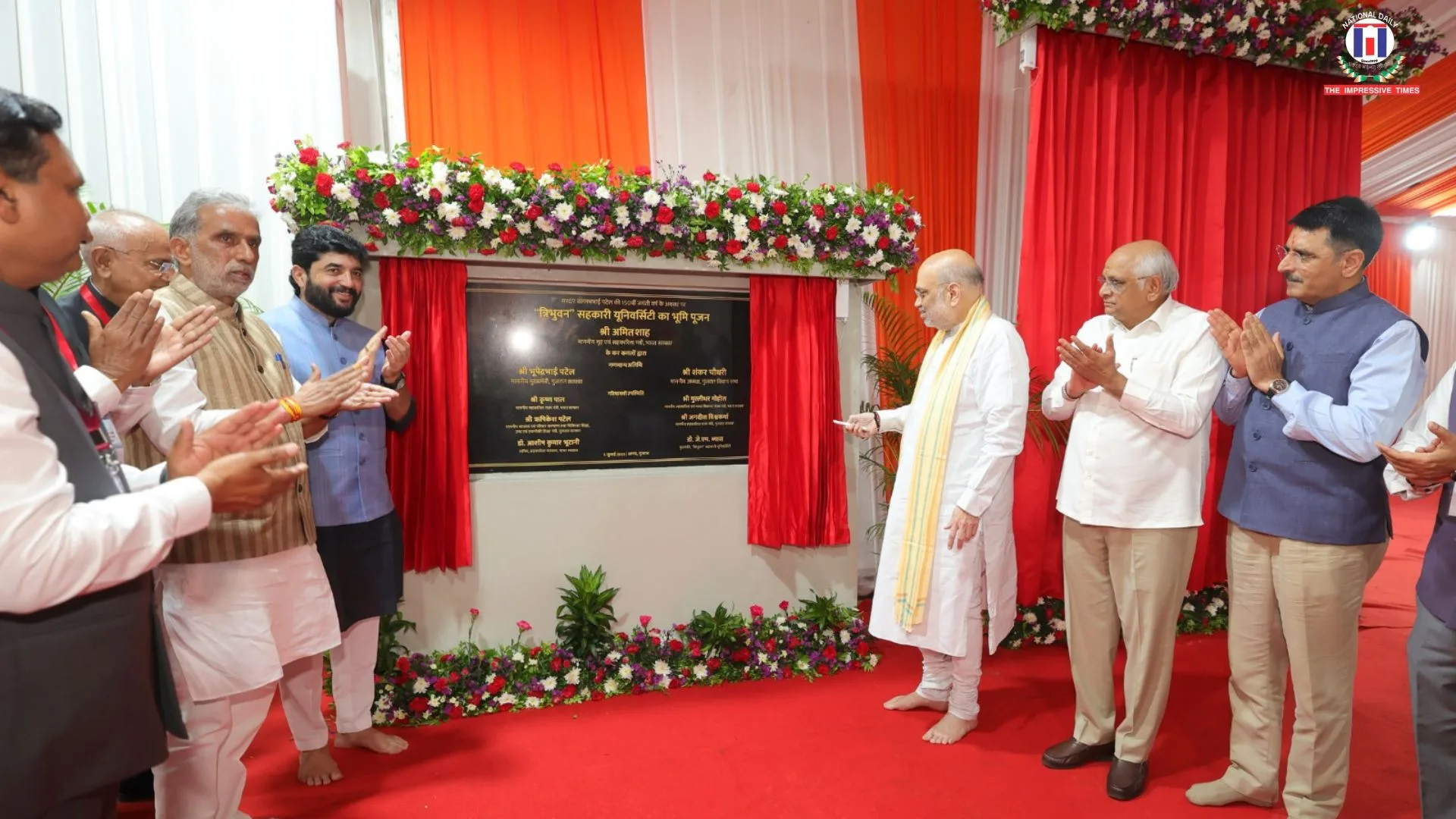
As part of a historic initiative that will remake India’s cooperative sector, Union Home Minister and Minister of Cooperation Shri Amit Shah on July 5 did the Bhoomi Poojan for the nation’s first national cooperative university, Tribhuvan Sahkari University, in Anand, Gujarat. This ambitious project is a major milestone in India’s cooperative movement, and it will be the first effort to address the historic gap in cooperative education, training, research, and innovation.
The university, which takes its name from the mythological founder and cooperative icon of Amul, Tribhuvan Kashibhai Patel, is conceived as a cradle for producing talented professionals, committed cooperative leaders, and policy strategists to fortify the spine of India’s cooperative sector. Spread over 125 acres with an estimated cost of Rs 500 crore, the university will have a pan-India presence, with affiliated institutions and training centres in each state.
A Historic Tribute to a Cooperative Pioneer
Naming the university after Tribhuvan Das Patel, affectionately recalled as the father of India’s dairy cooperative revolution, has deep symbolic significance. Patel’s trailblasing efforts, along with national heroes such as Sardar Vallabhbhai Patel and Verghese Kurien, brought into being Amul, revolutionising India’s dairy sector and paving the way for rural empowerment through cooperative organisations.
Tribhuvan Das Ji planted the seeds of the cooperative revolution on this very soil of Anand. Today, that seed has resulted in a banyan tree that sustains 36 lakh women, operating businesses worth Rs 80,000 crore, all without investing over Rs 100 each,” Shri Amit Shah added, pointing to the extensive reach of Patel’s vision.
He highlighted that the naming of the university after Patel is an appreciation of his tireless struggle against exploitative monopolies such as Polson Dairy and the construction of Amul as a symbol of rural self-sufficiency and prosperity. “This university is a manifestation of his dream of empowering every farmer, every villager, and every marginalised citizen through cooperation,” Shah further stated.
Closing the Education and Training Gap in the Cooperative Sector
Even though the cooperative sector is humongous in size and socio-economic importance, with 30 crore Indians, almost a quarter of the population, linked to cooperatives, formal education and training channels have been lacking. Organisations such as the National Cooperative Development Corporation (NCDC) and National Cooperative Union of India (NCUI) have done their share, but their penetration has been limited owing to the size of the sector.
Tribhuvan Sahkari University aims to fill this lacuna by establishing a strong academic and practice training hub exclusively for the cooperative sector. Upon completion of the construction phase, the university is likely to certify as many as 8 lakh people every year, imparting degree, diploma, and PhD programs on cooperative studies, rural management, and allied disciplines.
“Previously, cooperative workers were trained post-recruitment. Now, only trained and qualified personnel will be added to the cooperative workforce,” Shah said, highlighting the role of the university in bringing transparency, professionalism, and accountability to cooperatives that are traditionally blamed for nepotism and bad governance.
Hub and Spoke Model: Reaching Every Corner of India
The university shall follow a hub and spoke strategy, with its main campus at Anand, Gujarat, located in the Institute of Rural Management Anand (IRMA), and a chain of affiliated institutions throughout the country. IRMA, established by Verghese Kurien in 1979, has played a pivotal role in moulding rural management professionals and co-operative leaders. After the founding of the university, IRMA will be a specialised school of the university and a Centre of Excellence in Rural Management, maintaining its autonomy and identity.
Every state will have cooperative training colleges enrolled as schools or colleges under the university to make quality cooperative education accessible to rural youth across the country. Strong cooperative states like Maharashtra, Gujarat, Kerala, and Karnataka will have four to five affiliated colleges, and other states will have one to two institutions each.
Specialised Schools, Digital Learning, and Global Collaboration
Tribhuvan Sahkari University will consist of sector-specific schools, with specialised programs in key areas including:
· Dairy and Animal Husbandry
· Fisheries and Marine Cooperatives
· Sugar and Agro-based Industries
· Banking and Rural Credit
· Cooperative Finance and Marketing
· Cooperative Laws and Governance
To achieve universality and accessibility, the university will utilise the SWAYAM platform for e-learning and thereby provide digital learning possibilities to students in far-flung and rural areas. In addition, it will aggressively seek partnerships with overseas universities, cooperative institutions, and research centers, promoting knowledge sharing and best global practices.
“The vision is to make India a global hub for cooperative education and thought leadership,” Shah underscored.
Increasing Employment and Economic Empowerment
The university’s launch is in sync with the Union Government’s grander vision of facilitating cooperative-driven economic development, as envisioned under the Ministry of Cooperation, established in July 2021 to achieve the motto “Sahkar se Samriddhi” (Prosperity through Cooperation).
Shah announced that the government has set out to establish PACS to the tune of 2 lakh new PACS, with 60,000 PACS planned to be developed by the end of 2025. Such PACS alone will provide employment opportunities to around 17 lakh people, in addition to improving rural credit availability and financial strength.
Tribhuvan Sahkari University will play a key role in churning out skilled manpower for these PACS, district dairy cooperatives, cooperative banks, and other upcoming sectors like cooperative insurance and transport services.
“We want to introduce cooperative taxis, cooperative insurance companies, and other services. For that, we require trained officers, managers, and cooperative leaders with knowledge of the spirit and technicalities of this movement,” Shah clarified.
Towards Transparent, Accountable, and Research Driven Cooperatives
Indian cooperatives have long been criticised for their lack of transparency, mismanagement, and interference from politics. Realising the same, the government has brought forth several reforms, such as the Multi-State Cooperative Societies (Amendment) Act, 2023, to strengthen governance and accountability.
Tribhuvan Sahkari University will propagate this reform agenda by developing a new breed of cooperative professionals with technical skills, ethical leadership, and a scientific mind. The university will also be a research centre, producing data, policy options, and strategic blueprints for the sector’s sustainable development.
The university will lead cooperative policy-making for the next 5, 10, and 25 years. Not only will it prepare employees but also future cooperative leaders such as Tribhuvan Das Patel, who will be the torchbearers of the spirit of cooperation,” Shah observed.
Global Context: International Year of Cooperatives 2025
The inauguration of India’s first national cooperative university acquires an added importance since the United Nations General Assembly has announced 2025 as the International Year of Cooperatives, and its theme is “Cooperatives Build a Better World.”
The institution of the university goes hand in hand with this global festivity, affirming India’s cooperative-led development and its vision to become a role model for the rest of the world.
Spirit of Cooperation: Rooted in Indian Ethos
Shah beautifully connected the cooperative movement with India’s civilisational culture, condensed in the principles of “Vasudhaiva Kutumbakam” (the world is one family) and “Sarve Bhavantu Sukhinah” (may all be happy). He underlined that cooperation, much more than being an economic paradigm, is the spiritual and cultural legacy of India of cooperation, inclusiveness, and sustainable development.
“Coordination guarantees not only economic well-being but human well-being, animal well-being, and conservation of the environment. It lifts the poor and marginalised to a just and equitable society,” Shah added.
A Roadmap for India as a Global Cooperative Powerhouse
With more than 30 crore members, 40 lakh cooperative employees, and 80 lakh board members, the Indian cooperative sector is already the largest in the world. However, its potential for professionalisation, formalisation, and being competitive internationally is huge.
Tribhuvan Sahkari University will drive this change, not just creating skilled manpower but also innovation, research, and strategic thinking to make India a global cooperative leader.
Shah ended his speech with a call to cooperative professionals, training institutes, and stakeholders across the country to come together with the university and help make this historic mission a success.
“Let us cooperate to make India’s cooperative movement not only a national success but an inspiration for the whole world,” he exhorted.











Comments