



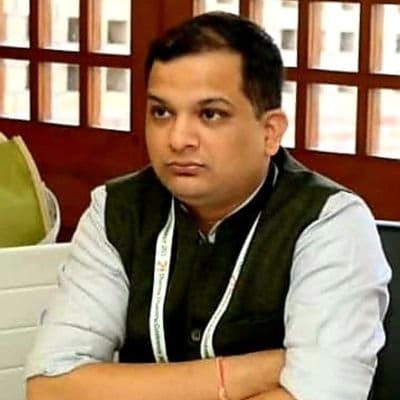

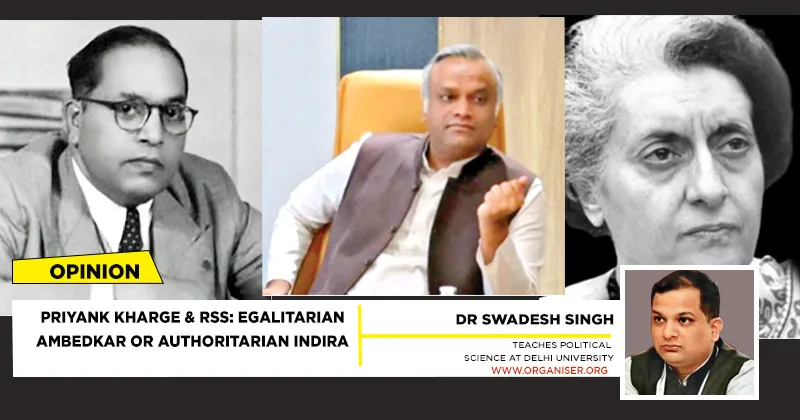
Karnataka Government Minister Priyank Kharge has said that if Congress Party comes to power, he will ban the Rashtriya Swayamsevak Sangh (RSS). One should understand Kharge’s intention behind saying this, from which ideological base he is speaking and what personal benefit he can get by giving this statement.
Congress and its leaders keep making all kinds of allegations against the Bharatiya Janata Party as well as the Sangh. Though the anti-RSS stance of Congress is well known since the time of Pandit Nehru, the Congress led by Sonia Gandhi has taken a hard stand against the Sangh in recent decades. Ever since the BJP Government has come to power under the leadership of Prime Minister Narendra Modi, Congress leader Rahul Gandhi has been seen making all kinds of allegations and calling it a Sangh-BJP Government.
Keeping Mother-Son Duo in Good Humour
In the Congress Party led by mother-son duo, there is a competition among the Congress leaders as to how to gain proximity with Sonia-Rahul by spewing venom against the RSS.
We should also know here that at this time there is a tussle going on in the Karnataka Government for the leadership, which the younger Kharge is probably trying to take advantage of. In the hope of becoming Chief Minister, he has given this statement that he will ban the Sangh. The Congress Party has also not distanced itself from this statement, which means that it should be believed that their high command will also have the same intention.
In the hope of becoming CM, Priyank has given this statement that he will ban the Sangh. Congress hasn’t distanced itself from this statement, which means that that their high command will also have the same intention
The background in which Priyank Kharge has given this statement should also be understood. Rashtriya Swayamsevak Sangh Sarkaryavah Dattatreya Hosabale recently stated in a programme that the words ‘Socialist’ and ‘Secular’ were not there in the original Constitution of India which was implemented on January 26, 1950. During the Emergency, Indira Gandhi’s Government amended the Preamble of the Constitution and added these words, so there should be a debate on these terminologies. Here it is important to understand that if scholars and nation builders like Babasaheb Ambedkar, Pandit Nehru, Sardar Patel, Rajendra Prasad and many others did not add these words after about three years of contemplation, then why were these words inserted in a hurry during the Emergency in the absence of any kind of opposition.
What was the intention behind this, what did we gain from this – should there not be a debate on all these aspects? Why shouldn’t there be a discussion to tell the coming generation so that such a thing does not happen again? But when someone brings the issue to the discussion table, leaders like Priyank Kharge are threatening a ban. Opposition leaders doing this for their momentary gains weakens our democracy. It is also worth noticing that this statement of younger Kharge has not been criticised by any scholar or activist who keeps on pleading for Freedom of Expression and cries about the ‘undeclared emergency’ in the country.
Diverting Attention from Excesses Committed During Emergency
By the way, Priyank Kharge and other Congress leaders might remember that whenever the Sangh has been banned, it has emerged as an even stronger organisation and ideology. First Pandit Nehru banned the Sangh in 1948 after Gandhi’s assassination, then Indira Gandhi banned it in 1975 during the Emergency and in 1992 Narasimha Rao banned the Sangh without any proof or investigation after the disputed Babri structure fell. Later, when the ban was gradually lifted, we got to see the bigger form of the Sangh Parivar.
Finally, when Priyank Kharge is talking about banning RSS – amidst inhuman atrocities during the Emergency, in the absence of opposition, for politics of appeasement and to please their masters sitting abroad – he should also decide whether he would like to stand with the Constitution and ideas of egalitarian Babasaheb Ambedkar or with the ideas of authoritarian Indira Gandhi. He should decide his role and the public will decide about him in the times to come.












Comments