





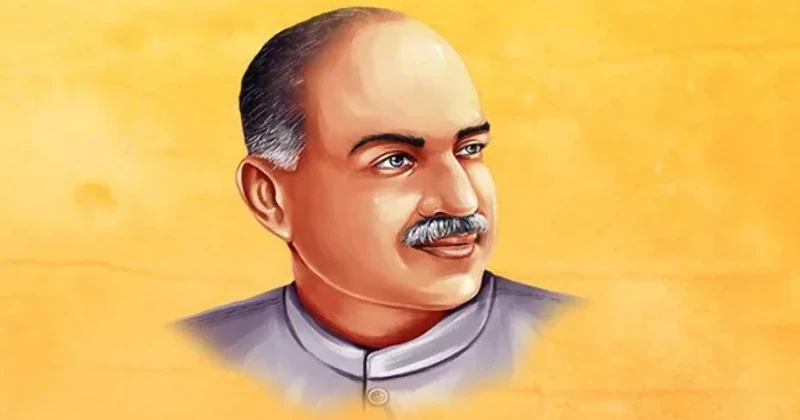
Dr Syama Prasad Mukherjee was born on July 6 1901, in Calcutta (now Kolkata), into the family of Sir Ashutosh Mukherjee and Mrs Jogmaya Devi. He was the second of seven children of his parents. Endowed with a sharp intellect and great erudition, Dr. Mukherjee pursued higher studies with excellence. Following his academic achievements, he became the youngest Vice-Chancellor of the University of Calcutta, and he served in that capacity twice.
Dr. Syama Prasad Mukherjee, while serving as Vice-Chancellor of the University of Calcutta, implemented numerous pioneering reforms in the field of education. At the time, Bharat was under British rule, and he endeavoured to restore dignity and self-pride in education. He replaced the colonial emblem of the university by redesigning it, thus removing the symbol of English subjugation and featuring a fully bloomed lotus with the auspicious symbol “Śrī” at its centre, a representation of Indian culture.
During that time, university convocation ceremonies were conducted in English. In 1937, during his tenure, he invited Gurudev Rabindranath Tagore to deliver the convocation address. For the first time at the University of Calcutta, Tagore delivered it in Bengali, seeding a new tradition. Promoting women’s education, crafting educational opportunities for Bhartiya scholars and intellectuals, and integrating Bhartiya Culture with the academic curriculum are some of the initiatives taken by Dr. Mukherjee in the field of education.
In 1929, Dr. Syama Prasad Mukherjee was elected to the Bengal Legislative Council from the University of Calcutta constituency. To protest against the oppression of Hindus by the erstwhile coalition government of the Muslim League and Krishak Praja Party in Bengal, Dr. Mukherjee entered politics. Later, Dr. Mukherjee joined the Hindu Mahasabha, eventually becoming its national President.
During that time, Bengal’s Chief Minister, Dr. Huseyn Shaheed Suhrawardy, was advocating for a “United Bengal” on the grounds of language. His plan aimed to prevent the partition of Bengal, proposing that the entire province join Pakistan. Some Congress leaders, unaware of the proposal’s implications, supported it. Dr. Syama Prasad Mukherjee recognised this nefarious design and firmly stated: “We will neither live in Pakistan, nor in a united Bengal. We are part of Bharat—and we will stay with Bharat.” He launched a vigorous political campaign against the scheme. Through letters and dialogues with Congress leaders and Lord Mountbatten, he successfully argued that if Punjab could be partitioned, why not Bengal? Today, we can take pride in knowing that without Dr. Mukherjee, Bengal might not have become part of Bharat. This realisation gains even more significance when compared with current events in Bangladesh, where Hindu communities, their revered goddess Kali, and their temples face insecurity, and statues of Gurudev Rabindranath Tagore—the author of the national anthem—are being desecrated.
Those who refuse to recognise their ancestors like Bangabandhu Mujibur Rahman will never safeguard the Hindu community. Dr. Mukherjee foresaw all this. Had Bengal not remained with Bharat, Bharat’s northeast would also have been lost. Today, we understand the strategic importance of the Chicken Neck that connects Northeast India with the rest, as well as the economic significance of the Bay of Bengal and the city of Kolkata. These are some realities that Dr. Mukherjee anticipated by keeping Bengal in the Bharatiya fold. However, this very crisis now reemerges before us in Bengal.
Dr. Syama Prasad Mukherjee served as the Minister for Industry in Prime Minister Jawaharlal Nehru’s government. He was deeply distressed by the forced conversions and atrocities against Hindus living in Pakistan during Bharat’s partition, and by the neglect of Hindu refugees who sought shelter in Bharat. In protest against the Liaquat–Nehru Pact—which he viewed as a biased agreement, while failing to address the refugee crisis—he resigned from the Nehru cabinet on April 06, 1950 and moved to Calcutta, dedicating himself to the service of Hindu refugee communities who had arrived from East Pakistan and other regions.
While serving as Industry Minister in 1948, Dr. Syama Prasad Mukherjee formulated Bharat’s national industrial policy. To channel industrial finance, he established the Industrial Finance Corporation of India (IFCI) in 1948. He introduced an industrial policy guided by the principle of Aatmanirbharta (Self-Reliance). Defence, Nuclear Energy, Railways, and Civil Aviation are the focus areas of his industrial plan. He was instrumental in setting up several major industrial projects that continue to serve the nation today, including Chittaranjan Locomotive Works, Hindustan Aircraft Factory (now Hindustan Aeronautics Limited, HAL), Sindri Fertiliser Plant, Dhanbad projects, Damodar Valley Corporation, Hirakud Dam, and Bhilai Steel Plant.
Dr. Syama Prasad Mukherjee was not just a politician, but a compassionate, service-oriented leader. In 1943, Bengal was ravaged by a devastating famine, with an estimated death toll of nearly thirty lakh people. It was not merely a natural disaster, but rather driven by the failures of British rule. Government relief efforts were slow, mismanaged, and often discriminatory, leaving the common people to rely on divine fate. Dr. Mukherjee strongly condemned both the British government and Bengal’s chief minister for their failed policies. He led relief operations, gathering aid from the community and directing sustained service efforts. So immersed was he in the relief work that he could not even attend his daughter’s wedding ceremony—specifically, the ritual of “sampradan” (a ritual usually performed by the father of the bride)—because he was actively serving famine victims.
After Independence, Dr. Syama Prasad Mukherjee founded the Bharatiya Jana Sangh to uphold nationalist ideals and defend democracy. At its inception, he declared, “We need a nationalist alternative to the Congress.” During the first Parliament, he led a United Front, known as the National Democratic Party (N.D.P.), in opposition to Prime Minister Nehru’s authoritarian tendencies. This coalition comprised 34 Lok Sabha MPs and 20 Rajya Sabha MPs. In response, Nehru reportedly remarked, “I will crush the Jan Sangh.” Dr Mukherjee firmly retorted to Nehru by stating, “I will crush this crushing mentality.” This exchange powerfully reflects his unwavering faith in democracy and moral courage.
Dr. Syama Prasad Mukherjee served as the President of the Maha Bodhi Society from 1942 until he died in 1953. He played a leading role in the 1952 International Buddhist Conference, overseeing the enshrinement of sacred relics of Sariputra and Mahamoggallana at Sanchi—an event marking a major restoration of Buddhist heritage in Bharat. He also travelled extensively in Myanmar (Burma), Vietnam, and Thailand, promoting Buddhist culture. A firm proponent of national unity, Dr. Mukherjee ideologically rejected the idea of Article 370 and the concept of multiple flags, heads of state, or constitutions within a single country. He championed the mantra: “Ek desh mein do nishan, do pradhan, do vidhan nahi chalenge.”
On June 23, 1953, he made the ultimate sacrifice for this vision, passing away during his protest in Jammu & Kashmir—a cause he died defending. Today, as we fulfil his resolution, the nation pays a humble tribute to this unwavering guardian of national unity and cultural heritage.
















Comments