Yamuna Cleanliness Drive: Sanatan Wisdom of sustainability
December 5, 2025
  • Read Ecopy
  • Circulation
  • Advertise
  • Careers
  • About Us
  • Contact Us
Android AppiPhone AppArattai
Organiser
  • ‌
  • Bharat
    • Assam
    • Bihar
    • Chhattisgarh
    • Jharkhand
    • Maharashtra
    • View All States
  • World
    • Asia
    • Europe
    • North America
    • South America
    • Africa
    • Australia
  • Editorial
  • International
  • Opinion
  • RSS @ 100
  • More
    • Op Sindoor
    • Analysis
    • Sports
    • Defence
    • Politics
    • Business
    • Economy
    • Culture
    • Special Report
    • Sci & Tech
    • Entertainment
    • G20
    • Azadi Ka Amrit Mahotsav
    • Vocal4Local
    • Web Stories
    • Education
    • Employment
    • Books
    • Interviews
    • Travel
    • Law
    • Health
    • Obituary
  • Subscribe
    • Subscribe Print Edition
    • Subscribe Ecopy
    • Read Ecopy
  • ‌
  • Bharat
    • Assam
    • Bihar
    • Chhattisgarh
    • Jharkhand
    • Maharashtra
    • View All States
  • World
    • Asia
    • Europe
    • North America
    • South America
    • Africa
    • Australia
  • Editorial
  • International
  • Opinion
  • RSS @ 100
  • More
    • Op Sindoor
    • Analysis
    • Sports
    • Defence
    • Politics
    • Business
    • Economy
    • Culture
    • Special Report
    • Sci & Tech
    • Entertainment
    • G20
    • Azadi Ka Amrit Mahotsav
    • Vocal4Local
    • Web Stories
    • Education
    • Employment
    • Books
    • Interviews
    • Travel
    • Law
    • Health
    • Obituary
  • Subscribe
    • Subscribe Print Edition
    • Subscribe Ecopy
    • Read Ecopy
Organiser
  • Home
  • Bharat
  • World
  • Operation Sindoor
  • Editorial
  • Analysis
  • Opinion
  • Culture
  • Defence
  • International Edition
  • RSS @ 100
  • Magazine
  • Read Ecopy
Home Bharat

Yamuna Cleanliness Drive: Sanatan Wisdom of sustainability

As the largest consumers of the world give lectures on the dangers of global warming, the world needs to look up to the Sanatan way of nature conservation and maintaining ecological balance — a Bharatiya civilisation that has forever revered, nourished, and protected the natural resources, thinking of the good of all humankind.

Paryavaran Sanrakshan Gatividhi TeamParyavaran Sanrakshan Gatividhi Team
Jul 1, 2025, 10:00 pm IST
in Bharat, Special Report
Follow on Google News
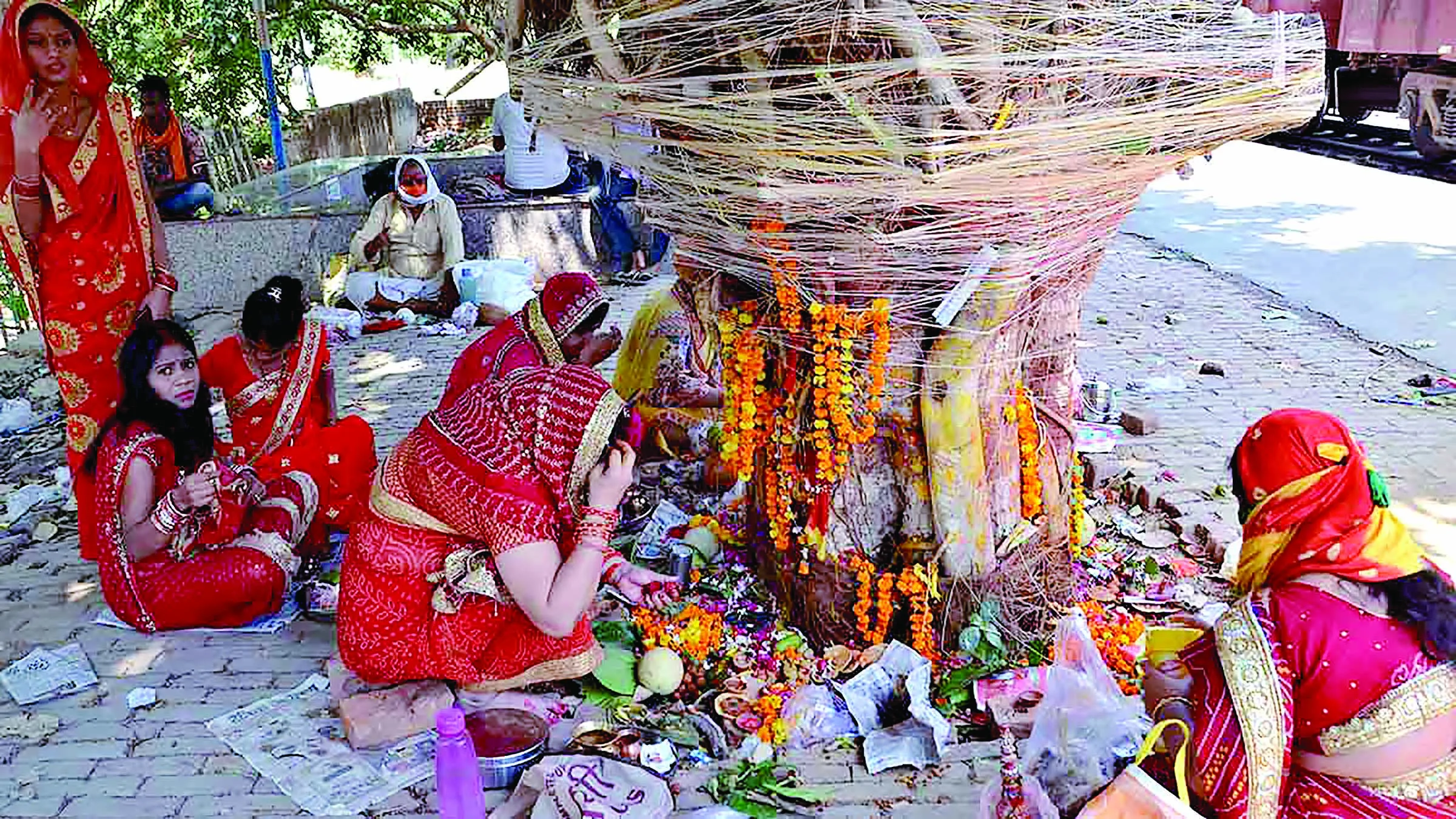
Sanatan believes life cannot exist without trees, so they express gratitude by worshipping them. In Sanatan traditions trees represent the unification of Trinity (Brahma, Vishnu, and Shiva)

Sanatan believes life cannot exist without trees, so they express gratitude by worshipping them. In Sanatan traditions trees represent the unification of Trinity (Brahma, Vishnu, and Shiva)

FacebookTwitterWhatsAppTelegramEmail

Bharat is the seventh-largest country in the world, with a total geographical area of 3,287,263 square kilometers. Despite comprising only 2.4 per cent of the world’s total area, Bharat is home to over eight per cent of the world’s biodiversity. With its four global biodiversity hotspots, Bharat ranks among the top 100 mega-diverse countries in the world. The nation’s vast range of geological and climatic conditions has given rise to a variety of forests, grasslands, wetlands, deserts, mountainous, and marine ecosystems spread across ten bio-geographic zones. These ecosystems nurture more than 91,200 animal species and 45,500 plant species, including many endemic species that are found nowhere else in the world. Moreover, Bharat is also home to several charismatic and iconic  species, including 70 per cent of the world’s tigers, as well as a significant population of Asian elephants and one-horned rhinoceroses.

Cow worship is part of Sanatan, her dung enriches soil, and produces biogas, a clean fuel that protects nature and reduces pollution

Today, most of the country’s biodiversity is protected under a network of 769 protected areas, covering about 162,072 square kilometers, which is less than five per cent of Bharat’s total geographical area. Approximately 70 per cent of Bharat’s population lives in rural areas, and most of them depend on biodiversity-based livelihoods. Around 400 million people reside in approximately 1,73,000 villages located near forests. Due to widespread poverty and lack of alternative income sources, their dependence on forest resources is extremely high. In spite of this extensive dependence on natural resources, the pressures of a growing population, and economic development, if Bharat’s biodiversity is still preserved today, the credit goes to Bharat’s Sanatan practices and beliefs that place high value on the protection and coexistence with nature and wildlife.

Oneness With Nature: Integral To Bharatiyata

Living in harmony with nature has been an integral part of Bharatiya Samskriti. It is abundantly reflected in the traditional practices, religious beliefs, rituals, folklore, arts and crafts, and the everyday lives of Bharatiya people. While conservation and sustainable use of natural resources is a relatively new concept in the modern and western world, Bharat has a long-standing tradition and cultural ethos of nature conservation.

This culture of preservation dates back to the Sanatan Vedic period. All four Vedas—Rigveda, Samaveda, Yajurveda, and Atharvaveda—are filled with hymns that highlight the supremacy of nature. The Rigveda mentions the Sun, Moon, wind, rain, rivers, trees, and mountains as deities, seen as sources of health, wealth, and prosperity. Similarly, the Atharvaveda highlights the importance of nature and contains several hymns in praise of the Earth.

With remarkable foresight, the Tirukkural, an ancient Tamil poetic work, emphasises the need to live in harmony with nature, describing how “shimmering waters, open spaces, hills, and forests form a fortress for human protection.” Likewise, the Sikh community’s principal scripture mentions, “Air is the Guru, Water the Father, and Earth the Great Mother of all.”

Sanatan Bharatiya sects also advocate for nature conservation. Buddhism believes in tolerance, love, compassion, forgiveness, and non-violence toward all beings. Jainism adopts the path of absolute non-violence, prohibiting the killing of any living creature on Earth.

Significance of Trees

Trees have been revered in Bharatiya sanskriti because they are essential not only for humans but also for the existence of animals, birds, insects, and micro-organisms. All four Vedas extensively describe various trees, herbs, fruits, flowers, and their significance. Trees and plants are regarded as living beings, and harming them is prohibited Sanatan Dharma. Many tree species such as Peepal, Goolar, Neem, Bel, Banyan, Ashoka, and Amla hold special places in our sanskriti and traditions.

In Buddhism, Sal and Peepal trees hold significant importance. It is believed that Bhagwan Buddha was born and attained Parinirvana under Sal trees and achieved enlightenment under the Peepal tree in Bodh Gaya. In Jain tradition, sacred trees are associated in various forms with Tirthankaras: Banyan with Rishabhdev, Sal with Sambhavanath and Mahavir etc. Ber trees are revered in Sikhism because Guru Nanak Dev Ji planted a Ber tree near the Bein River in Sultanpur Lodhi, and Guru Gobind Singh once stayed under a Ber tree in a village named Seelona in Ludhiana district. Both sites have now been converted into places of worship. Just as Bharatiya flora is closely tied to Sanatan beliefs and traditions, so too are various animals and wildlife. Our Sanatan traditions accord space and respect to wild and domestic animals. Many animals like tigers, elephants, bulls, horses, peacocks, swans, owls, vultures, rats, etc. are considered sacred and worshipped by Hindus.

Hindus Perceive divinity in all living beings, which is why animal deities occupy an Important place in Sanatan Dharma

In the present scenario, rapid economic development has significantly impacted the environment. While on one hand, economic progress has encouraged consumerism and exerted immense pressure on natural resources, on the other, environmental imbalance has increasingly marginalised sections of society that are largely dependent on these natural resources. Their lives and livelihoods today face a serious threat. In such circumstances, it becomes crucial to secure access to basic human needs like food, water, air, and other natural resources.

Today, as awareness grows in modern societies to address emerging environmental and ecological challenges, many countries around the world are formulating policies for environmental protection. While these policies often lean on modern science, they are directly or indirectly rooted in traditional knowledge systems developed in Sanatan times, which teach the values of simple living. Presently, it is imperative that we follow the principles of our ancestors, who perhaps had a better understanding of the environment than we do. Bharatiya traditions, customs, and religious beliefs teach us about the conservation of flora and fauna. They help us understand the basic ecological principle that every living entity in the biosphere plays a vital role in the cycle of energy and nutrients, thereby sustaining the continuity of life on Earth.


 

Topics: bharatiya sanskritiBhagwan BuddhaSanatan Vedic periodYamuna Cleanliness
ShareTweetSendShareSend
✮ Subscribe Organiser YouTube Channel. ✮
✮ Join Organiser's WhatsApp channel for Nationalist views beyond the news. ✮
Previous News

BJP Tamil Nadu president writes to NHRC seeking probe into custodial death of temple security staff Ajith Kumar

Next News

Kerala: Ex-PFI cadres find safe haven in Left Parties; CPI worker jailed in murder case, probe reveals terror links

Related News

Representative image

Indubitably, Sanskrit language is one of the wonders of the world

Piprahwa Relics, scared remains of Bhagwan Buddha

Piprahwa relics of Bhagwan Buddha repatriated to India by UK after 127 years following auction controversy

PM Narendra Modi

“Reverence and affability”: PM Modi highlights India’s initiative to share sacred relics of Bhagwan Buddha with Vietnam

Buddha relics return to Bharat after Vietnam pilgrimage: 17.8 million devotees pay homage

Shrimad Bhagavad Gita & Bharat Muni’s Natyashastra are now inscribed in UNESCO’s Memory of the World Register

Bhagavad Gita, Natyashastra inscribed in UNESCO’s Memory of World Register; PM Modi calls it a “Proud moment”

ASI discovers Buddhist Site at Ratnagiri

ASI unearths priceless relics at Ratnagiri including monolithic structure of elephant & colossal head of Buddha 

Load More

Comments

The comments posted here/below/in the given space are not on behalf of Organiser. The person posting the comment will be in sole ownership of its responsibility. According to the central government's IT rules, obscene or offensive statement made against a person, religion, community or nation is a punishable offense, and legal action would be taken against people who indulge in such activities.

Latest News

PM Modi presents Putin with Bhagavad Gita, chess set, and silver horse

Cultural ties strengthened: PM Modi presents Putin with Bhagavad Gita, chess set, and silver horse

Image for representational purpose only, Courtesy Vocal Media

Bihar to get ‘Special Economic Zones’ in Buxar and West Champaran

Thirupparankundram Karthigai Deepam utsav

Andhra Pradesh: AP Dy CM Pawan Kalyan reacts to Thirupparankundram row, flags concern over religious rights of Hindus

23rd India-Russia Annual Summit

India-Russia Summit heralds new chapter in time-tested ties: Inks MoUs in economic, defence, tourism & education

DGCA orders probe into IndiGo flight disruptions; Committee to report in 15 days

BJYM leader Shyamraj with Janaki

Kerala: Widow of BJP worker murdered in 1995 steps into electoral battle after three decades at Valancherry

Russian Sber bank has unveiled access to its retail investors to the Indian stock market by etching its mutual fund to Nifty50

Scripting economic bonhomie: Russian investors gain access to Indian stocks, Sber unveils Nifty50 pegged mutual funds

Petitioner S Vignesh Shishir speaking to the reporters about the Rahul Gandhi UK citizenship case outside the Raebareli court

Rahul Gandhi UK Citizenship Case: Congress supporters create ruckus in court; Foreign visit details shared with judge

(L) Kerala High Court (R) Bouncers in Trippoonithura temple

Kerala: HC slams CPM-controlled Kochi Devaswom Board for deploying bouncers for crowd management during festival

Fact Check: Rahul Gandhi false claim about govt blocking his meet with Russian President Putin exposed; MEA clears air

Load More
  • Privacy
  • Terms
  • Cookie Policy
  • Refund and Cancellation
  • Delivery and Shipping

© Bharat Prakashan (Delhi) Limited.
Tech-enabled by Ananthapuri Technologies

  • Home
  • Search Organiser
  • Bharat
    • Assam
    • Bihar
    • Chhattisgarh
    • Jharkhand
    • Maharashtra
    • View All States
  • World
    • Asia
    • Africa
    • North America
    • South America
    • Europe
    • Australia
  • Editorial
  • Operation Sindoor
  • Opinion
  • Analysis
  • Defence
  • Culture
  • Sports
  • Business
  • RSS @ 100
  • Entertainment
  • More ..
    • Sci & Tech
    • Vocal4Local
    • Special Report
    • Education
    • Employment
    • Books
    • Interviews
    • Travel
    • Health
    • Politics
    • Law
    • Economy
    • Obituary
  • Subscribe Magazine
  • Read Ecopy
  • Advertise
  • Circulation
  • Careers
  • About Us
  • Contact Us
  • Policies & Terms
    • Privacy Policy
    • Cookie Policy
    • Refund and Cancellation
    • Terms of Use

© Bharat Prakashan (Delhi) Limited.
Tech-enabled by Ananthapuri Technologies