





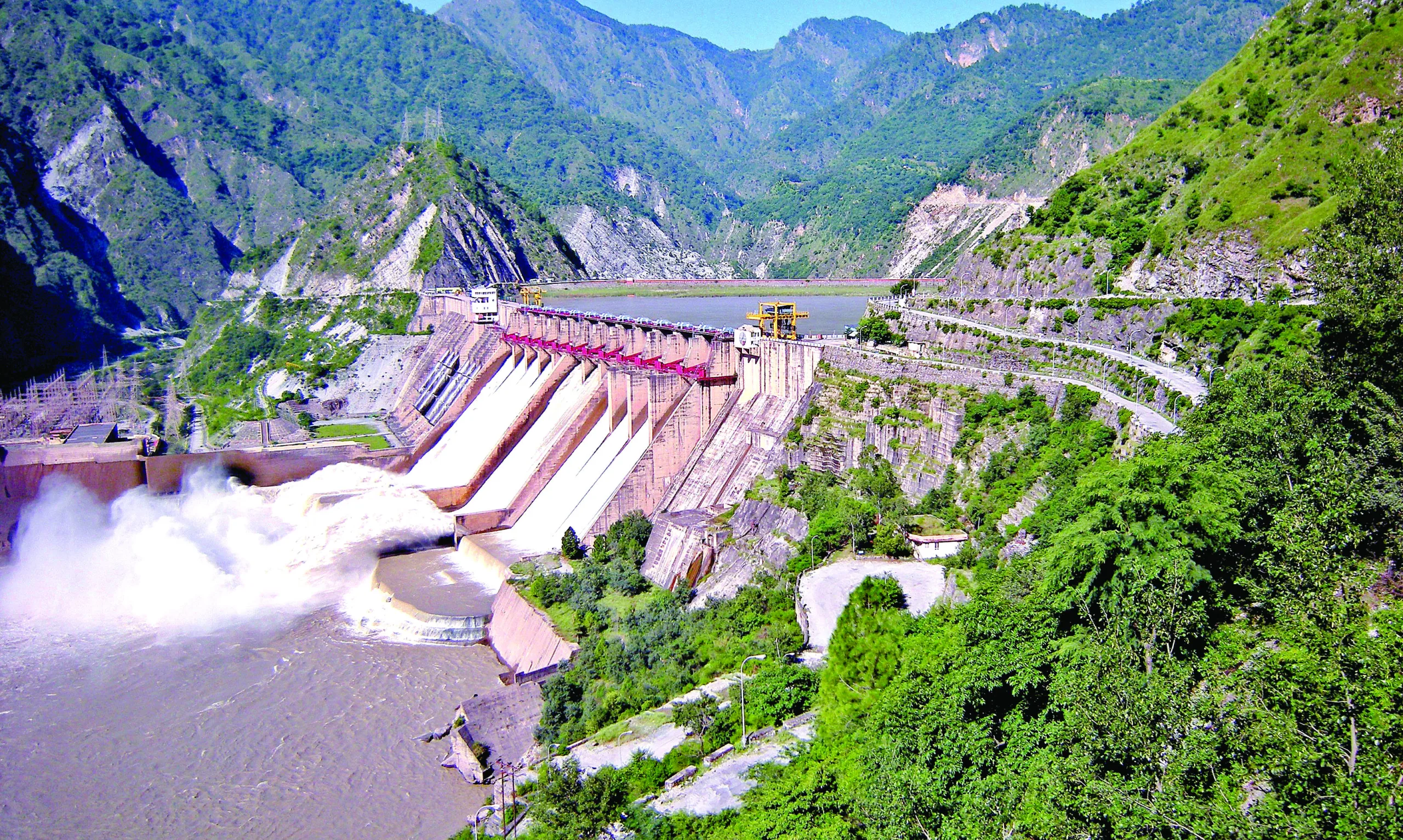
Pakistan has caused us immense harm by objecting to every single hydropower project that we have tried to construct after the Indus Waters Treaty (IWT) was signed on September 19, 1960. A lot has changed in the last 65 years since then, be it the demography, climate or dam building technologies.
What has, however, not changed is Pakistan’s habit of inflicting losses on Bharat by raising objections to its hydropower projects. Be they of 1 MW, 100 MW or 1,000 MW capacity, on any of the Western Rivers.
Cannot Tolerate Valley’s Prosperity
By objecting to projects, Pakistan meddles with their timelines. Thus, it has inflicted cost escalations on Bharat right from the beginning. Be it Salal on the Chenab in Reasi, or Baglihar in Ramban, or Kishenganga in Gurez, or Chutak in Kargil, or more recently on 850 MW Ratle project in Kishtwar,
Pakistan has been consistent and gets full marks for never failing in this task! We will discuss these projects one by one briefly here but start with the most recent case first.
With IWT in coma, the commas, if not full stops that Pakistan forces on all Indian projects, should be dispensed with
Discussing the fate of the Ratle project, now underway, is perhaps a good way of trying to understand the huge costs Pakistan inflicts on India by its behaviour. On May 29, 2013, then Prime Minister Manmohan Singh inaugurated this project as he travelled to Kishtwar accompanied to Chief Minister Omar Abdullah, UPA chairperson Sonia Gandhi, Governor NN Vohra and others. It was set to be completed within five years, or by the end of 2018.
What happened next was what Pakistan has always done to Bharat’s hydropower projects on any of the Western Rivers. It objected. This resulted in the private company that was involved in its construction abandoning it after executing some works. The project remained in a coma till it got revived during stewardship of the Union Territory (UT) of Jammu & Kashmir under Lieutenant Governor Manoj Sinha.
Presently, it is a work in progress and we are not sure about its completion date due to a host of factors, the most crucial being Pakistan’s objections, once again, as in the past. Pakistan had raised objections after its revival again and in June 2024, a team led by Neutral Expert Michel Lino had visited it. So far, India has suffered a loss of at least 5,100 MW (850×6) because of non-completion of this project alone during the last six years (from 2019 to 2024). What a colossal waste!
Pak’s Blackmailing Tactics Exposed
Earlier, Bharat faced impediments created by Pakistan when it undertook the construction of Salal hydropower project. This was the first project taken up in 1970 or thereabout on the Chenab.
Pakistan’s objections led to a situation whereby the Indian Government thought it more prudent to give in to its blackmailing tactics and complete the project. Instead of holding forth and getting entangled in long drawn legal proceedings at different levels.
In April 1978, Bharat suffered a loss of crores of rupees in lost generation capacity and silting of the reservoir. As a result, the Government shut its sluice gates permanently by filling concrete in them. The Government should consider reopening them, if technically feasible, and also clear sedimentation in its reservoir by whatever means possible. Now that the constraints Bharat observed due to IWT, which was the basis for conceding Pakistan’s irrational demands, is out of the way as it is in abeyance.
A couple of decades after the Salal fiasco that India had to endure, Pakistan raised objections to the Baglihar project being planned on the Chenab. Neutral Expert Raymond Lafitte gave its determinations on the project after hearing both sides. He said that sound, economic design of a dam was criteria that should be accepted unreservedly as unsound design may impact the costs of electricity for ordinary people, besides affecting the dam’s life.
Pakistan’s objections to Baglihar dam designs have undoubtedly harmed it, though not as much as they did in case of Salal. Periodic sediment cleaning of its reservoir and other required measures to improve its functioning should be a priority for the Central Government now. Maybe some of the steps being discussed here are already on, or likely to be initiated at a suitable time of its choosing.
With IWT in coma, the commas, if not full stops that Pakistan forces on all Indian projects, should be dispensed with. It bears mention here that Gurez remains one of the farthest and remotest areas of Kashmir Valley and it was here that Kishenganga Hydro Electric Project (KHEP) was planned. However, true to its record of the past, Pakistan objected to it as a prosperous Kashmir is not what it wants, or will ever even condescend to. The Kishenganga hydropower project went before the Court of Arbitration (CoA) which passed a partial verdict in 2013. In 2018, seven years ago in May, Prime Minister Narendra Modi inaugurated the KHEP.
Projects like Sawalakote, Kirthai and Miyar (in Himachal Pradesh) need to be now taken up on priority, rather top priority
Incorrigible foe that it acts as, to try to thwart and drag down India all the time, Pakistan has now again raised some objections to the KHEP. It simultaneously started the process of hearings before a Neutral Expert (NE) as also the Court of Arbitratiton (CoA). This simultaneous start of two parallel processes has been interpreted as a breakdown of the Treaty by India. It has rightly asked whose views will prevail in case the NE and CoA reach different conclusions in one or both cases (in Ratle power project and Kishenganga project).
Keeping the Treaty affords India an opportunity to do sediment clearing of the Kishenganga project. It is not clear if some steps have already been initiated to do so.
Fillip to Other Projects
Besides the projects mentioned above, India operates the Lower Jhelum Hydroelectric Project and Uri-I Hydroelectric Project also, both located on the Jhelum in Kashmir. It is also planning some more projects on the Jhelum to augment power generation further. However, Pakistan has in the past raised objections to these projects.
With Treaty restrictions out of the way, so long as it is kept in abeyance, India should both fast-track its planned projects and do what it deems fit for the efficient management of these projects.
It bears mention here that the Treaty allows storage of 3.6 MAF of water on the Western Rivers. In the last 65 years, however, only a capacity of 0.7 MAF has been created on Salal and Baglihar.
Pakkal-Dul) project of 1,000 MW capacity, presently under construction in Kishtwar, will build a storage capacity of 0.1 MAF, aggregating a total of only 0.8 MAF on the Chenab.
Some other projects like Sawalakote, Kirthai and Miyar (in Himachal Pradesh) need to be now taken up on priority, rather top priority, basis, setting aside and brushing away Pakistan’s possible objections into the dustbin.
Treaty Modification
Article XII of the Treaty is titled “Final Provisions’’ and has four clauses numbered 1, 2, 3 and 4. It is barely of 130 words and can be assessed easily on the Net now. Under Article XII (3) is defined the process for modification of the Treaty and it reads (3) The provisions of this Treaty may from time to time be modified by a duly ratified treaty concluded for that purpose between the two Governments.
The next sentence in this article says (4) The provisions of this Treaty, or, the provisions of this Treaty as modified under the provisions of Paragraph (3), shall continue in force until terminated by a duly ratified treaty concluded for that purpose between the two Governments.
Since the Treaty is in abeyance presently, India does not need to even consider entering into negotiations with Pakistan right now. It can just maintain a steady stance on this and follow Pakistan’s example which shows the way, in a way. The ball is now firmly in Pakistan’s court and it has to make the move, whenever it deems fit. Long before putting IWT in abeyance, unilaterally, India had served a notice under Article XII (3) on Pakistan for the first time on January 25, 2023. At that time, over two years and four months ago, India had urged Pakistan to respond within 90 days and join the negotiations for reviewing the Treaty. Pakistan had disdainfully sidestepped and ignored this notice.
On August 30, 2024, India had given another notice under Article XII (3) asking it for modification of the Treaty. On September 19, Pakistan Foreign Office (FO) spokesperson Mumtaz Zahra Baloch had suggested that India talk to Pakistan under the aegis of Permanent Indus Commission (PIC), ignoring notice under Article XII (3) again.
Incidentally, PIC is step 1 of the dispute redressal mechanism as defined in Article VIII of the Treaty while as under Article IX are given the processes for settlement of Differences and Disputes. Article IX is about appointment of Neutral Expert (NE) and the Court of Arbitration (CoA).
The time to invoke Article VIII is long gone and it is only under the “Final Provisions’’ (Article XII) that something may happen now. The original IWT, of 1960, seems to have died an unnatural death due to countless terror attacks engineered by Pakistan against India. As a responsible upper riparian, India may not be averse of IWT 2.0, updating it in the process.
For that to happen, Pakistan will need to approach India with a new negotiating team aimed at reviewing the Treaty. The original Treaty had taken nine years of tortuous negotiations to reach fruition. How long will IWT 2.0 take, if at all it comes about, is anybody’s guess!
In nations with royals as titular heads, it is a fairly well understood slogan. The King is dead! Long live the King! This fits in well with the condition of IWT too.
















Comments