





The Indian Institutes of Technology (IITs), long revered as India’s premier institutions for science, technology, engineering, and mathematics (STEM), have been synonymous with innovation and academic rigour. Established to propel India’s technological advancement, these institutes have produced engineers, scientists, and entrepreneurs who have shaped the nation’s progress and earned global acclaim.
However, beneath this legacy of excellence, a troubling transformation is unfolding. The humanities and social sciences departments, introduced to provide a well-rounded education, are increasingly becoming platforms for ideological activism, often at odds with India’s cultural ethos and national interests.
A recent viral thread on X has brought these concerns into sharp focus, exposing a growing trend of political indoctrination within these taxpayer-funded institutions.
Anupam Guha’s Controversial Stance
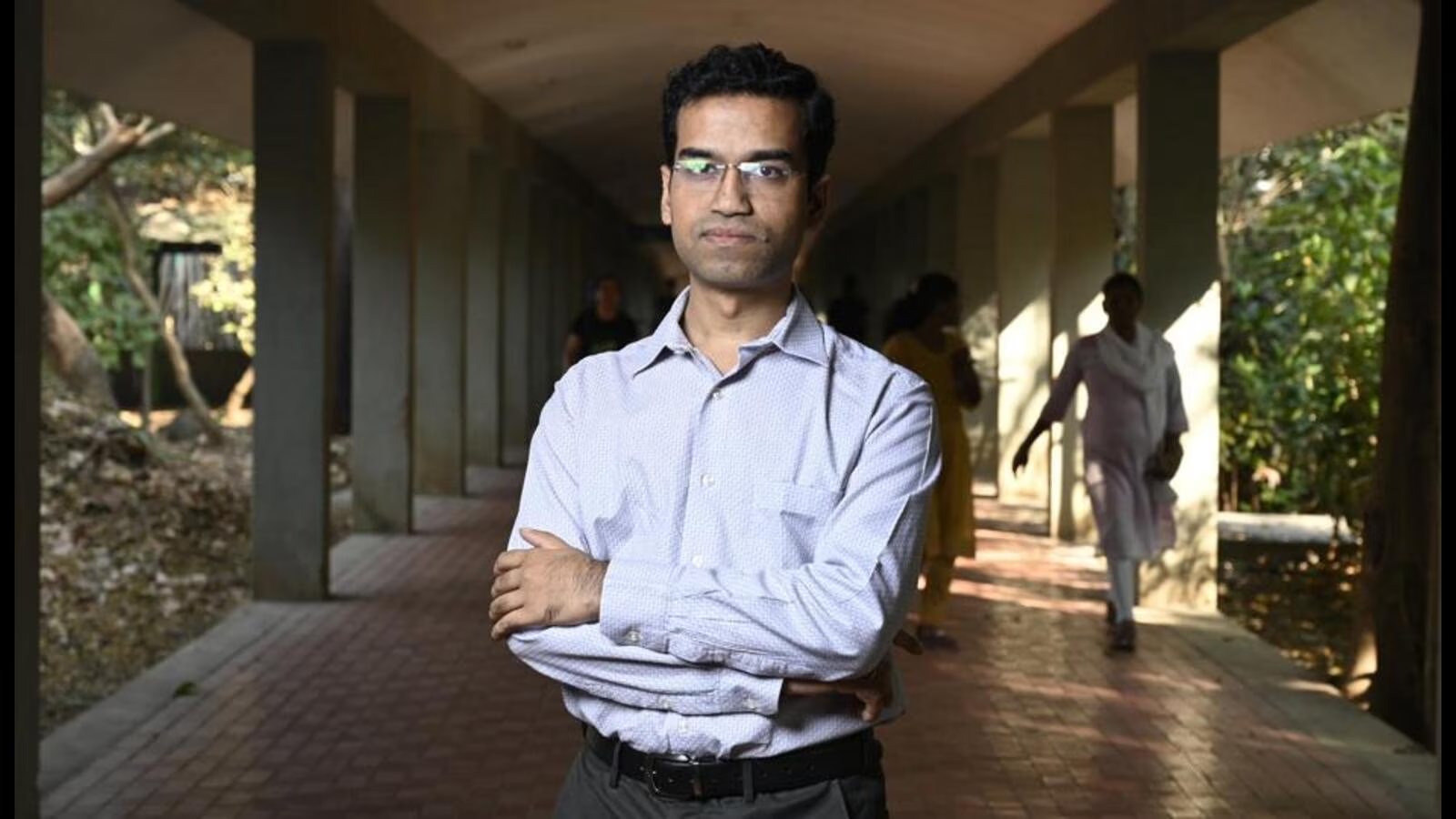
At the heart of this debate is Anupam Guha, an Assistant Professor at the Ashank Desai Centre for Policy Studies at IIT Bombay. Officially, Guha’s academic focus is artificial intelligence (AI), AI policy, and the future of labour, as described on IIT Bombay’s website.
However, his public persona on social media platforms like X paints a different picture—one of a vocal advocate for Marxist and far-left ideologies, often expressing views that appear hostile to Indian sovereignty, capitalism, and democratic processes.
In a recent post on X, Guha praised Megha Vemuri, an MIT student who used her graduation ceremony to deliver an anti-Israel tirade. Far from maintaining the intellectual neutrality expected of an educator at a publicly funded institution, Guha described Vemuri’s act as “brave” and admitted he lacked the courage to do something similar in his youth. This statement, widely circulated on X, raised questions about the appropriateness of a professor endorsing divisive political activism over academic objectivity.
Guha’s social media activity extends beyond this incident. He has publicly supported an article that labelled the abrogation of Article 370—a parliamentary decision upheld by India’s Supreme Court—as “constitutionally illegitimate.” The abrogation, which revoked the special status of Jammu and Kashmir in 2019, is a sensitive issue tied to India’s sovereignty. Guha’s endorsement of such views has sparked accusations of undermining national interests.
Professor of Humanities (Policy Studies) at IIT Bombay. Our IITs have become trash due to humanities departments.
I repeat once again: defund humanities from IITs. Save IITs. pic.twitter.com/RpfthiHkwT
— Harshil (હર્ષિલ) (@MehHarshil) June 3, 2025
During the 2018 Sterlite Copper Plant protests in Tamil Nadu, which resulted in nine deaths, Guha tweeted that “capitalism cannot function without state terrorism” and referred to the deceased as “martyrs.” His rhetoric during the anti-Citizenship Amendment Act (CAA) protests further amplified unrest, as he urged people to take to the streets against a law passed by Parliament to provide citizenship to persecuted minorities from neighbouring Islamic countries. Such actions, particularly from a government-funded academic, border on inciting agitation and amplifying separatist narratives, including those questioning India’s authority over Kashmir.
In another provocative post, Guha denounced the term “Tukde Tukde Gang”—a phrase used to describe secessionist and anti-national elements—as an act of “stochastic terrorism,” suggesting that those using it should face prosecution. Such language, is not that of a scholar but of a political ideologue engaged in narrative warfare against the Indian state. Guha has also openly identified as a communist, expressing disdain for opposing worldviews, further fueling concerns about his role as an educator shaping young minds.
Weaponising Academia: The Ashank Desai Centre’s Controversial Research
The concerns surrounding Guha are not isolated but reflect a broader trend within IIT Bombay’s humanities departments, particularly the Ashank Desai Centre for Policy Studies. The Centre recently commissioned a research paper titled “Delving Deeper into OpIndia.com’s Representation of Hindus and Muslims,” analysing 54,580 articles published by the news portal OpIndia from December 2014 to May 2023. The paper concluded that OpIndia fosters “anti-Muslim narratives” while portraying Hindus positively.
What has raised significant alarm is the authorship of this paper. Among the researchers is Shinjinee Majumder, a staff member at Alt News, a propaganda portal criticised for selective fact-checking, shielding radical Islamists, and peddling misleading narratives. The involvement of a figure associated with a controversial outlet in a taxpayer-funded study at a premier technical institute has sparked accusations of academic misconduct and institutional bias.
The use of public resources to produce what many call a “partisan hit job” disguised as research underscores a deeper issue: the erosion of academic neutrality at IITs. Rather than fostering critical inquiry, the Ashank Desai Centre appears to be functioning as an echo chamber for left-wing activism, producing outputs designed to delegitimise dissenting voices.
This development raises serious questions about the integrity of academic research and the misuse of public institutions to target non-left political perspectives.
Institutional Rot: Humanities Departments as Ideological Battlegrounds
The issues at IIT Bombay are not unique but part of a broader pattern across IITs, where humanities and social sciences departments have become hubs of far-left activism. Originally introduced to complement STEM education with a broader understanding of history, culture, and ethics, these departments are increasingly accused of promoting ideologies that undermine India’s national cohesion.
At IIT Gandhinagar, for instance, the Humanities and Social Sciences (HSS) department has come under scrutiny for research topics that appear to glorify Islamic theology under academic pretences. PhD topics such as “Fishing With Faith: Islam, Indigenous Knowledge, and Ecological Sustainability in Lakshadweep” and “From Gods to Jinn: Ontological Rewriting and the Islamization of Spirits in Kerala” have been criticised for romanticising religious narratives without critically examining their socio-political implications.
Further controversy emerged from alleged WhatsApp chats involving IIT Gandhinagar students, which suggest that Hindu students face pressure to remain silent about terror attacks targeting their community. Following the Pahalgam terror attack, where Hindus were killed by Pakistan-backed terrorists, students were reportedly discouraged from publicly condemning the violence.
In contrast, just seven days after Hamas’s October 7, 2023, attack on Israeli civilians, IIT Gandhinagar allegedly held a “Sham-e-Azadi” candlelight march in solidarity with Palestine. This apparent double standard—suppressing discourse on violence against Hindus while amplifying support for global Islamic causes—has fueled accusations of ideological bias and hostility toward Hindu identity.
Associate Professor Nishaant Choksi of IIT Gandhinagar has been accused of threatening disciplinary action against students questioning this ideological shift, using the institute’s honour code to silence dissent. Such actions, stifle the open debate and critical thinking that should define academic environments.
A Dangerous Convergence: Activism Meets Academia
The transformation of IITs into ideological hubs mirrors trends in Western universities, where critical theory and identity politics have overtaken classical liberal education. In India, however, the stakes are higher, as these institutions are funded by taxpayers who may not align with the ideologies being promoted. The convergence of academia with anti-state activism creates a paradox: citizens are financing intellectual efforts that challenge their nationhood, culture, and governance.
Professors like Anupam Guha are not merely exercising free speech but embedding divisive worldviews into the minds of young students under the guise of academic freedom. This trend risks diluting the STEM-focused mission of IITs, which were established to drive technological innovation, not political agitation.
A Threat to Intellectual Sovereignty
The ideological corrosion of India’s IITs is not a fringe concern but a tangible reality. When professors at premier institutions praise anti-India activism, question parliamentary decisions, and amplify separatist narratives—all while funded by taxpayers—it raises critical questions about the role of these institutes in serving the nation. The infiltration of ideological agendas risks undermining the global reputation of IITs as centres of STEM excellence, diverting resources from scientific inquiry to political theatre.
As India strives to maintain its position as a global leader in technology and innovation, the ideological takeover of its premier institutions must be addressed. Without course correction, the IITs risk losing their legacy as temples of technical excellence, becoming instead battlegrounds for ideological warfare. The future of India’s intellectual sovereignty hangs in the balance.











Comments