





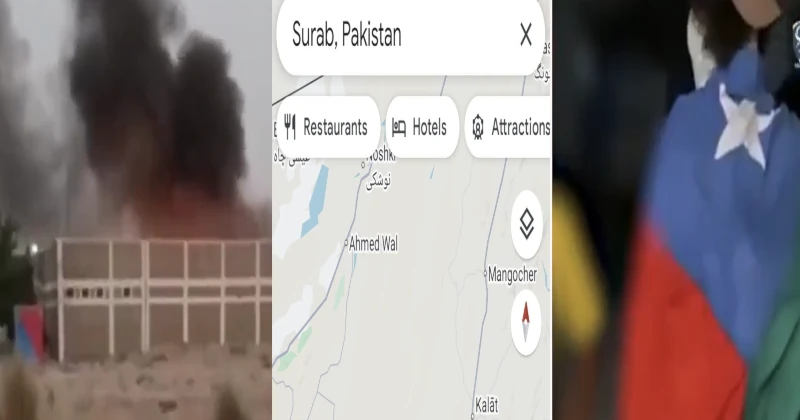
Smoke rises over the Kalat Division as the city of Surabnestled in the rugged heart of Balochistan—falls under the complete control of the Baloch Liberation Army (BLA). Armed separatist fighters have seized key government buildings, torched police and Levies stations, and established authority over vital infrastructure, marking one of the most severe challenges to Pakistan’s military and political control in the province since its annexation in 1948.
Eyewitness videos and photos show the sky blackened by fires lit across multiple locations, including the central police station, district administration offices, and banks. Loud gunfire echoed through the city as terrified residents watched militants in camouflage take over government compounds and begin security patrols.
The attack unfolded late May 30, evening when heavily armed BLA cadres launched coordinated assaults on all major government establishments in Surab. According to ground sources, fighters swiftly overran police resistance, killing a Station House Officer (SHO) and seizing arms and communication equipment. Several government personnel were reportedly taken hostage before militants set fire to official vehicles and installations.
Spokesperson Jeeyand Baloch confirmed the development in a brief but emphatic statement, declaring that BLA freedom fighters had taken “full and effective control” of Surab. Fighters are now conducting snap checking and patrols along the Quetta-Karachi and Surab-Gidar highways—routes vital to both civilian and military logistics.
Strategically positioned about 150 km from Quetta, Surab serves as a transit hub connecting the provincial capital with southern Balochistan. By capturing it, the BLA has delivered a severe logistical and symbolic blow to both the Pakistan Army and the Shehbaz Sharif government in Islamabad.
Sources within the region report that several government offices have been emptied or destroyed. Citizens have been instructed to remain indoors, and many shops and markets have shuttered in anticipation of further escalation.
Despite the gravity of the situation, there has been no formal response from the Pakistan Army or Ministry of Interior. Analysts interpret this silence as a sign of disarray—or perhaps fear—within Pakistan’s civil-military establishment.
The seeds of rebellion in Balochistan go back to 1947 when the Khan of Kalat sought to maintain Balochistan’s semi-autonomous status after the Partition. A year later, the Pakistani Army forcibly annexed the territory. Since then, five major insurgencies have erupted—in 1948, 1958, 1962, 1973, and 2004—all of them brutally suppressed.
Decades of neglect, exploitation, and militarisation have turned Balochistan into one of the most restive regions of South Asia. The province, rich in natural gas, copper, gold, uranium, and coal, continues to be plundered by the federal government and Chinese companies under the China-Pakistan Economic Corridor (CPEC), with little to no benefit trickling down to local communities. Thousands of Baloch students, activists, and intellectuals have either gone missing or been extra-judicially killed by state agencies. Mass graves and enforced disappearances have become common horror stories.
Control over Surab’s government machinery gives the BLA more than a moral victory—it offers a tactical and operational base to mount further actions. Roads leading into the city have been blocked. Reports indicate that militants are reinforcing defensive positions to repel any military counter-attack. The capture of weapons and vehicles suggests long-term occupation may be on the cards.
This escalation comes amid rising resistance in Sindh, growing unrest in Khyber Pakhtunkhwa, and renewed calls for freedom in Pakistan-occupied J&K (PoJK). Pakistan’s internal cohesion appears to be weakening as regional discontent accelerates. Intelligence experts warn that a sustained campaign by Baloch fighters could trigger similar takeovers in other districts such as Khuzdar, Kalat, and Mastung.
With Surab lying close to several CPEC routes, Beijing is likely to raise serious concerns over the viability of its billion-dollar investment in Pakistan. In the past, BLA fighters have targeted Chinese engineers and infrastructure projects in Gwadar and Dalbandin, branding them as symbols of colonial extraction.
A full-blown insurgent occupation of Surab could force China to either scale back or fortify its presence, further militarising the region and alienating locals.
Though mainstream international media and governments have largely ignored Balochistan’s plight, Surab’s capture is too significant to remain buried. Human rights groups are already expressing concerns about potential reprisals from the Pakistani Army, which has a record of brutal crackdowns in the region.













Comments