





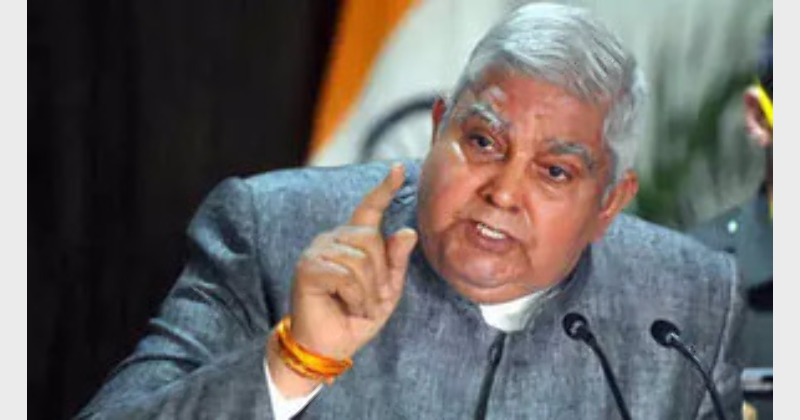
Vice-President and Rajya Sabha Chairman Shri Jagdeep Dhankhar delivered a powerful address at the inaugural session of the Rajya Sabha Internship Program (Phase 7) at the Vice-President’s Enclave, emphasising the critical role of indigenous strength, economic nationalism, and constitutional duties in securing India’s future. Speaking to young interns, he underscored the importance of national unity, parliamentary primacy, and a balanced approach to fundamental rights and duties to foster transparency, accountability, and national progress.
Securing Peace Through Strength
Highlighting the imperatives of national security, Shri Dhankhar stated, “For national security, we need indigenous strength. War is best avoided from position of strength. Peace is secured when you are ever ready for war….strength comes apart from technological prowess, conventional arms strength, from people also.”
He referenced the recent Operation Sindoor, which he said has “changed our mindset massively,” fostering unprecedented nationalism across the political spectrum.
“We are now nationalistic as never before. And this is reflected in the participation of all political landscape in delegations that have gone abroad to project our message of peace and our complete intolerance to terrorism,” he added.
Urging unity, he emphasised, “On issues of national security, economic progress, all factions need to put national interest over partisan priorities. I will appeal to everyone in the political spectrum to seriously reflect, come to a conclusion that on issues of national security, on issues of growth, on issues of our internal security, there must be the consensus.
Sometimes politics get too hot for nationalism and security, something we need to overcome.”
Balancing Rights with Fundamental Duties
Addressing the need for citizens to prioritise their constitutional responsibilities, Shri Dhankhar remarked, “The balance has to be maintained. Let us not cherry pick. We’ll go for fundamental rights, claiming them 24 x 7, and be totally oblivious of fundamental duties!…if we focus only on our rights and not on duties, we don’t measure up to the requirement of a citizen in the largest democracy, the oldest, the most functional.”
He explained that the 11 fundamental duties, introduced through the 42nd and 86th Constitutional Amendments, were not part of the original Constitution because the founding fathers assumed citizens would naturally align with them.
“Our founding fathers obviously expected that we will be aligned to these duties. We will respect those duties. But when it was noticed that it is required to spell them out in the Constitution so that people in particular become aware of these,” he said. Summarising their essence, he added, “If I have to give a sense of fundamental duties, it is to prioritise national well-being. To contribute optimally for public discourse, public order, public discipline, environment, everything which is known as goodness in life for one and all.”
He further highlighted the accessibility of India’s judicial system, noting, “India is amongst very few countries in the world where for enforcement of a fundamental right, you can knock the door of the highest court of the land. You can access judiciary at the premium level to vindicate your fundamental rights.”
However, he cautioned that all citizens and institutions must operate within constitutional boundaries, stating, “Every citizen and institution must exercise their powers within constitutional boundaries, upholding constitutional ideals. We can love our neighbour only when we don’t make incursion in the exclusive domain of the neighbour, physical territory and otherwise.
This Constitutional domain sanctity is required to be preserved in all situations. If there is any disruption of it, you can sense danger.”
Economic Nationalism as a Collective Responsibility
On economic nationalism, Shri Dhankhar called for a “vocal for local” approach, asserting, “Economic nationalism is the business of the people.”
He explained, “Swadeshi is closely connected with economic nationalism. Economic nationalism means we must consume Swadeshi. We must always take into consideration being vocal for local. This will inspire our people also to cater to our needs.”
He outlined three adverse consequences of importing goods that can be produced domestically: “One trouble, there is an avoidable hole in our foreign exchange reserve, and this is in billions of dollars.
Second, when we import items that can be made in this country, we are snatching work from our own people. We are depriving them of work. And thirdly, more importantly, we are blunting entrepreneurship.”
Encouraging individual contributions, he added, “Every individual can contribute. What clothes he wears, what he eats, what he wears, his shoes also. Everything. These are consumables. We fancy what is abroad.
Unmindful of the situation that we are injuring our national economy. I therefore assert economic nationalism is the business of the people.”
Parliament as the Will of 1.4 Billion People
Emphasising the centrality of Parliament, Shri Dhankhar declared, “Indian parliament is much beyond a legislative body. It is a reflection presently of 1.4 billion people’s will. It is the only legitimized constitutional platform that reflects authentically the will of the people, and therefore, Parliament has primacy.” He clarified the division of roles among institutions: “Parliament has primacy not in everything because there are areas where executive has primacy, how to govern.
The judiciary has primacy, how to deal with justice system but parliament has primacy on two counts—it is ultimate authority to make law. Secondly, it holds executive accountable.”
He stressed that governance hinges on transparency, accountability, and optimal institutional performance to accelerate India’s progress, stating, “Parliament is a place, ultimate place, for debate, dialogue, discussion, and discourse.”
Constitutional Legacy and Cooperation
Reflecting on the Constitution’s creation, Shri Dhankhar noted, “Our constitution, boys and girls, is a most sacred document. You will come to know how it was formalised, little less than three years, by our founding fathers who dealt with divisive issues, contentious issues, issues that were highly inflammatory, but they dealt with an approach of coordination, cooperation, consensus, something you have to learn in life.” He urged the interns to respect differing perspectives, saying, “You must always respect the other point of view. Because if you think you alone are right, the other person is wrong, you are depriving yourself of a great benefit of input. And secondly, my own experience is, more often than not, the other point of view is the correct view.”
He highlighted the cultural significance embedded in the Constitution, stating, “This document painstakingly evolved has taken note of our civilisational growth also. If you look at the Constitution as signed by framers of the Constitution, you will have the occasion to see it. When you see it, you’ll find it has 22 miniatures.
Each miniature reflects our historical past, glorious historical past. It shows Gurukul. It shows Indus Valley boom. It shows Ram, Sita, and Laxman coming back to Ayodhya after triumph of goodness over evil. That is in part three of the Constitution, fundamental rights. When it comes to directive principles of state policy, you will find Bhagawan Krishna giving discourse to Arjuna at Kurukshetra.”
A Call for Unity and Duty
Shri Dhankhar’s address to the interns underscored the interconnectedness of national security, economic self-reliance, and constitutional responsibilities. By drawing on India’s civilisational heritage and recent nationalistic fervor, he urged young citizens to embrace their fundamental duties, support Swadeshi, and contribute to a united, prosperous India. The Rajya Sabha Internship Program, now in its seventh phase, serves as a platform to instill these values in the next generation, reinforcing the role of Parliament as the embodiment of the people’s will.















Comments