





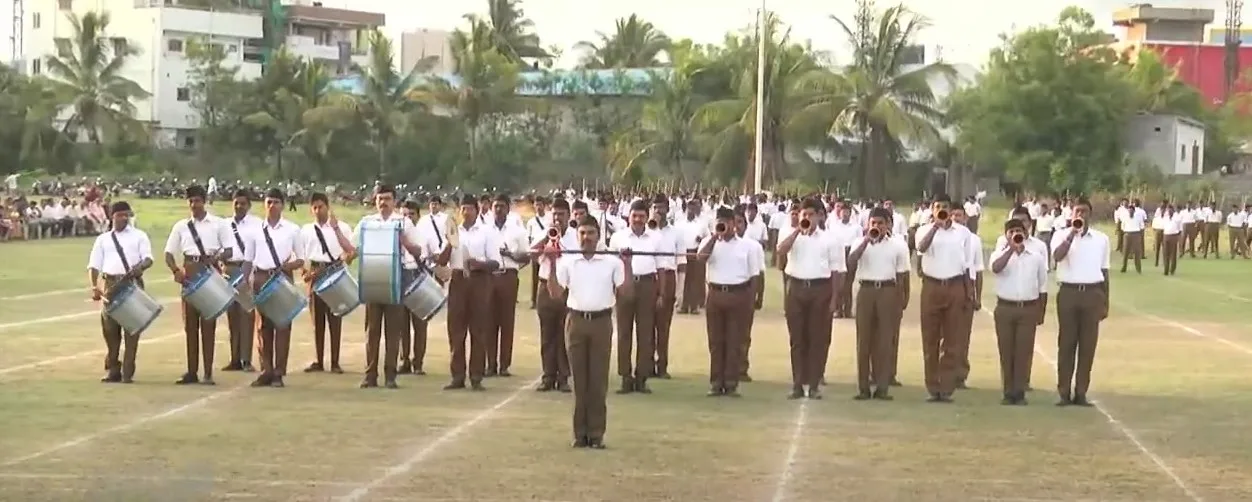
The Rashtriya Swayamsevak Sangh (RSS) Karyakarta Vikas Varga-1 Sarvajanikotsav was held on May 23 at Vidya Vihar High School in Annojiguda, Ghatkesar in Bhagyanagar. The event saw the presence of chief guest Captain Vineet Singh Ramawat, manager of Ramachandra Mission’s Kanha Shantivanam.
Speaking on the occasion, Ramawat said that the RSS has been working selflessly in society for many years, without any expectations or desire for recognition. He emphasised the need to strengthen our roots and culture, stating that we would then become a bridge for the next generation. “If the roots are strong, the branches (shakhas) too will spread. The root of all this is spirituality,” he said. Through his work with Ramachandra Mission, he added, ‘man-making mission’ is being realised.
Highlighting the historical injustices faced by the people of Hindustan, Ramawat pointed out that these events are also documented in history. “Dharma was troubled. The reason was fear and greed. Because of these, we forget our principles and roots,” he said. Hence, he stressed the importance of repeatedly remembering our unity and foundations.
Delivering the keynote address, RSS Dakshin madhya Kshetra Seva Pramukh Ekkka Chandrasekhar stated that the RSS was founded by Dr. Hedgewar as part of the nation-building project and cultural renaissance. He said that though Dr. Hedgewar was a doctor and a lifelong bachelor, he never thought about his personal life and dedicated everything to society.
Chandrasekhar said that Dr. Hedgewar understood that without a powerful society, national glory could not be attained. Even if success was achieved, it would not last, and weaknesses would return unless society remained awakened and united. That is why RSS was initiated with the grand idea of societal awakening and organisation. To achieve societal unity and awakening, and to build strength, individuals are essential, he said. Hence, ‘man-making mission’ was the central objective when the training camps began 90 years ago.
“For the past 90 years, we have been tirelessly working on the ‘man-making mission’. Lakhs of youth across the country are participating in these training camps and receiving guidance,” he noted.
Reflecting on Varga 1 training, he said that the results of this decades-long ‘man-making mission’ are now evident. “This 20-day training touched upon key aspects of holistic personality development. Thanks to 90 years of training, a well-prepared team of activists is now standing before the nation,” he said. Dr. Hedgewar believed that to achieve such a noble mission, inspired individuals were necessary. Without them, societal organisation would be impossible. Hence, the individuals who emerge from this training are entering society as role models.
Chandrasekhar recalled the expansion efforts and social activities initiated in the Northeast by Bhaiyyaji Kane in 1971. Leaving behind his teaching profession and adopting a child from a poor family, Bhaiyyaji Kane moved to Manipur, where he lived for 30 years. He left that child in the Vanvasi Kshetra and inspired the local people, saying, “I’ve given you my child; now you give yours for education.” This awakened the people of Manipur. As a result, 500 Vanvasi children were brought to Mangaluru in Karnataka for education, and a hostel was established for them. “Today, 10,000 Vanvasi students are being educated and guided. We have witnessed such transformation. Only a committed activist can bring such change,” he said.
Addressing the trainees, he added that through training camps, the Sangh has created thousands and lakhs of enthusiastic activists. “Listening to the stories of our nation’s history, culture, and great personalities inspires us. It also builds a comprehensive understanding of the nation,” he said. Studying the past deeply creates a bond with the land, which makes one capable of working for society. It is this emotional bond that the training camp fosters.
He invoked Swami Vivekananda’s vision, stating, “If India is to become a powerful, guiding force in the world, it needs organisation. He envisioned building a mechanism that would bring lofty values to the common person and establish a great institution. He also thought that the nation-building effort must include people who study all dimensions of life and work together with collective determination.”
Chandrasekhar asserted that the Sangh, through its 90-year course of work, has achieved all three points mentioned by Vivekananda. “As Vivekananda envisioned, we have built a great organisation. From just 17 participants in the first training session, RSS has now trained over 50 lakh activists. There’s scope for many more in the coming years,” he said.
Reflecting on the past century, he said, “This 100-year period is extremely significant. During this time, organisational work has been built up. Today, a powerful, united Hindu institution stands tall across the nation. RSS is present in every district – 910 in total – and in 55,000 mandals, with active shakhas in 35,000 of them. Nearly 10 lakh youth attend shakhas regularly. Such a strong and united Hindu institution hasn’t been seen in the past thousand years.”
He emphasised that RSS activists are individuals who live in unity with the nation. Regardless of where they live, what language they speak, or where they were born, they carry the same emotional connection to the nation. “This grand vision is now visible in India. Hindutva is not limited to India – it has expanded globally. Wherever an RSS activist goes, they take these values and this model of organisation with them,” he said. Globally, this training camp has laid the foundation for a powerful network. “We are approaching the 100-year mark of the Sangh’s founding. We are part of this century,” he added.
He presented the Ram Janmabhoomi donation drive as an example of the Sangh’s organisational strength. “In just 45 days, we aimed to reach 6 lakh villages, 12 crore families, and collect Rs 1,100 crores. Even the government machinery couldn’t reach this level, but thanks to our working methods, collective strength, and devotion to Rama, we met our target. This drive is a shining example of our strength,” he said.
He called for further expansion of the Sangh in the coming days, aiming to establish shakhas in one lakh villages. “This will create an awakened, united group of youth, which in turn will help build an awakened society. An awakened society will be able to think and act promptly whenever anything happens in the country. Such a socially conscious society is about to emerge,” he said.
Chandrasekhar said that the Sangh elders have directed that the movement be extended to one lakh villages and called upon the activists to work in the field. “Any ideology functions in one direction. But Sangh touches all dimensions. We have ideologically covered all angles,” he concluded.
As part of the Sarvajanikotsav, swayamsevaks demonstrated various skills they had learned – including Ghosh (instrumental music), Danda Yuddh, Niyuddh, Sanghik Geet, Vyayam Yog (yogic exercises) and Kreeda Patava (sports skills).












Comments