





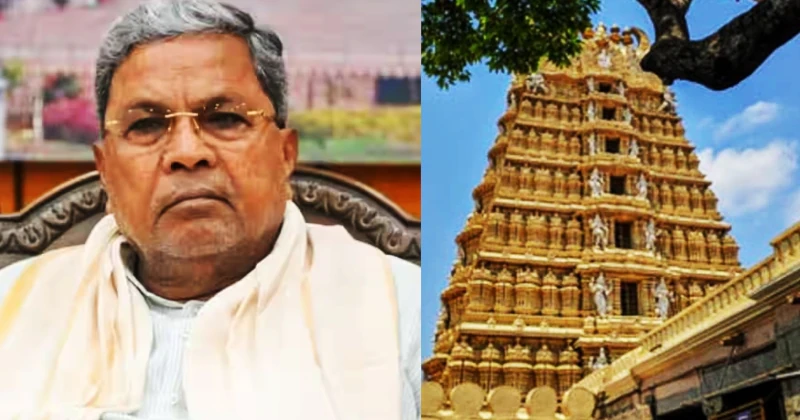
The Karnataka government finds itself under fire yet again, as Governor Thaawarchand Gehlot has formally reserved a highly controversial bill for Presidential assent that proposes diverting a larger portion of revenue from high-income Hindu temples to a common government-administered pool. Critics, including civil society voices and opposition parties, have condemned the move as a direct assault on religious autonomy and constitutional values.
The Karnataka Hindu Religious Institutions and Charitable Endowments (Amendment) Bill, passed amid loud protests in the legislative assembly in March 2023, aims to siphon off 10 per cent of the gross income from temples earning over Rs 1 crore annually and 5 per cent from those with income between Rs 10 lakh and Rs 1 crore. These funds will be merged into a central pool administered by the state’s Rajya Dharmika Parishat — a government-controlled body.
The move has sparked outrage, not only for its potential financial ramifications for Hindu religious institutions but also its perceived selective targeting of the Hindu faith under the guise of “common welfare.”
“Assault on Faith and Autonomy”
Opposition leaders, constitutional experts, and temple boards alike have termed the Bill a brazen attempt by the state to assert undue control over temple finances while remaining silent on similar revenue models for institutions of other faiths.
“This is not governance — it’s legalized looting of temples,” charged a senior BJP leader. “The Congress-led government in Karnataka is on a reckless spree of using temples as ATM machines, while peddling selective secularism. Why is this model not applied to other religious institutions?”
Critics have pointed out the long-standing debate over the constitutional validity of state control over Hindu temples, calling the move a violation of Articles 25 and 26, which guarantee freedom of religion and the right to manage religious affairs.
Notably, the Karnataka High Court 2006 declared the original Hindu Religious Institutions and Charitable Endowments Act, 1997, unconstitutional — a ruling currently stayed by the Supreme Court. Governor Gehlot referred to this legal limbo while refusing his assent and instead sending the Bill to the President for further scrutiny.
“I am not convinced by the clarifications given by the state government,” Gehlot noted in his communication to the parliamentary affairs department. “Approving this Bill without final legal clarity could lead to serious constitutional complications.”
Hypocrisy and Legal Tightrope
The government’s justification — that the Act remains operational due to a pending Supreme Court decision — has been labelled disingenuous by several legal experts. “You cannot build on a legal structure that has already been struck down, unless the highest court reinstates it,” remarked a constitutional lawyer based in Bengaluru.
While the government insists that the common pool will be used for the welfare of temples, devotees, and priests, there is little transparency on fund utilization. Past reports have revealed that such funds have often been diverted to non-temple-related projects, raising serious concerns over accountability.
Moreover, this legislative move has been interpreted by many as yet another attempt to encroach upon Hindu institutions while systematically avoiding interference in the management of churches or mosques.
Public Sentiment and Political Repercussions
The timing of the Bill — coinciding with growing public discontent over civic decay, farmer distress, and unemployment — has further irked citizens who believe that the government’s priorities are misplaced.
“Hospitals are underfunded, roads are broken, and farmers are crying for help. Instead of solving these problems, the government is eyeing temple donations meant for spiritual and religious purposes. This is a moral failure,” said a Bengaluru-based civic activist.
Temple authorities have also expressed their displeasure, warning that the move could severely impact daily operations, maintenance, and social services offered by these temples.













Comments