





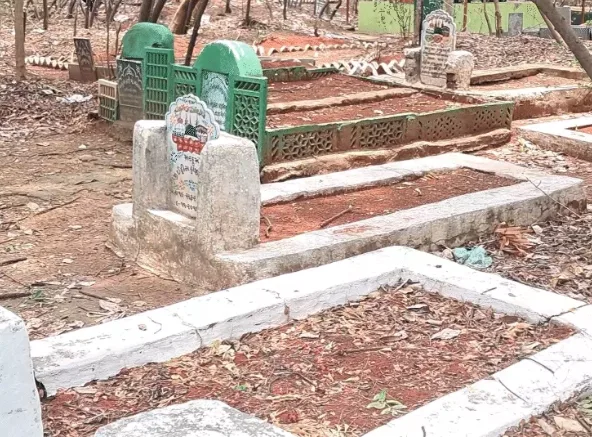
A shocking incident has come to light in Khandwa district, where the graves of six women in two separate cemeteries were found desecrated. The case surfaced on May 20, when relatives visiting the graves to offer prayers noticed signs of tampering. Families expressed concerns of wrongdoing with the bodies, while police suspect possible occult activities but have found no evidence of ritualistic items. Authorities have registered a case against unknown individuals and launched an investigation, with cyber experts tracing suspects via mobile tower data.
The Discovery of Desecration
The incident came to public attention on the morning of May 20, when two individuals visited cemeteries in Khandwa to offer fatiha at the graves of their loved ones. One man, visiting his mother’s grave in Kaharwadi cemetery, and another, at his wife’s grave in the larger cemetery near Kotwali police station, were horrified to find the graves disturbed. The stone coverings at the foot of the graves had been removed, soil was dug up, and the shrouds (kafan) covering the bodies were partially undone, exposing the lower halves of the corpses in a dishevelled state.
Abdul Rahman, a caretaker responsible for digging graves, was summoned to the Kaharwadi cemetery. Upon inspection, it was revealed that two additional women’s graves in the same cemetery had been similarly tampered with.
As news spread, members of the local Muslim community gathered, and police were informed. The City Superintendent of Police (CSP) Abhinav Barange and a tehsildar arrived at the scene to assess the situation.
Later that day, reports emerged of a similar incident in Sihada village, adjacent to Khandwa, where three more women’s graves were found desecrated. By the night, police from Kotwali and Moghat Road stations registered cases against unknown persons for interfering with burial processes, charging them with offences related to hurting religious sentiments.
Eyewitness accounts and family outrage
Haji Ayyub, an eyewitness from Kaharwadi, recounted his shock: “Three days ago, I buried my mother. When I went to offer fatiha, I saw the foot end of her grave open. Abdul Rahman suggested we close it, but I realised this wasn’t the work of animals—it was human. Two other women’s graves were also disturbed.”
Another relative, whose 60-year-old wife was buried on May 24, received a call from Abdul Rahman about the tampering. “When I reached the cemetery, the stone at the foot of my wife’s grave was removed, and the mat was displaced. Her feet were tilted unnaturally, unlike how we positioned her facing west during burial. Something wrong has happened—it’s not just occult rituals. The administration must take strict action,” he said, visibly distressed.
Families expressed deep concern that the desecration went beyond mere vandalism, suspecting foul play with the bodies. However, no items typically associated with tantric (occult) rituals, such as specific materials or symbols, were found at the sites.
Police investigation and theories
CSP Abhinav Barange confirmed that police received reports of grave tampering in both cemeteries on May 20. “We inspected the sites and registered cases. The investigation is ongoing, and we’re exploring all angles,” he said. Police are questioning caretakers and reviewing CCTV footage, while cyber experts are analysing mobile tower data to track individuals present in the area during the incident. No conclusions have been reached, but authorities are determined to identify and apprehend the culprits.
Abdul Rahman, the caretaker, noted, “I learned in the morning that three graves had been opened at the foot end. The mats were removed, and all were women’s graves.” Zahid Ahmad, treasurer of the cemetery committee, suggested the possibility of “mischievous elements or occult practices” but emphasised the disturbing condition of the shrouds, raising fears of improper handling of the bodies.
Local context and past incidents
The desecrated graves, all belonging to women estimated to be around 50 years old, were recently buried, with some interments occurring as recently as May 23. The tampering involved removing the stone coverings at the foot of the graves and disturbing the shrouds, leaving the lower halves of the bodies exposed.
A person knowledgeable about occult practices explained that Islamic rituals typically involve placing items in old or abandoned graves, not freshly buried ones. “This doesn’t seem like a ritual. Someone likely entered the graves with harmful intentions,” they speculated.
Social worker Akram Jatu recalled a similar incident in 2008, when a woman’s grave was found disturbed, and a semi-naked man was discovered at the site. “Children thought it was a ghost, but adults caught him and handed him over to the police. Such incidents can recur because cemeteries are often frequented by miscreants or addicts at night,” he said.
Community and official response
The incidents sparked outrage among the local Muslim community, with large crowds gathering at both cemeteries. In Sihada, villagers reported a similar desecration of three women’s graves, which had occurred three days prior. Police from Moghat Road, along with CSP Barange and Rameshwar outpost in-charge, inspected the site and registered a case for hurting religious sentiments.
CSP Barange assured that further action would be taken with the consent of the families. “We’re collecting evidence and questioning caretakers and others involved. Whoever is found guilty will be arrested,” he stated.
Ongoing Concerns and Investigation
The desecration of the graves has left the community in Khandwa and Sihada shaken, with families demanding justice and answers. The absence of occult-related items has deepened suspicions of malicious intent, and the police’s investigation continues to explore whether the acts were motivated by mischief, personal vendettas, or other sinister purposes.
As the probe intensifies, authorities are under pressure to ensure such incidents are not repeated, while the affected families seek closure for the violation of their loved ones’ resting places.
Rape of corpse common in Pakistan
Pakistan has witnessed several shocking incidents of necrophilia involving the desecration of women’s graves, highlighting a disturbing trend. On August 14, 2021, in Maulvi Ashraf Chandio village near Ghulamullah, Thatta district, unknown men dug up the grave of a 14-year-old girl who had died of natural causes and sexually assaulted her corpse. The family discovered the grave disturbed the following morning, with the body found in a nearby ditch showing signs of rape.
Similarly, on May 4, 2022, in Chak Kamala village, the corpse of a teenage girl, buried the same evening, was exhumed and raped. The family found the grave disturbed the next day, and police interrogated 17 suspects, though the investigation’s outcome remains unclear.
In November 2019, in Karachi’s Landhi Town, a group of unidentified men dug up a woman’s grave in Ismail Goth graveyard, just a day after her burial, and raped the body. The family declined to pursue legal action but expressed concerns over the caretaker’s claim that a dog had disturbed the grave.
In 2011, one of the most notorious cases emerged when Muhammad Rizwan, a gravekeeper in North Nazimabad, Karachi, was arrested after confessing to raping 48 female corpses over years. He was caught fleeing after desecrating a grave, drawing significant attention to the issue. More recently, on August 9, 2024, Salman Waheed was arrested in Karachi’s Korangi graveyard for sexually abusing the corpse of a 55-year-old woman buried the previous evening, admitting to similar acts on four other bodies.
















Comments