





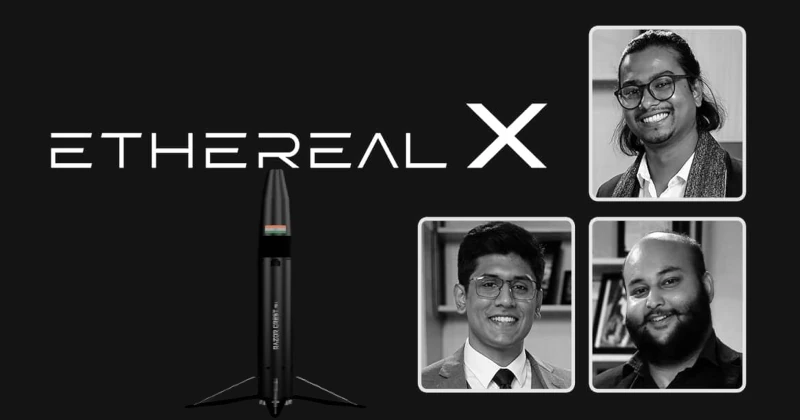
A Bengaluru-based aerospace startup, Ethereal Exploration Guild (EtherealX), is poised to launch the world’s first fully reusable medium-lift launch vehicle — a technological feat even global leader SpaceX has yet to achieve.
Founded in 2022 by former ISRO engineers Manu J. Nair, Shubhayu Sardar, and Prashant Sharma, EtherealX has emerged as a formidable force in India’s burgeoning private space sector. Their flagship vehicle, Razor Crest Mk-1, is designed to deliver payloads of up to 24.8 tonnes to Low Earth Orbit (LEO) in expendable mode and 8 tonnes in reusable mode — capabilities that exceed current Indian offerings and challenge global benchmarks.
At the heart of Razor Crest’s disruptive edge lies an industry-first innovation: recovery of both the booster and the upper stage, a feat that has long eluded even SpaceX due to the extreme re-entry heat associated with upper-stage recovery. While other companies battle this thermal inferno with expensive heat shielding, EtherealX is taking a radically different approach — harnessing the re-entry heat to power its proprietary propulsion system, a technique that could drastically slash turnaround time and operational costs.
“Why fight re-entry heat when you can redirect it to run your engines?” asks CEO and co-founder Manu J. Nair, summing up the core philosophy behind EtherealX’s thermodynamic engineering breakthrough.
For decades, the satellite launch industry has been monopolised by a few state-run giants and increasingly centralised through SpaceX’s dominance. In this tightly controlled ecosystem, India’s need for cost-efficient, high-frequency orbital access — particularly in the medium-lift segment (4–25 tonnes) — has gone largely unaddressed.
ISRO’s existing launch vehicles, including the GSLV Mk-III, barely scrape the lower end of the medium-lift threshold. EtherealX’s Razor Crest is designed to plug this vacuum — and do so with a cost structure that undercuts the global average by a factor of 21. With estimated launch prices ranging from $340 to $2,000 per kg, EtherealX aims to democratise access to orbit, with implications that go far beyond commercial satellite deployment.
“We’re operating in a segment where reusability hasn’t been cracked. We’re not just catching up — we’re redefining what’s possible,” said Nair in an exclusive interview with AIM.
From Startup to Space Superpower: Bengaluru’s Role in a New Launch Order
With operations based in India’s tech capital, EtherealX is riding the wave of Bharat’s space renaissance. Having already signed $110 million worth of launch MoUs with aggregators from Europe, Japan, and other spacefaring nations, the company is building a launch portfolio that reflects growing geopolitical distrust of Chinese and Russian launch pads, and a strong desire for non-aligned, multipolar orbital access.
“Europe is geographically handicapped for anything beyond polar launches. They don’t want to go to China or Russia. India is the obvious and strategic alternative,” Nair explained. EtherealX is also one of the select Indian firms included in the Indo-US Space and Defence Collaboration Programme, placing it at the heart of emerging global alliances in space tech and defence logistics.
Former ISRO Chairman S. Somanath echoed this sentiment at the Invest Karnataka 2025 summit, where he envisioned a future in which Bengaluru leads not just in launching satellites, but in building four-tonne to six-tonne class communications satellites — a domain still dominated by foreign OEMs.
Technology, not just talk: The path to 2027
EtherealX is already manufacturing its most powerful engine — a 1.2 meganewton semi-permanent unit — and planning a technology demonstrator launch by 2026, followed by a full-scale launch in March 2027. Intermediate testing milestones include upper-stage engine cluster firings and hop tests aimed at validating Razor Crest’s vertical takeoff and landing abilities.
With $5 million in seed funding secured, and more investment rounds in the pipeline, Nair remains optimistic. “The only thing between us and becoming the next SpaceX is deep tech capital — and that’s finally flowing into India,” he said, pointing to the emergence of sector-focused government venture funds that are backing high-risk, high-reward innovation.
‘Make in India’, launch for the world
Despite global ambitions, EtherealX remains grounded in its ‘Make in India’ commitment, with most components sourced indigenously thanks to Bharat’s robust space supply chain. High-precision, large-volume components are currently outsourced, but the company plans to scale manufacturing in-house as it matures.
This dual-track approach — global outreach coupled with domestic self-reliance — reflects a broader vision of positioning India not just as a launch site, but as a launch superpower. “You don’t have to interact with a foreign entity to build a rocket here. That’s the beauty of India’s space heritage,” Nair said.










Comments