





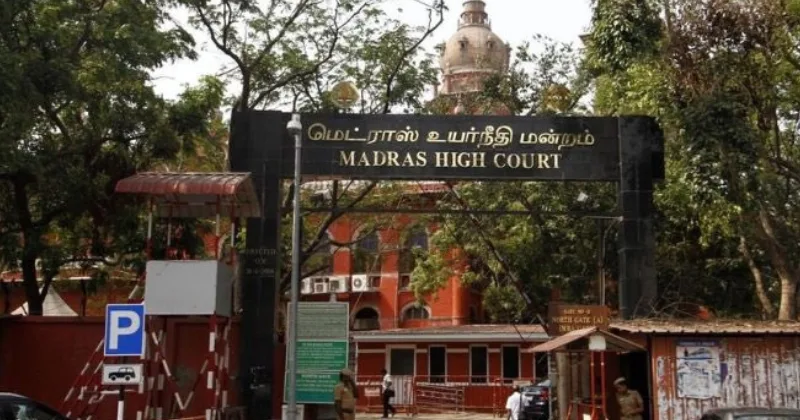
In a development that positions the DMK to appoint Vice-Chancellors of its choosing by removing the Governor—namely, the Pro-Chancellor—from the process, a vacation bench of the Madras High Court has stayed all ten new Tamil Nadu laws pertaining to the appointment of Vice-Chancellors.
துணைவேந்தர் நியமனம்- சட்டப்பிரிவுக்கு இடைக்கால தடை#ChennaiHighCourt | #MadrasHC | #UniversityVCAct | #University pic.twitter.com/vUQonINnRg
— PttvOnlinenews (@PttvNewsX) May 21, 2025
Wasting no time after securing a favourable verdict from the Supreme Court on 8 April—where, invoking Article 142, it was ruled that all pending bills with Governors are deemed to have received assent—the Tamil Nadu government passed several pieces of legislation in the State Assembly last April. These bills, aimed at amending existing Acts, propose restructuring the Vice-Chancellor (V-C) search committee by removing the Chancellor’s nominee from the panel.
According to the bills, the V-C search committee will now consist of two government nominees, a retired High Court judge, a retired or serving government officer not below the rank of Principal Secretary, and one nominee from the university syndicate. The bills also include provisions for the removal of V-Cs and remove the Governor’s authority to assent to or withhold assent from decisions made by the university syndicate.
The move follows the Supreme Court’s recent approval of ten amendment bills that curtailed the Governor’s powers to appoint V-Cs in 18 of the 20 state-run universities.
In response, Advocate K Venkatachalapathy of Tirunelveli filed a Public Interest Litigation (PIL) in the Madras High Court challenging the laws, which he argued run contrary to the objectives and functioning of the University Grants Commission (UGC). In his petition, he stated:
“Through Regulation 7.3 of the UGC regulations for teaching staff, the Commission granted powers to the Chancellor (Governor) to appoint Vice-Chancellors. However, the State, through these amendments, replaced the Chancellor’s authority with that of the Government, contrary to the stipulated appointment process.”
The petitioner added: “State universities are recognised as such under Section 2(f) of the UGC Act and are also recognised by the Commission under applicable regulations. Therefore, any state amendments affecting such universities—especially in areas already regulated by the UGC concerning Vice-Chancellor appointments—constitute a violation of the constitutional distribution of powers.”
He challenged the constitutional validity of the impugned Acts, which amend provisions of the following legislations:
The Tamil Nadu Fisheries University Act, 2012
The Tamil Nadu Veterinary and Animal Sciences University Act, 1989
The Madurai-Kamaraj University Act, 1965
The Anna University Act, 1978
The Bharathiar University Act, 1981
The Bharathidasan University Act, 1981
The Mother Teresa Women’s University Act, 1984
The Alagappa University Act, 1985
The Manonmaniam Sundaranar University Act, 1990
The Periyar University Act, 1997
The Tamil Nadu Open University Act, 2002
The Thiruvalluvar University Act, 2002
The Tamil Nadu Teachers Education University Act, 2008
The Annamalai University Act, 2013
The Tamil Nadu Dr Ambedkar Law University Act, 1996
The Tamil Nadu Dr M.G.R. Medical University Act, 1987
The Tamil Nadu Agricultural University Act, 1971
The Tamil University Act, 1982
The case was heard by the summer vacation bench comprising Justices G.R. Swaminathan and V. Lakshminarayanan. After hearing arguments and counters, the bench stayed the operation of the ten state university laws, the passage of which had resulted in a Presidential reference. The judgment also fuels the ongoing Centre-State power tussle.
In their 31-page order delivered on 21 May, the bench stated:
“We are clearly of the view that the impugned amendments suffer from the vice of repugnancy and run counter to the line of decisions of the Hon’ble Supreme Court mentioned earlier… We are convinced that the impugned amendments are ex facie unconstitutional. If an unconstitutional process is allowed to proceed, it would cause irreparable injury and public interest would suffer. In the aforementioned cases, Vice-Chancellors were appointed in breach of the procedure laid down in the UGC Regulations and eventually, Writs of Quo Warranto were issued. But such remedies take time. We are therefore of the view that the balance of convenience lies in staying unconstitutional legislation. In fact, we do not propose to stay the operation of the amending Acts in toto. We confine ourselves to staying that part of the legislation which takes away the Governor’s power of appointment. Nor do we propose to stay the constitution of the search committees. If interim stay is granted, the original position will revive.”
The bench added: “We therefore stay the operation of the impugned amendment Acts to the extent that they take away the power of appointment of the Vice-Chancellors of the petitioner-mentioned universities from the hands of the Chancellor and vest the same in the Government.”
Earlier, Advocate General PS Raman argued: “A legislation passed by a State Assembly can be stayed only when there is glaring unconstitutionality or it is manifestly arbitrary. In this case, a state legislation prevails over UGC regulations.”
Senior advocate P. Wilson, appearing for the State, contended: “The petitioner, a BJP district functionary from Tirunelveli, chose to move this specific second vacation court. This amounts to forum shopping. Allowing the petitioner to argue would be judicial impropriety.”
















Comments