





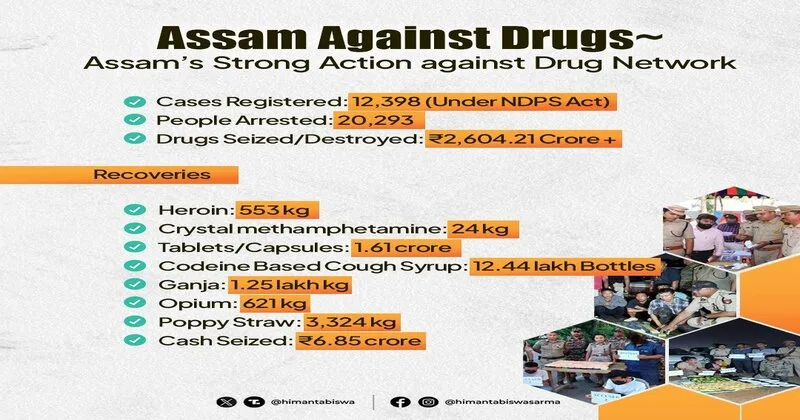
Guwahati: In a relentless drive to uproot the narcotics network from Assam, the state police, under the leadership of Chief Minister Himanta Biswa Sarma, have made substantial gains in the past four years. As part of the statewide crackdown under the mission ‘Assam Against Drugs’, authorities have seized narcotics worth over Rs 2,600 crore and arrested more than 20,000 individuals since 2021. What is now coming into sharper focus is the demographic pattern among the arrested drug traffickers—a disproportionately high number of whom belong to the Muslim community.
According to official data, the Assam Police registered 12,398 cases under the Narcotic Drugs and Psychotropic Substances (NDPS) Act and arrested 20,293 people, including over 1,000 women drug peddlers. Reliable sources closely monitoring the procedings revealed to Organiser Weekly that close to 90 percent of those arrested are Muslim men, and about 95 percent of the arrested women involved in drug peddling are also from the Muslim community.
This revelation points to a deepening crisis within certain sections of Assam’s Muslim society, particularly in areas with known transit routes used for smuggling drugs originating from neighboring states and countries. Despite this, Muslim political leaders, religious figures, and rights activists have remained largely silent, choosing not to address or acknowledge the extent of drug abuse and trafficking networks operating within the community.
Chief Minister Sarma, who has been at the forefront of the anti-drug crusade, reiterated the state’s commitment to cleanse Assam of the drug menace. “Since 2021, we have taken a firm stand against the menace of drugs. Under our Mission #AssamAgainstDrugs, we have seized over Rs 2,600 crore worth of various drugs and arrested over 20,000 people to contribute to the overall vision of a #DrugsFreeBharat,” CM Sarma wrote in a post on social media platform X.
The scale of the narcotics recovered is staggering. Police operations have led to the confiscation of 553 kg of heroin, 24 kg of crystal meth, 1.61 crore tablets and capsules, 12.44 lakh bottles of codeine-based cough syrup, 1.25 lakh kg of ganja, 621 kg of opium, and 3,324 kg of poppy straw. Authorities have also seized Rs 6.85 crore in cash, suspected to be proceeds of the drug trade.
In one of the latest operations, Guwahati Police intercepted a vehicle coming from Silchar and recovered 395.67 grams of heroin worth Rs 3.16 crore. Similar seizures in Kokrajhar and Golaghat districts have netted more traffickers and large quantities of banned substances.
While Assam’s police continue to make strategic arrests and high-value seizures, the government is also emphasizing rehabilitation and awareness as complementary tools in the fight against drugs. However, the conspicuous silence from influential leaders within the Muslim community has raised questions about the societal response to what is now clearly a multi-layered problem involving organized crime, community vulnerability, and socio-economic factors.
Observers argue that a holistic fight against drugs will require not just policing but community cooperation, especially from those areas repeatedly flagged as drug trafficking hubs. The state government has appealed to community elders, civil society groups, and religious institutions to play a proactive role in countering this menace.
As Assam marches toward its goal of becoming a drug-free state, the statistics offer both encouragement and concern. Encouragement in terms of the scale of enforcement, but concern over the depth of societal involvement, especially among communities that are yet to openly confront the issue.
With drug routes extending from Myanmar and Manipur, Mizoram to the heart of Assam, and traffickers exploiting economic and social vulnerabilities, the next phase of the campaign may need to go beyond seizures and arrests—into community reform, interfaith engagement, and stronger surveillance mechanisms.











Comments