





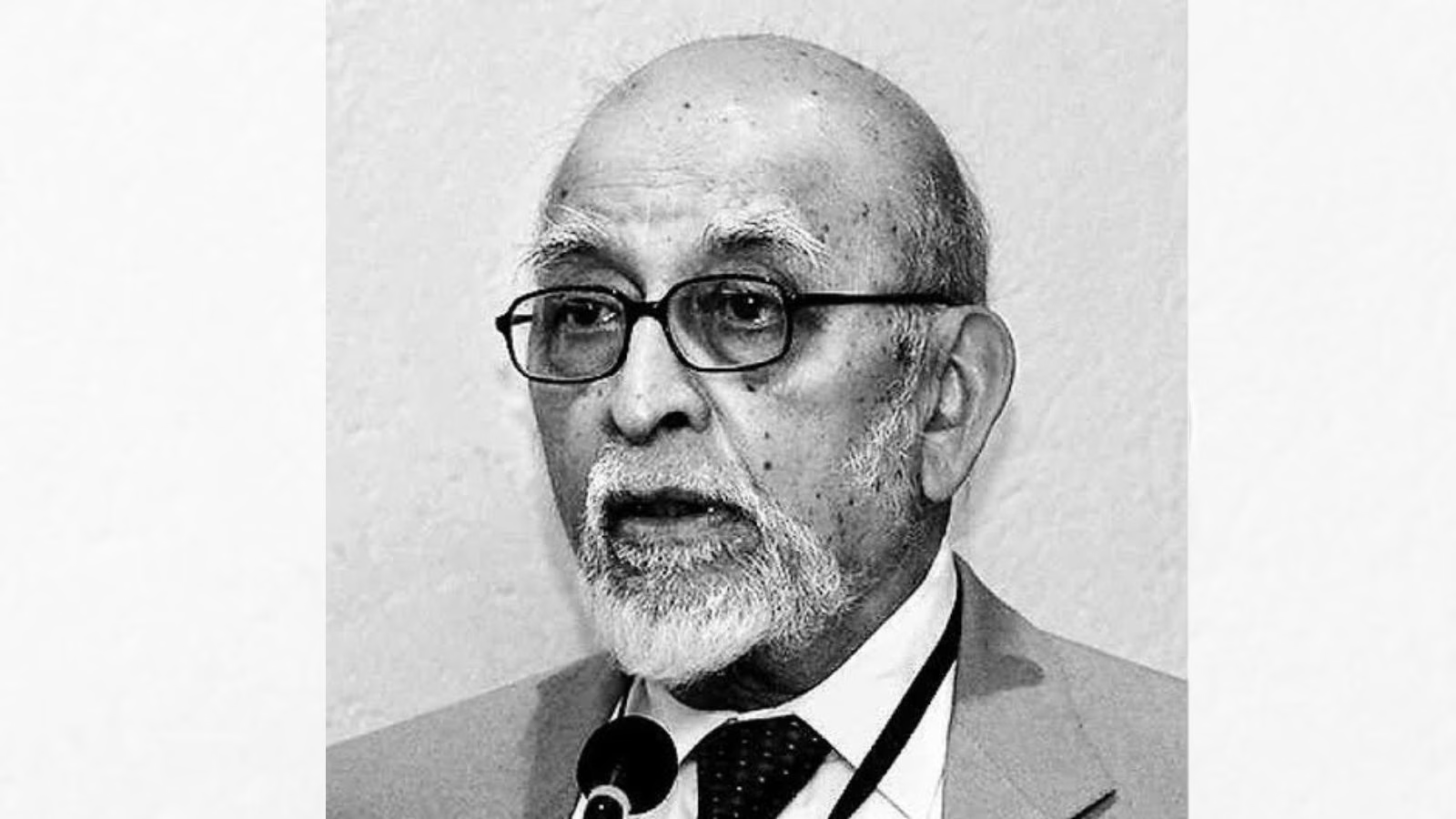
Dr. Malur Ramasamy Srinivasan, a towering figure in India’s nuclear energy programme and former chairman of the Atomic Energy Commission (AEC), passed away in Ooty on Tuesday (May 20) following a cardiac arrest. He was 95.
Dr. Srinivasan, fondly known as MRS among colleagues, was admitted to a private hospital on Monday after complaining of discomfort. He breathed his last on Tuesday, leaving behind a monumental legacy that transformed India’s nuclear landscape.
Born on January 5, 1930, in Karnataka, Srinivasan completed his early schooling in Mysore before graduating with a degree in Mechanical Engineering from the University Visvesvaraya College of Engineering (UVCE) in 1950—an institution founded by the legendary M Visvesvaraya. He went on to pursue his master’s degree and earned a Ph.D. from McGill University, Montreal, in 1954, specialising in gas turbine technology.
From Apsara to Kalpakkam: Architect of India’s Nuclear Power Grid
Dr. Srinivasan joined the Department of Atomic Energy (DAE) in September 1955, working under the guidance of Dr. Homi J. Bhabha, the father of India’s nuclear programme. He played a key role in the construction of India’s first nuclear research reactor, Apsara, which went critical in August 1956. Over the decades, his career intertwined with the most eminent names in Indian science, including Dr. Vikram Sarabhai, Dr. Homi Sethna, and Dr. Raja Ramanna.
In 1959, Srinivasan was appointed as the Principal Project Engineer for the construction of India’s first atomic power station and later rose to the role of Chief Project Engineer of the Madras Atomic Power Station. He held several key roles in the DAE, including Director of the Power Projects Engineering Division and Chairman of the Nuclear Power Board. As the founding Chairman and Managing Director of the Nuclear Power Corporation of India Ltd (NPCIL), he oversaw the development and operation of 18 nuclear power units across the country.
His administrative and technical acumen culminated in 1987 when he was appointed Secretary of the Department of Atomic Energy and Chairman of the Atomic Energy Commission—at a time when India was navigating the challenges of energy independence and nuclear non-proliferation.
Recognition and Legacy
In recognition of his immense contribution to India’s scientific development, Dr. Srinivasan was awarded the Padma Vibhushan, India’s second-highest civilian award, in 2015.
Former Secretary of the Department of Science and Technology, V S Ramamurthy, described him as a “walking dictionary of nuclear power in the country.”
National Leaders Pay Homage
Prime Minister Narendra Modi expressed grief over Dr. Srinivasan’s demise, stating: “Deeply saddened by the passing of Dr. M R Srinivasan, a stalwart of India’s nuclear energy programme. His instrumental role in developing critical nuclear infrastructure has been foundational to our being self-reliant in the energy sector. He is remembered for his inspiring leadership of the Atomic Energy Commission. India will always be grateful to him for advancing scientific progress and mentoring many young scientists. My thoughts are with his family and friends in this sad hour. Om Shanti.”
Tamil Nadu Governor R N Ravi lauded Srinivasan’s “visionary leadership and scientific acumen” which contributed significantly to India’s self-sufficiency in nuclear energy. Chief Minister M K Stalin called him a “pillar of India’s atomic energy programme” and “a true nation builder.”
The Sage Who Dreamed of the Atom: Revisiting Acharya Kanada’s Atomic Theory
As the nation remembers Dr. Srinivasan’s contributions to modern nuclear science, it’s also worth revisiting the ancient Indian roots of atomic theory, first postulated by Acharya Kanada, also known as Kashyapa, an Indian sage and natural philosopher.
More than 2,500 years before the Western world attributed atomic theory to John Dalton (who proposed it in 1803), Acharya Kanada had formulated the concept of Parmanu (atoms) and laid the foundations of the Vaisheshika school of Indian philosophy. His atomic theory proposed that all matter is composed of indivisible, indestructible particles, each possessing specific properties based on the substances they form.
Kanada described how two atoms could form a binary molecule (Dwinuka), and how various combinations of atoms under specific conditions, like heat, could lead to chemical changes. For instance, he explained the change in the colour of earthen utensils upon heating as a chemical transformation of the underlying atoms.
His seminal work, Vaisheshik Darshan, articulated foundational concepts of matter:
1) Atoms are eternal and indivisible.
2) They exist in two states: motion and absolute rest.
3) Atoms can combine in various ways to produce new substances.
4) Everything material originates from the union and interaction of these atoms.
5) Atoms cannot be seen with the naked eye, yet they are the building blocks of life and death, defined by their organised or disorganised forms.
While Greek philosophers Leucippus and Democritus also proposed similar atomic concepts around the 5th century BCE, scholars like McEvilley (2002) argue that such theories might have stemmed from cross-cultural exchanges, influenced by Indian thought.
Final Salute
Dr. M R Srinivasan’s life was not just one of scientific rigour but also of national service, marked by humility and foresight. As India charts its path toward advanced nuclear technology and energy self-reliance, Srinivasan’s vision and contributions will continue to illuminate that journey, just as Acharya Kanada’s insights remind us of the enduring intellectual legacy India brings to the world.
Dr. M R Srinivasan is survived by his family, his mentees, and the nation he helped power, one atom at a time.











Comments