





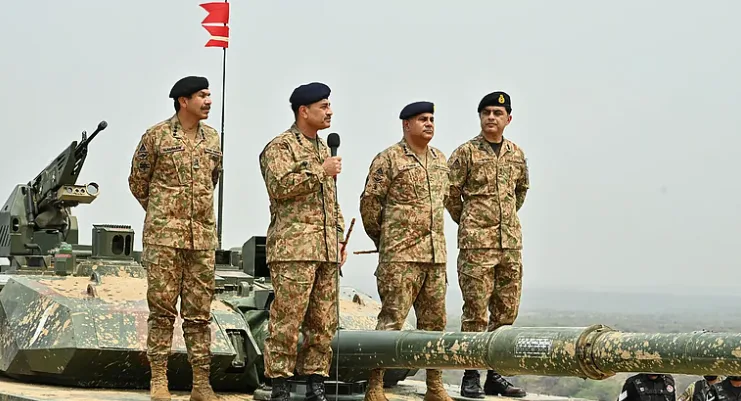
In a move that has sparked widespread debate and drawn historical parallels, Pakistan’s Army Chief General Asim Munir has been conferred the prestigious title of Field Marshal, the first such elevation since General Ayub Khan in 1959. The decision, approved by Prime Minister Shehbaz Sharif’s cabinet on May 20, comes at a time of heightened tensions with India following a deadly terror attack and subsequent military clashes.
The promotion, though largely symbolic, has reignited concerns about the military’s dominance in Pakistan’s fragile and so-called democratic framework, evoking memories of the country’s slide into dictatorship under Ayub Khan decades ago.
The Past: Ayub Khan and the Dawn of Military Rule
The last time Pakistan saw a Field Marshal was in 1959, when General Ayub Khan, then the army chief, promoted himself to the rank to solidify his grip on power. This followed a period of intense political instability in the nascent state, formed after the Partition of India in 1947.
Pakistan’s early years were marked by relentless political turmoil, with seven prime ministers cycling through office between 1947 and 1958, none completing a full term. The parliamentary system was plagued by no-confidence motions, collapsing coalitions, and a fragmented political landscape.
The Muslim League, once the driving force behind Pakistan’s independence, had splintered after the deaths of its founding leaders, Muhammad Ali Jinnah in 1948 and Liaquat Ali Khan in 1951. Civilian institutions remained weak, with unelected bureaucrats and a burgeoning military establishment filling the power vacuum. A new constitution in 1956 declared Pakistan a republic, but failed to stabilise its politics.
In October 1958, President Iskander Mirza, disillusioned with democracy and facing a crumbling government, abolished the 1956 Constitution, declared martial law, and appointed General Ayub Khan as Chief Martial Law Administrator. Mirza believed he could control Ayub, retaining influence as president.
However, Ayub swiftly outmanoeuvred him, assuming the presidency himself within weeks and becoming Pakistan’s first military ruler.
Ayub’s self-promotion to Field Marshal in 1959 was a strategic move, both symbolic and political, designed to elevate him above military and civilian leadership. His decade-long rule, which lasted until 1969, was characterised by press censorship, a tightly controlled presidential system, and the entrenchment of military dominance in Pakistani politics. His regime set a precedent for future military interventions, shaping the country’s governance for decades.
The Present: Asim Munir’s Elevation and Regional Tensions
Fast forward to 2025, General Asim Munir’s promotion to Field Marshal comes at a critical juncture for Pakistan. The decision follows a devastating military setback in a recent conflict with India, triggered by a terror attack in Pahalgam that killed several Indian tourists. In response, India launched Operation Sindoor, targeting terrorist camps in Pakistan and Pakistan-occupied Kashmir (PoK). When the Pakistan Army attempted to defend these camps, Indian forces escalated their response, striking Pakistani air bases and military posts, inflicting significant damage.
General Munir, who has been a vocal supporter of groups implicated in cross-border attacks, has heightened tensions with his rhetoric. In recent statements, he invoked the two-nation theory, the ideological basis for the 1947 Partition, while issuing sharp warnings to India.
His promotion to Field Marshal, approved by the cabinet, is seen as an attempt to bolster his authority amid domestic and international pressures.
While the Field Marshal rank holds little operational significance in modern Pakistan, its historical connotations are hard to ignore. The title, rarely bestowed, places Munir in the same league as Ayub Khan, raising questions about the military’s intentions in a country where elected governments have often been overshadowed by the armed forces.
Political and Symbolic Implications
Pakistan’s political landscape in 2025 remains precarious. The military has long been the most powerful institution in the country, often dictating foreign policy and national security decisions. Civilian governments, including that of Prime Minister Shehbaz Sharif, have struggled to assert authority in the face of military influence. Munir’s elevation has sparked concerns that the military may be tightening its grip, particularly as Pakistan grapples with economic challenges, internal unrest, and strained relations with India.
The timing of the promotion, days after heavy military losses, suggests an effort to project strength and unity. However, it has also drawn criticism from opposition leaders and civil society, who fear a return to the era of military dominance that began under Ayub Khan.
“This is a dangerous signal,” said a senior opposition figure, quoted anonymously in the media. “The Field Marshal title is not just a rank—it’s a symbol of unchecked power. We cannot afford to slide back into dictatorship.”
Regional and Global Context
The escalation with India adds another layer of complexity. The Pahalgam attack, attributed to Pakistan-based militant groups, has reignited long-standing tensions between the two nuclear-armed neighbours. India’s Operation Sindoor has been described as one of the most aggressive cross-border operations in recent years, with significant casualties reported on the Pakistani side. Munir’s promotion, coupled with his hardline stance on India, could further inflame the situation, raising fears of a broader conflict.
A Nation at a Crossroads
As Pakistan navigates this turbulent period, the elevation of General Asim Munir to Field Marshal serves as a stark reminder of the military’s enduring influence.
The ghost of 1959 looms large. Ayub Khan’s rise to power marked the beginning of a long era of military rule, with lasting consequences for Pakistan’s democracy. Whether Munir’s promotion signals a similar trajectory remains to be seen, but for now, it has cast a shadow over the country’s political future.
















Comments