





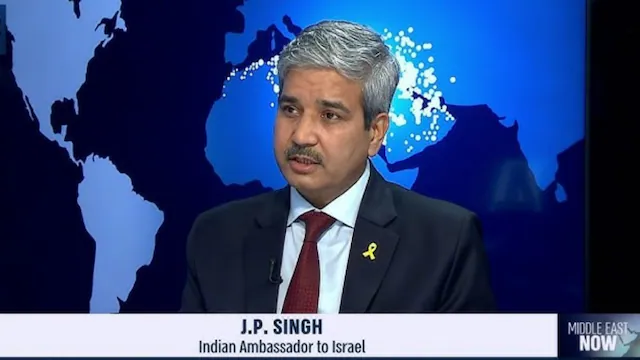
In a bold rebuke to Pakistan, India’s Ambassador to Israel, JP Singh, announced that the Indus Waters Treaty (IWT), a long-standing symbol of bilateral cooperation, has been put in abeyance due to Pakistan’s persistent support for cross-border terrorism. Speaking to Israel’s i24 News, Singh declared that the treaty’s principles of goodwill cannot coexist with violence, citing the April 22 Pahalgam attack that killed 26 people as the final trigger for India’s decision.
Treaty Suspension Amid Terror Concerns
Singh delivered a stern message to Islamabad, stating, “Goodwill, friendship, and blood can’t flow together.” He emphasized that the IWT, signed in 1960 to govern the sharing of Indus River system waters, relies on mutual trust, which Pakistan has “repeatedly violated” through its sponsorship of terror groups like Lashkar-e-Taiba (LeT) and Jaish-e-Mohammed (JeM). “Over the years, we allowed water to flow; Pakistan allowed terror to flow,” Singh said, referencing decades of attacks, including the 2008 Mumbai attacks, 2016 Pathankot attack, 2019 Pulwama attack, and the recent Pahalgam attack, which targeted tourists based on their religion.
The decision to pause the treaty follows the Pahalgam attack by The Resistance Front, which killed 26 people, including a naval officer and a Nepali national, in Baisaran Valley. Singh stated that the suspension will remain in place until Pakistan dismantles its terror infrastructure and extradites key perpetrators, including Hafiz Saeed, Masood Azhar, Zaki-ur-Rehman Lakhvi, and Sajid Mir.
“When the US can extradite Tahawwur Rana, why can’t Pakistan hand over Hafiz Saeed, Masood Azhar, Zaki-ur-Rehman Lakhvi, and Sajid Mir? Everything will be normal if Pakistan hands over these terrorists to India,” he asserted, referencing the recent US extradition of a 26/11 Mumbai attack conspirator.
Operation Sindoor: A Calibrated Response
Singh provided a detailed account of Operation Sindoor, India’s military response to the Pahalgam attack, which unfolded in two phases. On May 7, 2025, Indian forces conducted precision strikes on terror camps and launchpads in Muzaffarabad, LeT headquarters in Muridke, and JeM headquarters in Bahawalpur, eliminating over 100 terrorists. When Pakistan retaliated by targeting Indian military installations, India responded with strikes on Pakistani army bases, radar systems, and airfields, including Nur Khan and Sargodha. “Their DGMO called ours — and that’s how the ceasefire was initiated on the evening of May 10,” Singh revealed.
However, he cautioned that the operation is not concluded. “The ceasefire is holding for now. But Operation Sindoor is paused, not over. A new normal has been set — we will follow an offensive doctrine. Wherever terrorists are, we will strike. Their infrastructure will be destroyed,” he warned. Satellite images have since revealed extensive damage to Pakistani air bases, and sources report that the Indian Army neutralized over 600 drones launched by Pakistan during the tensions.
Pakistan’s Duplicity and Global Accountability
Singh accused Pakistan of evading accountability for past attacks, including Mumbai, Pathankot, and Pulwama, despite India and the US providing detailed dossiers. “They keep saying they want investigations and international probes. But what about Mumbai, Pathankot, Pulwama? We gave them dossiers. The US gave them evidence. Yet Sajid Mir, Hafiz Saeed, Zaki-ur-Rehman Lakhvi are roaming free. You simply cannot believe them,” he said. He called for Pakistan to face consequences for sheltering terrorists, urging the international community to adopt a zero-tolerance stance.
India-Israel Strategic Partnership
Turning to bilateral ties, Singh described India-Israel cooperation as “strategic and rapidly expanding.” He highlighted the role of Israeli defence systems in Operation Sindoor, complementing India’s indigenous platforms under the Make in India initiative. “The difference is: we use these platforms to target terrorists. Pakistan uses its resources to protect them,” he noted. Beyond defence, Singh outlined opportunities in infrastructure, agriculture, water management, science, and technology. He cited India’s $1.5 billion investment in Haifa port, interest in Tel Aviv metro projects, and migration agreements facilitating skilled Indian workers in sectors like caregiving, hospitality, and agriculture. “Even during conflict, there was no security issue for Indian workers in Israel,” he added.
Call for a Global Anti-Terror Alliance
Singh advocated for a global alliance against terrorism, uniting nations like India and Israel that have suffered from terror attacks. “Those who suffer must come together — not just against terror groups, but their supporters and shelters. The world must act with zero tolerance,” he urged. He emphasised that India’s actions, including the IWT suspension and Operation Sindoor, signal a shift toward a proactive, offensive strategy to combat terrorism.
As India recalibrates its doctrine and diplomacy in the face of state-sponsored terror, Singh’s message from Tel Aviv signals a firm shift — one where goodwill will no longer be unconditional, and where treaties may no longer outlast terror.
















Comments