





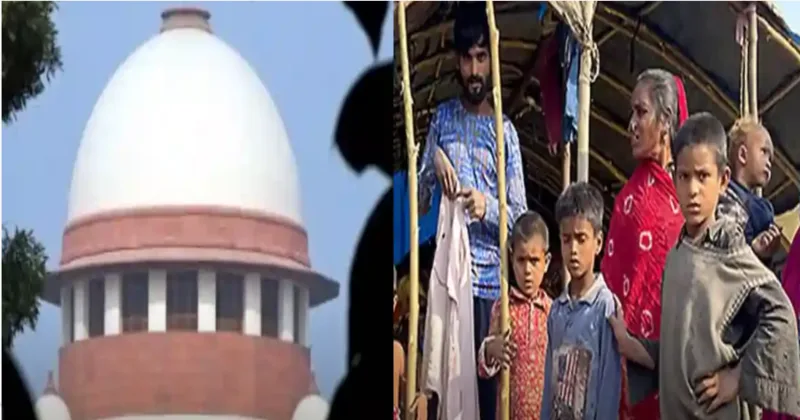
On May 8, 2025, the Supreme Court of Bharat declined to intervene in the alleged deportation of illegal Rohingya migrants from Delhi, emphasising that the right to reside in Bharat is exclusive to its citizens. The court underscored that if Rohingyas are determined to be ‘foreigners’ under the Foreigners Act, 1946, they will be dealt with in accordance with law.
The issue of Rohingya illegal immigrants living in India has evolved into a significant legal and national security concern. Despite being undocumented foreign nationals with no legal right to remain in Bharat, thousands of Rohingyas have settled in various parts of the country. The Government of Bharat has consistently maintained that their presence constitutes a national security threat, and the Supreme Court has repeatedly upheld the sovereign power of the Indian state to deport illegal immigrants under the Foreigners Act, 1946.
Invoking Bharatiya Constitution
Two Rohingyas, namely – Mohammad Salimullah and Mohammad Shaqir – illegally residing in Delhi, approached the Supreme Court relying on a Reuters report alleging that the Centre intended to deport 40,000 Rohingya Muslims to Myanmar. They invoked Article 21 (Right to Life) and Article 14 (Equality) of the Constitution, along with the international principle of non-refoulement, arguing that they had been granted refugee cards by the UNHCR.
During the pendency of the matter, on March 7, 2021, media reports suggested that 150–170 Rohingyas were detained in Jammu and held in a converted sub-jail. The petitioners thus filed an interim application to release the detainees.
Govt Rejects Refugee Designation
The Union of Bharat strongly opposed the plea and submitted that the Rohingyas are illegal immigrants under Section 2(a) of the Foreigners Act, 1946. Bharat has a porous border and has witnessed organised illegal infiltration aided by touts and human trafficking agents. Intelligence inputs suggested security threats linked to certain Rohingya networks. The Supreme Court had already dismissed a similar plea regarding deportation of illegal immigrants from Assam in 2018. Importantly, the Government made it clear that Bharat does not recognise the UNHCR’s refugee designation, and any deportation will follow due process of law as required under the Foreigners Act.
On March 26, 2021, the Supreme Court, led by the then CJI SA Bobde and Justices Bopanna and Ramasubramanian, refused to grant any interim relief. The Bench held unequivocally that firstly, the right not to be deported is ancillary to the right to reside, which is reserved only for citizens. Secondly, while Articles 14 and 21 apply to all persons, Article 19(1)(e)—which grants the right to settle in India—does not extend to illegal immigrants. Thirdly, Courts cannot interfere in matters of international relations or comment on the internal situation in Myanmar.
Recent Proceedings
On May 8, 2025, a Special three-judge Bench, comprising Justices Surya Kant, Dipankar Datta, and N. Kotiswar Singh, heard urgent pleas filed by senior advocate Colin Gonsalves and advocate Prashant Bhushan,
The petitioners alleged that women and children holding UNHCR refugee cards were picked up and deported without notice, and that deportation would expose them to torture and death in Myanmar, which has declared them stateless. Gonsalves submitted that the Court had protected the Rohingya refugees “for 10 years” and that the Union could not undo this till the matter was decided. In light of the recent deportations, he questioned if more refugees would face a similar fate. Bhushan pointed to an affidavit from the Manipur Government, which states that Myanmar refuses to accept the refugees, labelling them “stateless persons.” He also cited reports by the UN Special Rapporteur on Human Rights, who stated that the Rohingyas should not be deported under international law.
The petitioners argued that firstly the Rohingyas fled genocide by the Myanmar Army; secondly, they have been recognised as refugees by the UNHCR and issued refugee cards; and thirdly, they are entitled to protection under non-refoulement, and Article 21 (Right to Life) of the Indian Constitution.
The Solicitor General on behalf of the Union Government submitted that firstly India is not a signatory to the 1951 Refugee Convention or its 1967 Protocol, and the UNHCR designation of the Rohingyas as refugees have no legal standing under the Indian law. Secondly, power under Section 3 of the Foreigners Act to regulate, prohibit, or restrict foreigners is absolute, especially in the context of national security. Thirdly, Article 51(c) (promotion of international law) is not enforceable if it conflicts with domestic legislation. He further asserted that the right against deportation is linked to the right of residence, which is a right reserved exclusively for Indian citizens. The Solicitor General further assured the court that all deportations would be carried out in accordance with due process, and that security concerns warranted Government’s position.
SC Declines to Stay Deportation
The Supreme Court declined to stay the deportation, citing security concerns raised by the Union Government, which referred to a prior Supreme Court decision allowing deportations from Assam and Jammu & Kashmir. The Court contemplated that while, Article 21 (Right to Life) and Article 14 (Equality before Law) apply to all persons, Article 19(1)(e) — the right to reside and settle in India is available only to Indian citizens.
Justice Surya Kant remarked that if they have a right to stay here, it will be acknowledged. However, if they do not have a right, they will be deported as per the procedure prescribed in law. Justice Dipankar Datta remarked that the April 2021 order declining any stay on deportation had attained finality and as such, deportations could legally continue if they followed due process. He further reiterated that the right to reside in India under Article 19(1)(e) is limited to Indian citizens. He concluded that all foreign nationals would be governed by the Foreigners Act, 1946, which outlines the procedure for deportation.
The court has scheduled the matter for a detailed final hearing on July 31, 2025.
Earlier on February 4, 2025, in another matter concerning Bangladeshi illegal immigrants, the Supreme Court sternly criticised the State of Assam for indefinitely detaining persons declared as foreigners without initiating their deportation, particularly in cases where nationality is already known. A bench comprising Justices Abhay S. Oka and Ujjal Bhuyan rejected the state’s excuse that deportation was stalled due to the absence of foreign addresses, stating that such reasoning was untenable and procedurally unacceptable. Addressing Assam’s Chief Secretary, the bench remarked that once a person is declared a foreigner, deportation must follow regardless of precise addresses, suggesting they be sent to the capital city of their country of origin.
The Court directed immediate deportation proceedings for 63 individuals whose nationality is confirmed. The Solicitor General acknowledged lapses and assured the Court that he would coordinate with the Ministry of External Affairs to expedite the process. Meanwhile, concerns were raised over individuals languishing in detention for over a decade due to bureaucratic inaction, with Bangladesh reportedly refusing to accept them. The Court expressed concern over the financial burden on the state exchequer and directed both the State and Union Governments to file proper affidavits and report on deportation actions taken.
Thus, the Supreme Court’s stance so far reflects a clear and consistent message: illegal immigrants cannot claim the same rights as citizens. Once a person is declared an illegal immigrant staying in India, they must be deported. The Government of India has a constitutional duty to ensure internal security, uphold the integrity of its borders, and maintain demographic stability. While humanitarian concerns may be acknowledged, they cannot override national interest and legal sovereignty. India must not become a sanctuary for illegal entrants, especially when their presence poses serious strategic and law enforcement challenges.















Comments