





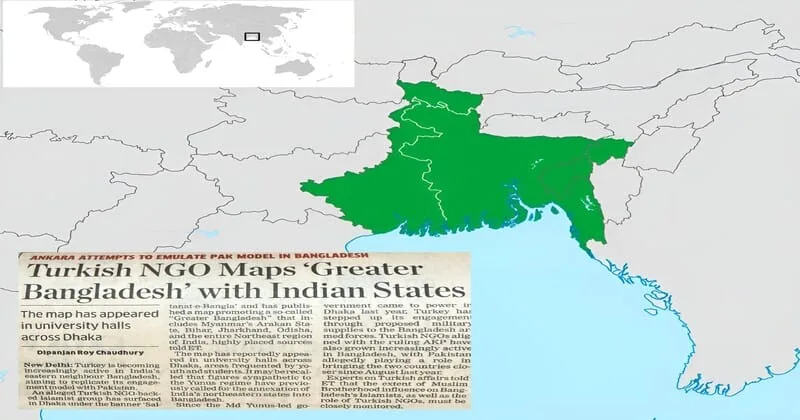
A major diplomatic controversy is unfolding after a Turkish-backed NGO in Dhaka allegedly displayed provocative maps depicting a so-called “Greater Bangladesh,” which includes significant portions of India’s eastern and northeastern regions, along with parts of Myanmar.
Sources reveal that the controversial map features India’s Bihar, Jharkhand, Odisha, the entire Northeast, and Myanmar’s Arakan state. It reportedly appeared in university halls across Dhaka, especially in areas frequented by students and young people.
Turkey could emulate Pak plan in Bangladesh: Alleged Turkish backed NGO in Dhaka Saltanat-e-Bangla displays maps of Greater Bangladesh comprising several Indian states of Eastern & Northeast — My report @ETPolitics @aniltrigunayat @ETDefence pic.twitter.com/HLt1ZaK0gF
— Dipanjan R Chaudhury (@DipanjanET) May 18, 2025
An image from April this year, taken at Dhaka University’s Teacher-Student Centre (TSC) during Pohela Boishakh (Bengali New Year) celebrations, showed an individual posing with a “Saltanat-E-Bangla” map that portrayed several Indian regions as part of a so-called greater Bangladesh.
The development has raised serious concerns in India, particularly as bilateral relations with Bangladesh continue to deteriorate. Tensions have escalated due to the Yunus-led government’s failure to address the increasing violence against minorities, particularly the Hindu community, across the country.
The controversy has become more alarming amid Turkey’s expanding influence in Bangladesh. Under the Yunus government, military cooperation between Ankara and Dhaka has reportedly intensified, while Turkish NGOs—believed to be affiliated with Turkey’s ruling AKP party—have grown more active in the country.
The controversy has become more alarming amid Turkey’s expanding influence in Bangladesh. Under the Yunus government, military cooperation between Ankara and Dhaka has reportedly intensified, while Turkish NGOs—believed to be affiliated with Turkey’s ruling AKP party—have grown more active in the country.
The controversy emerges amid intense competition between Bangladesh and India in the textile industry, with bilateral trade reaching USD 12.9 billion in 2023–24. As strategic tensions escalate, India is expected to closely monitor Turkey’s activities and ideological footprint in the region.













Comments