





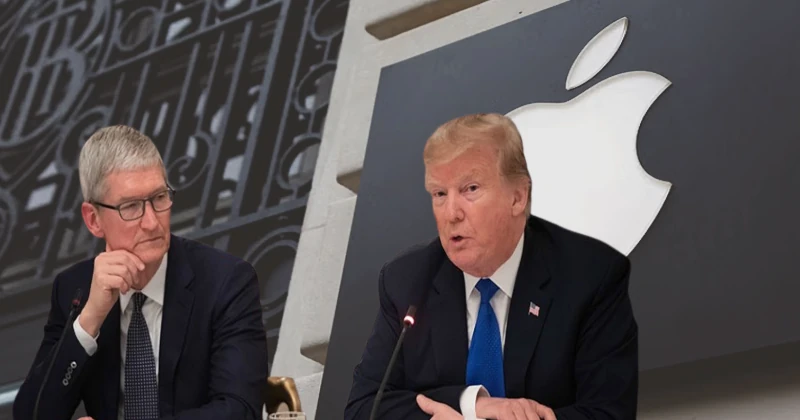
US President Donald Trump, speaking at a business summit in Qatar, publicly admonished Apple CEO Tim Cook, urging the tech giant to halt its rapidly growing iPhone production in India. Referring to his alleged direct conversation with Cook, Trump said:
“I said to him, ‘My friend, I’m treating you very good. You’re coming up with $500 billion, but now I hear you’re building all over India. I don’t want you building in India.’”
This unprecedented public rebuke of a top US corporation for expanding in India has rattled US-India trade watchers, stirred political tensions, and cast a spotlight on Apple’s tightly guarded “China+1” pivot to India. Trump, who repeatedly targeted Chinese manufacturing during his presidency, now appears to be pushing back against India’s ascent as a tech manufacturing superpower.
But despite the rhetoric, Apple is not budging. On the contrary, sources within the company have told Indian officials in no uncertain terms that their expansion in India is non-negotiable. With $22 billion worth of iPhones produced in India in FY25, the country has firmly embedded itself in Apple’s global supply chain — a shift too big to reverse.
“India can take care of themselves,” Trump says: But Apple can’t ignore the world’s fastest-growing production base
While addressing the summit in Doha, Trump launched a pointed tirade:
“You (Apple) want to build in India, if you want to take care of India. India is one of the highest tariff nations, it is very hard to sell in India. But they have offered us a deal where there’s literally no tariff. So from the highest tariff, we’re going to almost no tariff.”
Trump’s statement, despite its economic undertone, was delivered with geopolitical sting. He praised India’s self-sufficiency — “India can take care of themselves very well” — while simultaneously demanding that a crown jewel of American innovation halt its India production. The remarks have led to immediate concerns in New Delhi. Yet, the Indian government has responded with calm confidence, even as it reached out directly to Apple following Trump’s comments.
“There is no change in Apple’s investment plans in India,” said a senior Indian official familiar with the conversation. “India has built a strong ecosystem for electronics manufacturing, and companies like Apple are here because of that competitiveness — not political pressure.”
Apple’s India play: From iPhone SE to iPhone 16 Pro Max
Since 2017, when Apple first began assembling the iPhone SE in India, its journey has evolved into a full-blown manufacturing revolution. By March 2025:
- 15 per cent of Apple’s global iPhone output is produced in India.
- Over 3 million iPhones were exported from India to the US in March 2025 alone.
- Apple has expanded from making older models to assembling premium flagships like the iPhone 16 Pro and Pro Max, as well as AirPods in Telangana.
What started as a low-risk diversification experiment is now a core component of Apple’s global supply chain strategy. In fact, by 2026, Apple is expected to manufacture all iPhones sold in the US exclusively in India, eliminating tariff vulnerability from its China-based plants.
Apple’s manufacturing partners are also making massive bets on India:
- Foxconn is acquiring 300 acres of land in Uttar Pradesh for a new mega-plant.
- A $2.6 billion facility is under construction in Bengaluru, Karnataka.
- Tata Electronics, which recently began assembling iPhones in Tamil Nadu, is doubling iPhone casing capacity to one lakh units.
“India is no longer a Plan B — it’s Plan A,” a senior Apple supply chain executive was quoted as saying by industry insiders.
“We put up with China, but not India,” says Trump
Trump’s outrage appears hypocritical to many, especially since Apple’s entire hardware business relied on China for over two decades without resistance. Industry analysts are calling out the inconsistency. “Trump tolerated Apple’s billion-dollar China deals for years but is now objecting to India a democratic ally and strategic partner,” said Anil Bhardwaj, a geopolitical analyst.
“This isn’t about tariffs. It’s about strategic anxiety over India’s rise.”
Some analysts believe Trump’s tirade was also aimed at rousing domestic support ahead of the Republican primaries. His protectionist tone “build only in America” is seen as appealing to American blue-collar voters, even if it ignores the economic realities of global manufacturing.
“It would take Apple tens of billions of dollars and years of rebuilding to recreate India’s cost-efficient supply chains inside the US,” said Lisa Lamm, a senior analyst at Bernstein Research.
India Reclaims Narrative: “We’re not a pawn in America’s trade war”
India’s response to Trump’s remarks has been tactful but firm. Rather than reacting with indignation, New Delhi has turned the spotlight back on its manufacturing credentials. Union IT Minister Ashwini Vaishnaw recently declared that iPhones worth Rs 1.5 lakh crore were exported in FY25, hailing the achievement as a landmark moment for the ‘Make in India’ mission.
Officials also reminded observers that Apple’s decisions are rooted in economic logic, not foreign diktats. “Apple knows what it’s doing. No tweet or offhand comment will derail a strategy that’s taken years to build,” said a Commerce Ministry source.
India’s Production Linked Incentive (PLI) schemes and state-level sops have helped India leapfrog competitors like Vietnam and Malaysia, especially in high-tech electronics. The global chessboard is shifting. And India, once seen as a low-cost assembly hub, is now commanding strategic relevance.















Comments