





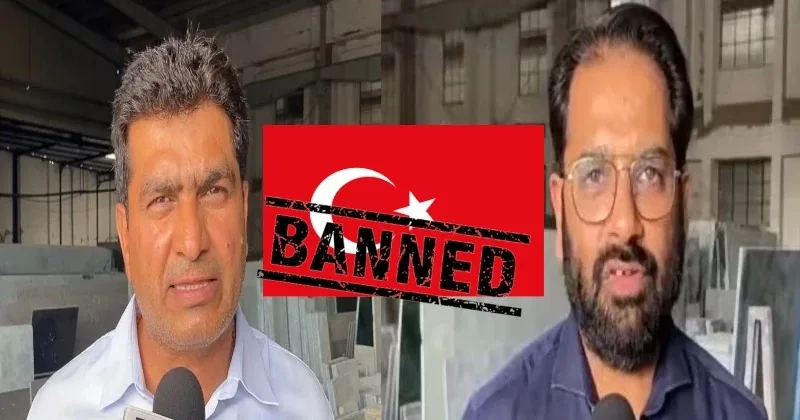
Marble traders from Udaipur, Rajasthan India’s largest marble hub have unilaterally severed ties with Turkey, protesting Ankara’s alleged support to Pakistan during Operation Sindoor. The decision came on the heels of revelations that Turkish-made drones were used by the Pakistani military during the recent conflict, a move viewed by Indian industry stakeholders as a direct affront to national sovereignty.
Udaipur’s marble industry, a cornerstone of India’s construction and luxury architecture sectors, has long been one of the biggest importers of Turkish marble. According to industry estimates, India imports between 14 to 18 lakh tonnes of marble annually, and Turkey alone accounts for over 70 per cent of that volume, amounting to a staggering Rs 2,500 to Rs 3,000 crore in trade.
This sudden boycott marks not only a significant shift in India-Turkey trade relations but also signals a broader willingness among Indian businesses to align with the nation’s strategic and defence priorities especially in the wake of Operation Sindoor, where Pakistani aggression was decisively countered by the Bharatiya Armed Forces.
“We are one of the biggest markets of Turkish marble and have decided to stop trade with Turkey immediately,” declared Kapil Surana, President of the Udaipur Marble Processors Association. The association, comprising around 125 prominent members, has sent a formal request to the Prime Minister’s Office urging the central government to impose an official ban on all marble imports from Turkey.
🚨 Udaipur marble traders END business with Turkiye for siding with Pakistan amid the ongoing tensions between India & Pakistan.
Kapil Surana, President of Udaipur Marble Processors Committee, says, “If all associations stop trade, it’ll show Indians stand with our government.” pic.twitter.com/UWwEizNnrX
— Megh Updates 🚨™ (@MeghUpdates) May 14, 2025
Hitesh Patel, General Secretary of the association, emphasised: “This is a huge loss for Turkey. The economic impact will be significant because this is not just business — this is about standing with our armed forces and our national interest.”
Patel revealed that the traders have also proposed extending the boycott beyond marble, targeting other Turkish imports to send an even stronger signal. “Why stop at marbles? If a country supports forces hostile to India, then every rupee of trade is a compromise on our national honour,” he asserted.
The move follows alarming disclosures made during a press briefing by the Indian Armed Forces amid Operation Sindoor, where initial forensic investigation of drone wreckage pointed to the use of Turkish-made Asisguard Songar drones by the Pakistani military. These drones, equipped with assault capabilities, were reportedly deployed across the Line of Control during the height of hostilities.
“This is not just about drones. It’s about a hostile country supporting our enemy with high-tech warfare systems. And Turkey needs to face the economic consequences of such reckless decisions,” said a senior member of the Udaipur association who did not wish to be named.
In recent years, India has increasingly emphasised Atmanirbhar Bharat, especially in critical sectors. The decision by Udaipur’s marble traders dovetails with this national vision, potentially opening the door to revitalising domestic marble quarries in Rajasthan, Gujarat, and Madhya Pradesh.
“This boycott is not a loss. It’s a win for the Indian economy and a chance to reduce our dependence on foreign goods,” said Surana. “Our local quarries have the potential to replace Turkish imports if proper government support is extended.”
Turkey’s growing alignment with Pakistan on geopolitical matters from Kashmir to military cooperation has been increasingly viewed with suspicion in New Delhi. Analysts suggest that this economic rupture could deal a blow to Turkey’s already fragile export-dependent economy while further isolating Pakistan on the international stage. “This isn’t just marble. This is strategic pressure, economic retaliation, and a loud message from Bharat’s private sector: We will not fund our enemies,” said an analyst at a Delhi-based policy think tank.
Udaipur’s initiative may soon find echoes across the country, with traders in other marble hubs reportedly exploring similar bans. The unprecedented move showcases the power of economic diplomacy from the ground up, as India’s private sector steps in to fortify national security through trade choices.
“We support the Prime Minister and the bold actions he has taken during Operation Sindoor,” Patel concluded. “If he imposes sanctions or restrictions, we will follow without question. For us, the nation always comes first even before business.”















Comments