Global Media hails India's precision strikes
December 5, 2025
  • Read Ecopy
  • Circulation
  • Advertise
  • Careers
  • About Us
  • Contact Us
Android AppiPhone AppArattai
Organiser
  • ‌
  • Bharat
    • Assam
    • Bihar
    • Chhattisgarh
    • Jharkhand
    • Maharashtra
    • View All States
  • World
    • Asia
    • Europe
    • North America
    • South America
    • Africa
    • Australia
  • Editorial
  • International
  • Opinion
  • RSS @ 100
  • More
    • Op Sindoor
    • Analysis
    • Sports
    • Defence
    • Politics
    • Business
    • Economy
    • Culture
    • Special Report
    • Sci & Tech
    • Entertainment
    • G20
    • Azadi Ka Amrit Mahotsav
    • Vocal4Local
    • Web Stories
    • Education
    • Employment
    • Books
    • Interviews
    • Travel
    • Law
    • Health
    • Obituary
  • Subscribe
    • Subscribe Print Edition
    • Subscribe Ecopy
    • Read Ecopy
  • ‌
  • Bharat
    • Assam
    • Bihar
    • Chhattisgarh
    • Jharkhand
    • Maharashtra
    • View All States
  • World
    • Asia
    • Europe
    • North America
    • South America
    • Africa
    • Australia
  • Editorial
  • International
  • Opinion
  • RSS @ 100
  • More
    • Op Sindoor
    • Analysis
    • Sports
    • Defence
    • Politics
    • Business
    • Economy
    • Culture
    • Special Report
    • Sci & Tech
    • Entertainment
    • G20
    • Azadi Ka Amrit Mahotsav
    • Vocal4Local
    • Web Stories
    • Education
    • Employment
    • Books
    • Interviews
    • Travel
    • Law
    • Health
    • Obituary
  • Subscribe
    • Subscribe Print Edition
    • Subscribe Ecopy
    • Read Ecopy
Organiser
  • Home
  • Bharat
  • World
  • Operation Sindoor
  • Editorial
  • Analysis
  • Opinion
  • Culture
  • Defence
  • International Edition
  • RSS @ 100
  • Magazine
  • Read Ecopy
Home Bharat

Operation Sindoor is the new normal: Global Media hails India’s precision strikes and PM Modi’s no-tolerance doctrine

Following the deadly Pahalgam terrorist attack, India's Operation Sindoor drew widespread global media attention for its precise, calibrated strikes on terror camps in Pakistan, marking a bold shift in India's counter-terror doctrine. PM Modi’s declaration of a “new normal” against terrorism rejecting nuclear blackmail and linking peace to strength was echoed across international headlines

WEBDESKWEBDESK
May 13, 2025, 06:00 pm IST
in Bharat
Follow on Google News
FacebookTwitterWhatsAppTelegramEmail

With missiles ripping through terror enclaves in Pakistan and Pakistan-occupied J&K (PoJK), and the world’s most powerful leaders watching closely, India has sent an unambiguous message: the age of strategic restraint is over. Under the decisive leadership of Prime Minister Narendra Modi, Operation Sindoor marked a paradigm shift in India’s national security doctrine—a muscular, unapologetic counter-terror policy that has now been ratified on the global stage.

Following the devastating Pahalgam terrorist attack on April 22, where 26 innocent civilians mostly Hindus were butchered in cold blood, India’s armed forces responded with precise missile strikes targeting the operational bases and leadership infrastructure of globally designated terrorist groups Lashkar-e-Taiba (LeT) and Jaish-e-Mohammed (JeM).

The strikes were swift. The message was surgical.

In his first public address after the successful operation, Prime Minister Modi didn’t mince words. His tone was not of a statesman asking for sympathy, but of a leader commanding global respect. His message was a cold, calibrated warning to Pakistan and a strategic signal to the world: “Terror and talks cannot go together. Terror and trade cannot run in parallel. Blood and water cannot flow together.”

PM Modi’s words echoed across newsrooms from Washington to Tokyo, many describing the speech as the boldest redefinition of India’s counter-terror doctrine in decades.

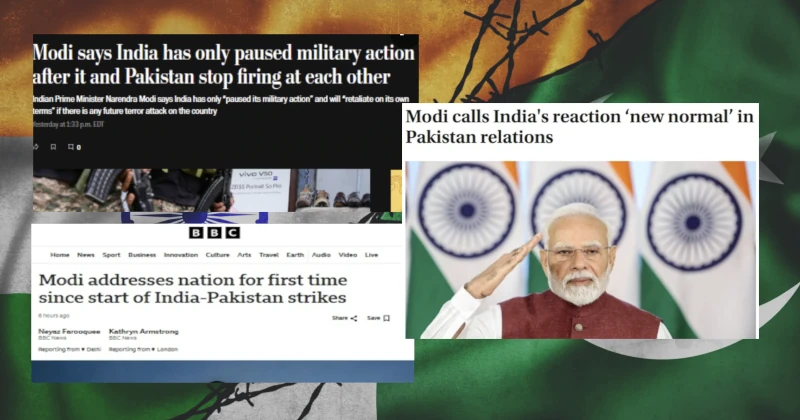
Declaring that “Operation Sindoor has struck a new line in the fight against terror—a new yardstick, a new normal,” PM Modi explicitly warned against nuclear blackmail, the old Pakistani tactic that had long throttled India’s military responses. This time, he said, India had acted, paused—not stopped—and would retaliate on its own terms if provoked again. The phrase “New Normal” now headlines nearly every major international article.

How the World Reported India’s Decisive Retaliation

Global media commentators noted India’s assertive yet disciplined response. The Washington Post described Operation Sindoor as “triumphant” at home, observing that some leaders viewed it as a chance to “rewrite the deterrence playbook” in South Asia by proving India can strike deep within Pakistan.

Conservative analysts in India lauded the strikes as a show of air power and resolve. Meanwhile, major outlets reported that Western capitals largely urged calm but acknowledged India’s right to act. US President Trump immediately voiced support, saying it was a “shame” what happened and hoping the conflict would end quickly.

European media highlighted PM Modi’s insistence that “terror and talks cannot happen together”, echoing his assertion that “water and blood cannot flow together” when one side sponsors terror. Notably, international coverage recognised PM Modi’s rejection of nuclear coercion as a significant shift.

Commentators from The Guardian to BBC noted his “sharp warning” against Pakistan’s nuclear threats and his framing of Operation Sindoor as India’s entry into a new era of counterterrorism. Some analysts pointed out that by naming the operation “Sindoor” (vermillion, the marriage powder), PM Modi was invoking the image of widowed wives seeking justice.

This symbolic messaging combining honor for victims with strategic resolve was widely reported. In Japan and Israel, editorials noted that democracies under threat of terrorism often receive domestic and quiet international sympathy; Japan Times op-eds urged regional powers to support India’s stance against cross-border terror.

Samaa TV (Pakistan): “PM Modi warns: Operation Sindoor suspended, not ended” In a rare moment of admission, the Pakistani broadcaster acknowledged PM Modi’s stern message and admitted the psychological impact of India’s “suspended, not concluded” operation.

In the dead of night on May 8, India’s Rafale fighter jets launched SCALP cruise missiles into the heart of Pakistan’s terror architecture in Bahawalpur, Muridke, Kotli, and Muzaffarabad. These locations, long known as sanctuaries for LeT and JeM terrorists, were obliterated in what analysts are calling one of the most precise non-nuclear strikes in modern South Asian history.

According to a statement from the Ministry of Defence:

“India has demonstrated considerable restraint in the selection of targets and method of execution. The strikes were focused, measured, and non-escalatory. No Pakistani military installations or civilian infrastructure were targeted.”

US, UK, Europe, and Israel back India’s position

The New York Times ran with: “India Launches Missile Strikes Inside Pakistan After Kashmir Attack” The NYT noted that India had informed the United States in advance, underscoring India’s transparency and maturity as a regional power.

CNN’s headline: “India and Pakistan on Brink of Wider Conflict”, framed India’s use of modern military hardware as a clear advantage, but reiterated that India avoided civilian and military Pakistani targets, reinforcing the legitimacy of the mission.

The Times of Israel led with: “Israel Backs India’s Right to Self-Defence”, a rare but potent diplomatic endorsement that reflects deepening strategic alignment between democracies facing common threats.

Le Monde (France): “India Strikes Pakistan in Response to Terror Attack”, noted the growing acceptance of India’s position among European policymakers who now view Pakistan’s terror-export policy as the root cause of instability in the region.

Operation Sindoor was not just a military strike—it was a geopolitical reset. It showed that India will no longer be the victim-nation issuing dossiers and pleas at global forums. It is now a nation that strikes first, explains later, and does so with surgical precision.

For decades, Pakistan banked on the theory that India’s size, democracy, and desire for peace would paralyse it from responding. PM Modi’s India has shattered that illusion. In one of the most telling lines of his speech, PM Modi said: “If Pakistan wishes to survive, it must dismantle its terror infrastructure. There is no other path to peace.”

Also Read: Chants of ‘Vande Matram’, echo at ‘Adampur base’ as PM Modi fact checked Pakistan over lies on damage to airbases

India’s tricolor held high even in tense times: the nation stands united against terrorism.Operation Sindoor represents an evolution in India’s cross-border strike policy. In past years, India has reacted forcefully to terrorism – as in the 2016 Uri surgical strikes and the 2019 Balakot air strikes – but those were primarily tactical replies. Sindoor, by contrast, has been explicitly cast as a new strategic doctrine. Analysts note that PM Modi himself drew on those precedents: Uri and Balakot were “fitting replies” to provocations, but Sindoor is now framed as a standing policy .

By publicly “suspending” rather than ending Sindoor, PM Modi sent a warning that future terror attacks on Indian soil will meet the same fate, regardless of nuclear threats.

Topics: PM ModiNational SecurityGlobal MediaPahalgam Terrorist attackOperation Sindoor
ShareTweetSendShareSend
✮ Subscribe Organiser YouTube Channel. ✮
✮ Join Organiser's WhatsApp channel for Nationalist views beyond the news. ✮
Previous News

Operation Sindoor: ‘Bharat will not tolerate Pakistan’s nuclear blackmail’

Next News

Chhattisgarh: Maoists execute 4 civilians in Bijapur; 31 extremists killed at operation in Karregutta, 400 IEDs seized

Related News

Fact Check: Rahul Gandhi false claim about govt blocking his meet with Russian President Putin exposed; MEA clears air

Retired Subedar held for leaking Army details to Pak handlers posing as Indians

Gujarat ATS dismantles spy network involving Ex-Army personnel and woman for sharing information with Pakistan

“Inspiration for millions”: PM Modi gifts Russian edition of Bhagvad Gita to Putin

Representative image

Navy Day 2025: Celebrating valour & strategic role of the Indian Navy in maritime security; PM Modi extends greetings

Prime Minister Narendra Modi

PM Modi pays tribute to Dr Rajendra Prasad on his birth anniversary

Prime Minister Narendra Modi

Historic November for India: From Ram Mandir to space-tech to global games, Bharat’s cultural, strategic & global rise

Load More

Comments

The comments posted here/below/in the given space are not on behalf of Organiser. The person posting the comment will be in sole ownership of its responsibility. According to the central government's IT rules, obscene or offensive statement made against a person, religion, community or nation is a punishable offense, and legal action would be taken against people who indulge in such activities.

Latest News

PM Modi presents Putin with Bhagavad Gita, chess set, and silver horse

Cultural ties strengthened: PM Modi presents Putin with Bhagavad Gita, chess set, and silver horse

Image for representational purpose only, Courtesy Vocal Media

Bihar to get ‘Special Economic Zones’ in Buxar and West Champaran

Thirupparankundram Karthigai Deepam utsav

Andhra Pradesh: AP Dy CM Pawan Kalyan reacts to Thirupparankundram row, flags concern over religious rights of Hindus

23rd India-Russia Annual Summit

India-Russia Summit heralds new chapter in time-tested ties: Inks MoUs in economic, defence, tourism & education

DGCA orders probe into IndiGo flight disruptions; Committee to report in 15 days

BJYM leader Shyamraj with Janaki

Kerala: Widow of BJP worker murdered in 1995 steps into electoral battle after three decades at Valancherry

Russian Sber bank has unveiled access to its retail investors to the Indian stock market by etching its mutual fund to Nifty50

Scripting economic bonhomie: Russian investors gain access to Indian stocks, Sber unveils Nifty50 pegged mutual funds

Petitioner S Vignesh Shishir speaking to the reporters about the Rahul Gandhi UK citizenship case outside the Raebareli court

Rahul Gandhi UK Citizenship Case: Congress supporters create ruckus in court; Foreign visit details shared with judge

(L) Kerala High Court (R) Bouncers in Trippoonithura temple

Kerala: HC slams CPM-controlled Kochi Devaswom Board for deploying bouncers for crowd management during festival

Fact Check: Rahul Gandhi false claim about govt blocking his meet with Russian President Putin exposed; MEA clears air

Load More
  • Privacy
  • Terms
  • Cookie Policy
  • Refund and Cancellation
  • Delivery and Shipping

© Bharat Prakashan (Delhi) Limited.
Tech-enabled by Ananthapuri Technologies

  • Home
  • Search Organiser
  • Bharat
    • Assam
    • Bihar
    • Chhattisgarh
    • Jharkhand
    • Maharashtra
    • View All States
  • World
    • Asia
    • Africa
    • North America
    • South America
    • Europe
    • Australia
  • Editorial
  • Operation Sindoor
  • Opinion
  • Analysis
  • Defence
  • Culture
  • Sports
  • Business
  • RSS @ 100
  • Entertainment
  • More ..
    • Sci & Tech
    • Vocal4Local
    • Special Report
    • Education
    • Employment
    • Books
    • Interviews
    • Travel
    • Health
    • Politics
    • Law
    • Economy
    • Obituary
  • Subscribe Magazine
  • Read Ecopy
  • Advertise
  • Circulation
  • Careers
  • About Us
  • Contact Us
  • Policies & Terms
    • Privacy Policy
    • Cookie Policy
    • Refund and Cancellation
    • Terms of Use

© Bharat Prakashan (Delhi) Limited.
Tech-enabled by Ananthapuri Technologies