





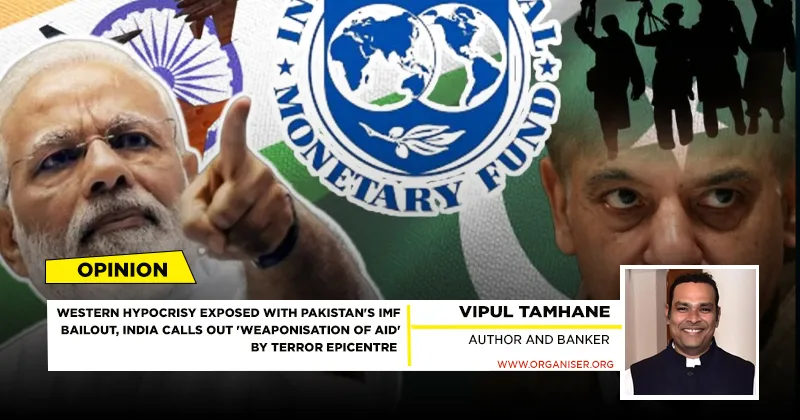
As the International Monetary Fund (IMF) prepares to disburse yet another tranche, $1.3 billion from a $7 billion Extended Fund Facility, Pakistan’s chronic dependence on international financial assistance is once again faced with scrutiny. However, this time around, we care about even more than economics. We care about terrorism, accountability, and the moral limits of international assistance. The lead resistance to this is India, which is questioning the very basis of whether extending funding to a country that has been or is clearly accused of having sheltered and sponsored terrorism is appropriate.
India’s opposition to Pakistan’s IMF bailout is not a trivial reaction to geopolitical circumstances, but a logical strategic opposition, shaped by years of terrible experiences in dealing with its duplicitous western neighbour. New Delhi’s articulation of its opposition is centrally grounded on three axes of attack: misuse of the IMF funds; Pakistan’s unwillingness or inability to reform; and; the odious precedent of rewarding a country that has used diplomacy as a cover to rehabilitation terrorism as part of its policies.
Ever since Pakistan first took out an IMF loan of $25 million in 1958, it has requested and been part of 24 IMF programs, approximately one per 2.5 years. Such persistence not only explicitly speaks volumes for longstanding fiscal ineptness with a clear pattern of dependence and lapse, ushering in a fundamental failure to evolve a self-generating economy. The IMF approved a loan to Pakistan in July 2019 for around $6 billion. This loan was under a three-year Extended Fund Facility (EFF) agreement to stabilize the economy of Pakistan, and the world saw the May 2023 economic collapse. Evidently the IMF fails to observe the pattern here.
While the IMF conditions imposed on Pakistan propose pro-fiscal discipline and anti-corruption strategies, oversight is woefully weak. A recent report by the Auditor General of Pakistan reported nearly 600,000 unresolved audit observations, indicative of financial misgovernance occurring within Pakistan’s national budget process. The Financial Action Task Force (FATF) has issued more than 8,700 suspicious transaction reports to Pakistan authorities in 2018, suggesting significant concerns related to fiscal and personnel failures allowing terror financing to proceed through a surfeit of excessively weak banking channels.
India’s core objection stems from a ‘Security First’ point of view. This protest within an IMF forum is based on the assumption that international financial institutions should not indirectly finance terrorism in any way. The idea of Pakistan’s persistent patronage, if not overt support, to Lashkar-e-Taiba (LeT), Jaish-e-Mohammed (JeM) and Hizbul Mujahideen is the very essence of India’s criticism. These entities have made obscenely ghastly incursions into Indian soil such as the Mumbai terror attacks of 2008, and the Pulwama bombing of 2019.
India is clear and unwavering: IMF funds in the absence of stringent supervision could all too easily be diverted into the very institutions: the military and intelligence services, that defend and thus enable these terror groups. When aid from the global community does prop up a regime, that chooses to spend those funds in support of terror groups that destabilize all its neighbours, and not in support of reforming itself, we lose all moral pretext for an aid regime.
Pakistan’s military has direct control over the country’s economy through military-operated conglomerates and opaque systems of patronage, with very little civilian monitoring. This militarization makes the line between humanitarian assistance and enrichment for the military blurred. Pakistan, in having to deal with Indian retaliations because it provides havens to terrorism, has no money to support long-term conflict. India perceives this as the “Weaponization of Aid,” accusing that money intended for stabilization has been diverted to modernize Pakistan’s armed forces. Accounts of state rewards for dead militants further incite suspicions of military alignment with extremist groups. Thus, India’s appeal for “moral checks” in world lending is an appeal for reform, arguing that IMF lending must be contingent upon promises to break up terror groups and demilitarize the economy.
India’s response to Pakistan occurs as tensions run high along the border. In the weeks prior, drone incursions, blackouts, and shelling had occurred in Firozpur, Gurdaspur and Jammu. One particularly shocking attack occurred in Firozpur in which a drone dropped incendiary weapons, injuring civilians and an attack involving shelling at a Gurudwara (Sikh religious centre) near a Christian missionary school resulted in the deaths of two children, which again highlights the human cost of the fallout. The Pakistani Defence Minister’s statement that “war is the only option left” indicates a readiness to up the ante. This indicates a regime that is economically collapsing and diplomatically isolated and it is utilizing militarism to rally a domestic audience and to distract from failures at home, while adding yet another level to this appeal for funds.
The situation is nothing short of a diplomatic tightrope, where India has responded with patience and resolve. Military posturing being done at a high-level, India has so far resisted the temptation to retaliate and is making use of international mechanisms like the IMF to exert pressure and seek some form of accountability, but now it’s high time.
In other words, the three-pronged response, combining diplomatic protest, economic opposition, and military deterrence, declares that India is maturing as an emerging global power and is moving away from a defensive reaction toward an established proactive policy based on its voice as an international player.
In Indian strategic circles, there is mounting disenchantment against Western hypocrisy with Pakistan’s IMF bailout, even in the face of Indian protests and FATF notices. It is argued that institutions such as IMF and World Bank are guided by geopolitical considerations, rather than principles. While the US looks at India as a strategic partner, it simultaneously keeps the military-industrial complex of Pakistan alive by way of economic lifelines. Some voices go as far as suggesting extreme actions, such as India pulling out of the IMF or rallying for international sanctions against terror-sponsoring regimes, a dilemma suggestive of Indian foreign policy being pushed to an assertive limit.
IMF will have to be accountable for global financial ethics. India’s protest against IMF bailout is not a local dispute, it is a test for global financial ethics. Should institutions like the IMF continue to pour money into repressive regimes, promote militarisation, and give shelter to terrorists?
India is not aiming to isolate Pakistan out of conflict desire. It is making one simple demand: accountability before aid. Without such a principle, aid is complicity.
As the IMF board meets, the world has to make a choice between whether financial institutions will be drivers of reform or facilitators of repression. For India, that decision has already been taken. And if the world seriously wants peace in South Asia, it has to listen to this call for moral solidarity, not selfish charity.













Comments