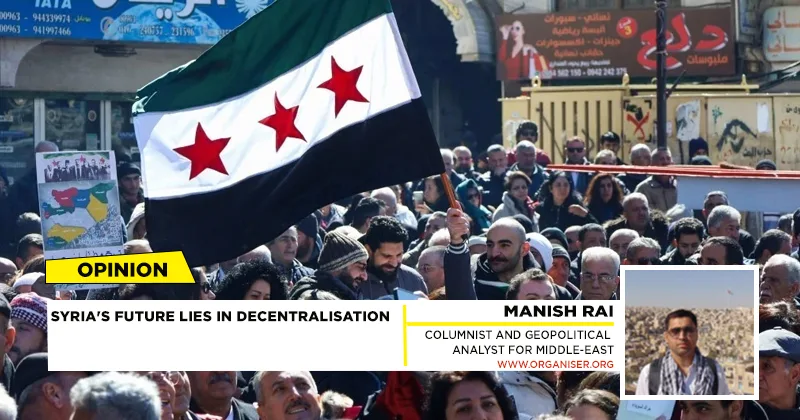
Syria's future lies in decentralisation
December 6, 2025
  • Read Ecopy
  • Circulation
  • Advertise
  • Careers
  • About Us
  • Contact Us
Android AppiPhone AppArattai
Organiser
  • ‌
  • Bharat
    • Assam
    • Bihar
    • Chhattisgarh
    • Jharkhand
    • Maharashtra
    • View All States
  • World
    • Asia
    • Europe
    • North America
    • South America
    • Africa
    • Australia
  • Editorial
  • International
  • Opinion
  • RSS @ 100
  • More
    • Op Sindoor
    • Analysis
    • Sports
    • Defence
    • Politics
    • Business
    • Economy
    • Culture
    • Special Report
    • Sci & Tech
    • Entertainment
    • G20
    • Azadi Ka Amrit Mahotsav
    • Vocal4Local
    • Web Stories
    • Education
    • Employment
    • Books
    • Interviews
    • Travel
    • Law
    • Health
    • Obituary
  • Subscribe
    • Subscribe Print Edition
    • Subscribe Ecopy
    • Read Ecopy
  • ‌
  • Bharat
    • Assam
    • Bihar
    • Chhattisgarh
    • Jharkhand
    • Maharashtra
    • View All States
  • World
    • Asia
    • Europe
    • North America
    • South America
    • Africa
    • Australia
  • Editorial
  • International
  • Opinion
  • RSS @ 100
  • More
    • Op Sindoor
    • Analysis
    • Sports
    • Defence
    • Politics
    • Business
    • Economy
    • Culture
    • Special Report
    • Sci & Tech
    • Entertainment
    • G20
    • Azadi Ka Amrit Mahotsav
    • Vocal4Local
    • Web Stories
    • Education
    • Employment
    • Books
    • Interviews
    • Travel
    • Law
    • Health
    • Obituary
  • Subscribe
    • Subscribe Print Edition
    • Subscribe Ecopy
    • Read Ecopy
Organiser
  • Home
  • Bharat
  • World
  • Operation Sindoor
  • Editorial
  • Analysis
  • Opinion
  • Culture
  • Defence
  • International Edition
  • RSS @ 100
  • Magazine
  • Read Ecopy
Home World

Syria’s future lies in decentralisation

The recent Kurdish Unity Conference in Qamishli reignited calls for a decentralised Syrian state, clashing with the interim government's push for centralised power amid rising minority unrest. With Syria’s deep ethno-sectarian divides, only a devolved governance model can ensure national unity, stability, and minority inclusion in post-Assad Syria

Manish RaiManish Rai
May 4, 2025, 01:00 pm IST
in World, Opinion, International Edition
Follow on Google News
FacebookTwitterWhatsAppTelegramEmail

The Conference on Kurdish Unity and Common Stance was recently concluded in Qamishli, North-East Syria. Over 400 delegates from various parts of Syria participated in the conference, which aimed to strengthen Kurdish unity and establish common political positions. A communiqué at the end of the conference, which United States officials also attended, demanded that a future Syrian constitution should enshrine respect for Kurdish national rights in post-Assad Syria. The most important point of the pan-Kurdish statement was advocacy for Syria as a decentralised democratic state. Unfortunately, without giving much thought to this idea, the Syrian Presidency, in a haphazard manner, rejected it. The Syrian presidency’s statement rejected the call for a decentralised state and mentioned that recent statements by Syrian Democratic Forces (SDF) leaders advocating a federal solution are clearly against the agreed-upon deal. The Syrian President was joined by Syria’s Islamist leaders, who opposed Kurdish demands for the country to adopt a decentralised system of government as a new political order, stating that this poses a threat to national unity. Before the Syrian uprising morphed into a full-scale war, Syria was probably the most authoritarian regime in the Arab region, unequalled in the scale of its repressive practices except by the Iraqi regime of Saddam Hussein. The new authorities in Damascus want to rebuild the country on this same line with a highly centralised governance structure.

Today’s Syria, because of thirteen years of conflict, now suffers from deep divisions along both ethno-sectarian and geographic lines. While economic links and interdependency persist between the various parts of the country, and most Syrians remain remarkably attached to the idea of national unity, the country’s social fabric has fragmented. Even after the removal of the regime of Bashar al-Assad, the new interim government did not put any effort into restoring confidence among the minorities of the country. In March this year, Alawites living mostly in coastal areas of Syria were brutally targeted by the militias allied with the current government, and the Jihadists killed more than 1600 civilians. Currently, another minority group. i.e. Druze are being targeted by the forces loyal to Damascus; the clashes between pro-government fighters and local Druze gunmen resulted in the killing of more than a dozen people in a suburb of the Syrian capital. In the aftermath of this violence, the Druze have taken control of Suwayda province and are preventing interim government forces from entering. The same goes for Druze-populated districts in the capital’s suburbs, including Jaramana, Sahnaya, and Jdeidat Artouz. With this kind of deep feeling of insecurity among the minorities, building a Syrian state with concentrated power in Damascus is unrealistic.

Ironically, interim President Ahmad-al-Sharaa wrongly believes that centralisation is essential to preventing further fragmentation and dismantling competing power structures. By consolidating authority under a strong central state, he seeks to monopolise control over security, political, and economic decision-making, ensuring the transitional authorities retain dominance over Syria’s future direction. He is following the same deeply centralised approach he adopted in Idlib. Still, Sharaa needs to understand that this approach can’t be applied to pan-Syria, as ruling a homogenous province that mainly has one ethnicity and governing a very diverse country is different. The Syrian conflict has devastated every component on which a country stands on its own, like its population, civil society, infrastructure, cultural heritage, and economy. Before the conflict, Syria was a middle-income country with an economy based on agriculture, industry, oil, trade, and tourism, with decent health care and education. In a country that has suffered from decades of authoritarian rule, an overly centralised system could replicate the same patterns of exclusion and repression that fuelled the previous conflict, potentially leading to renewed instability, governance paralysis, or even conflict relapse.

One thing is clear: Syria can’t be a monolithic nation-state. However, the Syrians must decide whether it will be a decentralisation, federalism, or a confederation. However, deciding the exact form of a decentralised state structure will be a long negotiation process. In the past, some form of decentralisation was conceptualised. Along the lines of a 2011 decree, the Syrian government of Bashar Al-Assad issued the devolution agreement detailing the role of local authorities. Decree 107, also known as the “Local Administration Law,” was introduced as part of a package of political reforms passed in August 2011 in response to demands by a civil uprising already sweeping the country. The decree was designed to devolve political and administrative responsibilities to institutions at the local level, but it was never fully clear how it would be implemented. However, this proposal of the past regime can be used as a starting point to develop a governance system that is acceptable to everyone.

Syria is a multiethnic society consisting of Sunni Arabs, Kurds, Assyrians, Armenians, Turkomans, Alawites, and Yazidis. To keep the country united and stable, it is need of the hour to delegate powers at the local level. In multiethnic countries like Nigeria and India, this model has arguably helped hold these nations together. The future Syrian state should be a nation that accommodates and grants rights to all ethnic groups, and everyone feels their participation in running the state.

Mr Jwan Shekaki from NPA Syria, based in Qamishli, and Mr Hozan Zubair, a Syrian Journalist from Al-Hasakah, currently based in Erbil, Kurdistan, provided inputs for this article.

Topics: QamishliSyriaSDFKurdish Unity ConferenceSyria decentralisation
Manish Rai
Manish Rai
The writer is a Political Analyst for West Asia and Af-Pak Region. [Read more]
ShareTweetSendShareSend
✮ Subscribe Organiser YouTube Channel. ✮
✮ Join Organiser's WhatsApp channel for Nationalist views beyond the news. ✮
Previous News

Viksit Bharat through the lens of the Bhagavad Gita: A spiritual blueprint for India’s development

Next News

A step towards Bharatiyakaran: Reclaiming India’s educational identity

Related News

Delhi Police foils major terror plot: Two suspected ISIS operatives arrested; crowded areas in the national capital were reportedly on target

Delhi Police foils ISIS-inspired terror plot; Adnan and one other operative held for planning attack on prominent mall

Interim President of Syria Ahmad al-Shaara(File Photo)

Al-Shaara’s recent diplomatic wins emboldened him to monopolize the power

Interim President of Syria Ahmad al-Shaara, a UNSC sanctionned terrorist and a former member of Al Qaeda addresses UNGA

UN Hypocrisy: Syrian President Ahmad al-Sharaa speaks at UNGA, former Al-Qaeda member and a UNSC sanctioned terrorist

Interim President of Syria Ahmed al-Sharaa

Interim President of Syria Ahmed al-Sharaa, a terror designate under UNSC list is set to address the UNGA

Civilians carrying the dead body

Syria’s Deadliest Clashes Since Assad’s Fall: Over 200 killed in Islamist-led Govt’s retaliatory attacks

“The past record of the Modi government will be a source of comfort,” says S Jaishankar on efforts in Syria

Load More

Comments

The comments posted here/below/in the given space are not on behalf of Organiser. The person posting the comment will be in sole ownership of its responsibility. According to the central government's IT rules, obscene or offensive statement made against a person, religion, community or nation is a punishable offense, and legal action would be taken against people who indulge in such activities.

Latest News

PM Modi presents Putin with Bhagavad Gita, chess set, and silver horse

Cultural ties strengthened: PM Modi presents Putin with Bhagavad Gita, chess set, and silver horse

Image for representational purpose only, Courtesy Vocal Media

Bihar to get ‘Special Economic Zones’ in Buxar and West Champaran

Thirupparankundram Karthigai Deepam utsav

Andhra Pradesh: AP Dy CM Pawan Kalyan reacts to Thirupparankundram row, flags concern over religious rights of Hindus

23rd India-Russia Annual Summit

India-Russia Summit heralds new chapter in time-tested ties: Inks MoUs in economic, defence, tourism & education

DGCA orders probe into IndiGo flight disruptions; Committee to report in 15 days

BJYM leader Shyamraj with Janaki

Kerala: Widow of BJP worker murdered in 1995 steps into electoral battle after three decades at Valancherry

Russian Sber bank has unveiled access to its retail investors to the Indian stock market by etching its mutual fund to Nifty50

Scripting economic bonhomie: Russian investors gain access to Indian stocks, Sber unveils Nifty50 pegged mutual funds

Petitioner S Vignesh Shishir speaking to the reporters about the Rahul Gandhi UK citizenship case outside the Raebareli court

Rahul Gandhi UK Citizenship Case: Congress supporters create ruckus in court; Foreign visit details shared with judge

(L) Kerala High Court (R) Bouncers in Trippoonithura temple

Kerala: HC slams CPM-controlled Kochi Devaswom Board for deploying bouncers for crowd management during festival

Fact Check: Rahul Gandhi false claim about govt blocking his meet with Russian President Putin exposed; MEA clears air

Load More
  • Privacy
  • Terms
  • Cookie Policy
  • Refund and Cancellation
  • Delivery and Shipping

© Bharat Prakashan (Delhi) Limited.
Tech-enabled by Ananthapuri Technologies

  • Home
  • Search Organiser
  • Bharat
    • Assam
    • Bihar
    • Chhattisgarh
    • Jharkhand
    • Maharashtra
    • View All States
  • World
    • Asia
    • Africa
    • North America
    • South America
    • Europe
    • Australia
  • Editorial
  • Operation Sindoor
  • Opinion
  • Analysis
  • Defence
  • Culture
  • Sports
  • Business
  • RSS @ 100
  • Entertainment
  • More ..
    • Sci & Tech
    • Vocal4Local
    • Special Report
    • Education
    • Employment
    • Books
    • Interviews
    • Travel
    • Health
    • Politics
    • Law
    • Economy
    • Obituary
  • Subscribe Magazine
  • Read Ecopy
  • Advertise
  • Circulation
  • Careers
  • About Us
  • Contact Us
  • Policies & Terms
    • Privacy Policy
    • Cookie Policy
    • Refund and Cancellation
    • Terms of Use

© Bharat Prakashan (Delhi) Limited.
Tech-enabled by Ananthapuri Technologies