





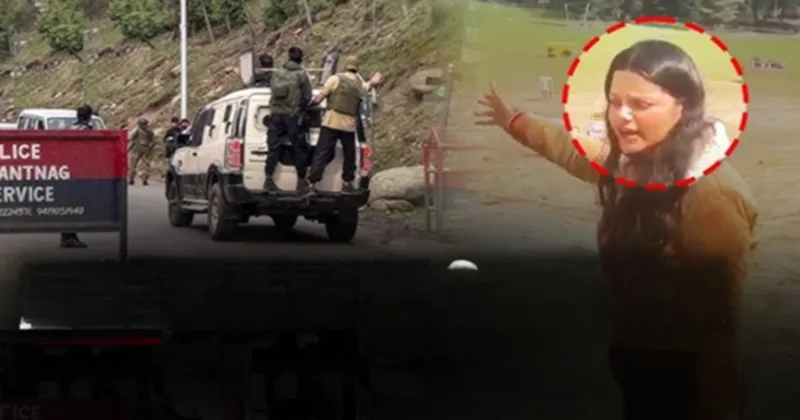
After the Pahalgam Terror Invasion, champions of secularism in Bharat wanted to curb social media handles such as the one that posted an AI-generated Studio Ghibli image of the victims with a caption: “Dharm poocha, jaati nahi.” It long manifested as an ailment in Bharat that countless secular souls hereof never hesitated to play divisive in the name of Dalit politics, but attempted to deny the reality that the fault line that still bleeds Bharat from within is the historical fault line of religious partition. However much one may try to deny, the terrorist invaders of Pahalgam indeed asked for religion of the victims, not their castes.
The same secular fellas reached the house of Havildar Jhantu Ali Shekh of 6 Para Special Forces of the Bharatiya Sena after he laid down his life defending the border of Bharat but not the house of Purnam Kumar Shaw. While Jhantu Ali Shekh from Nadia district of West Bengal lost his life in the Dudu-Basantgarh region of Udhampur district on April 24 during an exchange of gunfire with terrorists, Purnam, the BSF Jawan from Rishra, West Bengal was captured by Pakistan and still remained in the Pak-ranger’s custody.
Subedar Rafiqur Ali Shekh, the elder brother of Jhantu Ali Shekh said that Indian Army had no religion. But the secular politicians looked only at the religion of Jhantu Ali, not his supreme sacrifice for the motherland. Had they not, they would have visited Purnam Kumar Shaw’s family members too with priority.
While the court records of post poll violence 2021 proved beyond ambiguity that GoWB with powerful IAS, IPSs & the ruling dispensation of West Bengal patronized anti-Bharat hooligans, a large majority of whom were Muslims, mortal remains of a proven patriot like Jhantu Ali Shekh too was received by the pro-Pakistan West Bengal Minister & Kolkata Mayor Firhad Hakim at Netaji Subhas Chandra Bose International Airport on April 25. Was the tribute from a pro-Pakistan soul an honour to an Indian Army man or a humiliation to the cause of his sacrifice?
Mahua Moitra too delivered media talks on the selfless & truly secular services of the Indian Army while she once called Bharat a ‘susu-potty republic’ & collaborated with foreign powers to leak out the intra-parliament proceedings of Bharat to them. An irony that such anti-Bharat souls too paid tribute to Jhantu Ali Shekh on his martyrdom for Bharat.
Not only TMC, even CPM West Bengal too had paid a number of visits to Jhantu Ali’s house. The same CPM who reportedly marked, “Indian Army abducts, rapes women”. Left Parties in the Universities like JNU are infamous for their activism against the Indian Army in Kashmir. “On 23 February, 1991, an entire village was raped. And truth and justice have been throttled. The rapists haven’t been tried or punished. Instead the complaint of rape was never even investigated! Kunan Poshpora is a festering wound – and it is no aberration. Kunan Poshpora reminds us of the reality of Kashmir, where India’s Army systematically terrorises the people in the name of protecting ‘the rest of India’ and the ‘country’s integrity’.” Wrote AISA in their website. The same AISA whose leader Aishee Ghosh is a leader of West Bengal CPM at present. Leaders of such a party went frequently to the house of Jhantu Ali Shekh perhaps to gain political mileage. While CPM West Bengal’s Facebook Page didn’t have a single post till May 1 on the BSF Jawan Purnam Kumar Shaw’s being captured by Pakistan, it contained more than 10 posts on the martyrdom of Jhantu Ali Shekh. CPM & TMC, in spite of posing against the Indian Army in their political sphere, flocked together at Jhantu Ali’s place not perhaps because he sacrificed his life for Bharat but that he was a Muslim. Who can forget Mamata Banerjee’s declaration from an Administrative Review Meeting on January 2, 2025 that BSF was oppressing women in West Bengal? Similar words came from Banerjee’s favourite film director Aparna Sen in November 2021. An Urban Naxal in reality, Sen stated without ambiguity that BSF were “rapists” & “murderers”.
Such grotesque face of being secular in Bharat calls for some standardised definition of secularism to insulate the inherent secular psyche of Bharat Rashtra.












Comments