





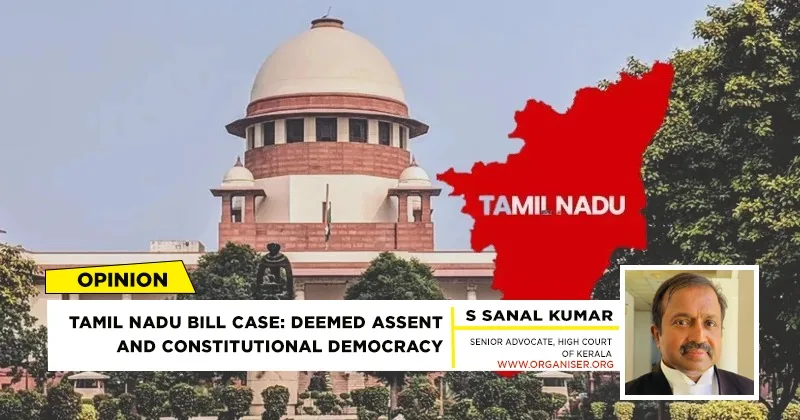
The furore over ‘Deemed Assent’ in Tamil Nadu Bills Case is not over yet. The fixing of time line for the Governor to take a call on Bills passed by Legislature and for the President to decide on the ‘Reserved Bills’ is viewed in dissenting notes from political quarters. The Vice president of India, Jagdeep Dhankar, is in news for his aggressive dissent on the verdict and exhortation for reasserting ‘Parliamentary Sovereignty’
Jurisdiction under Article 32
Apparently in exercise of the powers under Article 32, the Supreme Court adjudicated on a ‘conscious vacuum’ left in Article 200 and 201 of the Constitution of India. Article 32, which by itself is a fundamental right falling in part IIIof the Constitution (Fundamental Rights) ensures the right to move the Supreme Court by appropriate proceedings for the enforcement of fundamental rights under that part. For a petition under Article 32 to lie at the behest of a State Government, the violation of fundamental right of a citizen or an individual has to be demonstrated, going by the conventional and textual interpretation of Constitution. Fundamental right under part III of the Constitution are guaranteed to persons, citizens and religious denominations, linguistic groups and other non-State entities. State, in its umbrella definition takes with in its sweep, the Union Government and Parliament of India, State Governments and Legislatures of States and all local or other authorities within the territory of India or under the control of Government of India. The Guarantor’s duty when observed in breach, the guaranteed gets fundamental right to move the Supreme Court. Tussle between the State legislature or State Government and the Governor on the other side on assent to a Bill passed by the Legislature taking the hues of cause of action of violation of ‘fundamental right’ of the guarantor entity-too wild an interpretation, which seems to be so artificially stretched to make artillery to strike at the fine balance of Constitutional equilibrium of power. A polemic made as State of Tamil Nadu is espousing the cause of people of Tamil Nadu of their fundamental right to be governed by a provincial legislation on university matters (Bills mostly are relating to appointment of vice -chancellor) is unduly delayed by the Governor or President is seemingly illogical when tested on the touch stone of established principles of interpretation of constitutional law. The ‘will of the people’ not getting imprimatur at the hands of Governor is not denial of fundamental of rights of citizens of Tamil Nadu, which the State Government could take to the Supreme Court under Article 32 for grievance redressal. Under part III of the Constitution, Government of a State is the ‘Guarantor’ of fundamental right. When the somewhat comprehensive definition of ‘State’ as contained under Article 12 of the Constitution is examined closely, one can visualise the Union Government and Union Parliament as the trunk and State Governments and its legislatures as limbs in the anatomy of the Constitution. The constitutional scheme does not appear to have foreseen a component itself of Union of India turning against it, or its Executive Head (President) and filing Petitions under article 32 alleging violation of fundamental rights-an unprecedented constitutional melodrama now unfolded in the Tamil Nadu case.
Remedy of State Government under Article 226 of the Constitution
More in alignment with Constitution would have been, if the State of Tamil Nadu moved against the Governor and President before the Chennai High Court under Article 226 of the Constitution. High Court’s jurisdiction being wider and more sweeping than that of the Supreme Court, it could entertain any plea by any person for issuance of writs to any ‘person, or authority, including in appropriate cases, any government for the enforcement of any of the rights conferred by part III and ‘for any purpose’. Instead of going for convoluted constitutional interpretations for invocation of jurisdiction of Supreme Court on the plea of violation of fundamental rights, the Tamil Nadu Government could have made out a convincing case of ‘delay and defeat of democracy’; at least in the matter of assumption of jurisdiction by constitutional courts as the High Court’s power extends to ‘for any other purpose’ under Article226.
Article 32 and 139 of the Constitution
Except in a case of violation of fundamental rights, the original jurisdiction of Supreme Court is not available. Breach of violation of fundamental rights of individuals or groups is the core of the cause action under article 32. Construing delay in the assenting process of Bills as denial of fundamental right guaranteed to citizens is a proposition difficult for universal acceptance. Article 139 empowers the Parliament to ‘confer on the Supreme Court power to issue directions and writs for any purposes other than those mentioned in clause(2) of Article 32. States may have grievances against various constitutional functionaries like delay in assenting process which may not be falling within the contours of Articles 32, 131 or 143. A State Government, being part of the broader definition given to STATE as defined under article 12, cannot easily, without jurisdictional qualms, allege that its fundamental rights are violated for invoking the original jurisdiction of Supreme Court under article 32. Time is overdue for Parliament to make a law under Article 139 expanding the original jurisdiction of Supreme Court for enabling various constitutional functionaries to settle disputes involving interpretations on Constitution with clarity on jurisdiction.
Suit under Article 131
The Supreme Court’s original jurisdiction to the exclusion of other courts extends to any dispute between the Government of India and one or more other States. The President represents the Government of India, when Union of India undertake executive acts. Since the reservation of Bills to President by Governor is done on the legislative process part, an independent and solemn power is exercised by the President of India under Article 201 of the Constitution. No unreasonable elasticity can be given to the term ’Government of India‘ as occurring in Article 131 in the process of interpretation to include President in its sweep when the exercise of power by him on legislative side does matter. The scope of interpretations on Article 200 and 201 is grim in the light of plain interpretation of Article 131- to maintain a suit against Governor and President. An issue as to whether a State Government can challenge a central legislation on the plea of violation of fundamental right is understood to have been pending before a larger bench of the Supreme Court. The case has its roots from challenge of NIA Act by State of Chhattisgarh on the premise of violation of fundamental rights.
Formation of Constitution Bench
“The minimum number of judges who are to sit for the purpose of deciding any case involving a substantial question of law as to the interpretation of Constitution or for the purpose of hearing any reference under Article 143 shall be five”: so mandates the Constitution under Article 145(3). The Tamil Nadu Bill Assent case is decided by a Bench of two judges. The Bench’s constitutional sanction to decide issue of interpretation of Article 200 and 201 is doubtful and raising eyebrows. The number of minimum of 5 Judges was fixed originally in the Constitution when the original strength of Supreme Court was 7. Now by Act 37 of 2019, the total strength has gone up to 33 excluding the Chief Justice. Framers of the Constitution, while deciding the proportionate strength of Constitution Bench as five to the total strength of seven, had in their mind that every interpretation on Constitution must reflect the collective voice of “overwhelming majority” of Judges of the Supreme Court to add it authority, acceptability and legitimacy-both in quality and quantity, being as the learned law men’s opinion. Going by the original logical foundation for the strength of Constitution Bench, the present Bench should be a whopping twenty-four (5 to 7 originally, if so 24 to 34 now). Even the full strength of apex court deciding constitutional issues is not unheard elsewhere. Anyhow, 1979 constitution amendment fixed the strength as a minimum of five for a constitution bench for its formation. The decision on Tamil Nadu Bill could have got a ready acceptance and authority had it been in consonance with Article 145(3). As the jurisdictional competence of a bench of two Judges to decide on constitutional issue is doubtful, its precedential value under Article 141 as `law laid down’ gets blurred. Pendency of another matter of State of Kerala before the Supreme Court involving more or less similar issue may prompt a reference to Constitution Bench for examination of the entire gamut of the issue, which ultimately may lay down the authoritative interpretations of Article 200 and 201.
The Immunity to President and Governors
Article 361 of the Constitution affords immunity to President and Governors. The absolute protection is, ‘shall not be answerable to any court for the exercise and performance of the powers and duties of his office’. The office of the President of India is a unique one in the sense that it represents the ‘consolidated collective will’ of the people of India. The mode of election of the President of India, outlined in Article 54 and 55 of the Constitution endeavours to ensure both quantitative and qualitative choice of people India. The Electoral College consists of the elected representatives of both Houses of Parliament and State Legislative Assemblies. For ensuring uniformity in the scale of representation of different States, a value based voting pattern is provided. Depending on the size of the electorate a member of a State Legislative Assembly represents, varying values are given to votes of members of Legislative Assemblies of States in the election of President. Similar is the value assignment pattern of votes of members of Parliament. For ensuring correct scale of representation, a delicate and, at the same time complicated calibration is done to ensure proportionate representation of population of each State in the election to the office of President. The entire nation indirectly takes part in the election of President to vest him with the Supreme command of the Defence Force of Union of India under Article 53(2).
Governors are deputies of President appointed by him by warrant under his hand and seal. The Governor holds office during the pleasure of the President. The synergy and synthesis of Article 155 and 156 thus proclaim Governor to be the representative of the President, the executive head of Union of India. The insulated position accorded to President and Governor from Court proceedings establishes the paramountcy of constitutional democracy in India. Commenting on the position of Governor, Dr. Ambedkar said in Constituent Assembly (CAD June 1, 1949): “Of course there is because we do not want to vest the President with any discretionary power. Because the provincial Governments are required to work in subordination to the Central Government, and therefore, in order to see that they do act in subordination to the Central Government and the Governor will reserve certain things in order to give the President the opportunity to see that the rules under which the provincial Governments are supposed to act according to the Constitution or in subordination to the Central Government are observed”. A unique pyramid of the President at the top end as Executive Head of Union of India and the Governors at the base line as Heads of State Governments, is the system of Governance envisioned by the framers of the Constitution. While nearing the concluding sessions of constituent assembly, an Hon’ble member lamented at Dr. Ambedkar by saying that Dr. Ambedkar made India like Bismark’s Germany, when federal principles offered at the beginning were forgotten and steel block unitary structure evolved at the end of the day.
Article 142: Messiah or Missile
For doing complete justice, the Supreme Court is endowed with plenitude of powers as was enjoyed by the Privy Council. Privy Council, adjudicating appeals from India mostly on individual causes, could exercise this power effectively to meet the ends of justice. The impact of this ‘ justice formula’ for litigation in personam to do complete justice was confined to private litigations alone. No precedential value was ever attached to it. A rarely used Article in earlier days in private causes gradually found its way to its evolution as a legislative process; particularly when the Executive became frail with minority or coalition governments. The Judges Transfer case decided in early 80’s (S.P.Gupta V. Union of India 1982 AIR 149) is a classic example of mighty Executive versus Judiciary. The whopping majority Mr.Gandhi enjoyed was instrumental in imposing executive supremacy in the affairs of appointment and transfer of Judges of constitutional courts. Later, when the Executive became weak with minority governments at the centre, the Collegium System, unheard elsewhere started sprouting and blooming.It reached its full growth , when tall political leaders like L.K.Advani, V.C.Shukla and the like from all political parties were in the dock with Jain Hawala payoff scam surfaced.
Apprehending the danger of indiscreet use of Article 142, the Constitution Bench in Prem Chand Garg case (AIR 1963 SC 996) observed: “An order which this court can make to do complete justice between the parties, must not only be consistent with fundamental rights guaranteed by the Constitution, but it cannot even be inconsistent with the substantive provisions of the relevant statutory laws. Therefore, we do not think it would be possible to hold that Article 142(1) confers upon this court powers which can contravene the provisions of Article 32”. This view was approved in Naresh Shridhar Mirajkarv. State of Maharashtra (1966) 3 SCR 744) and A.R. Antulay v. R.S.Nayak (1998) 2 SCC 602). But in Vinay Chandra Mishra case (1995) 2 SCC 584, the Apex Court found the observation in Prem Chand Garg case as wrong and expanded its jurisdiction under Article 142 colossally. Contextual relevance to the period is also relevant as India during this time saw a minority government at the centre when Vinay Chandra Mishra case was decided.
Allahabad High Court Bar Association v. State of U.P posits a different situation where Supreme Court overturns an earlier decision setting a time limit of six months for High Courts to decide cases where stay of lower court proceedings was granted, with a default clause of automatic vacation of stay. The issuance of this general direction in exercise of powers under Article 142 was doubted which resulted in the constitution bench decision in Allahabad High Court Bar Association case. Finally resolving the issue Constitution Bench observed: (Para 32): “Therefore, constitutional courts should not normally fix a time bound schedule for disposal of cases pending in any court. The pattern of pendency of various categories of cases pending in every court, including High Court, is different. The situation at the grass roots level is better known to the judges of the concurred courts…..” The Constitution Bench quoted the observation of another Bench in P.Ramachandra Rao case: “Prescribing periods of limitation at the end of which the trial court would be obliged to terminate the proceedings and necessarily acquit or discharge the accused, and further making such directions applicable to all cases in the present and for the future amounts to legislation, which in our opinion, cannot be done by judicial directives and within the arena of the judicial law–making power available to constitutional courts, howsoever liberally we may interpret Article 32, 21, 141 and 142 of the Constitution…..”
In setting time lines to constitutional functionaries to exercise its powers and duties where no time limit is originally fixed, that too by invoking the powers under Article 142, one may doubt an overreach to the domain of Parliament. When no calendar for courts to adjudicate disputes with time frame can be issued under Article 142, the same logic may apply to gubernatorial actions. Comity among constitutional functionaries required directives with imploring and advisory tones particularly when grey areas of adjudications are undertaken.
Conclusion
The ‘inertia’ in gubernatorial office in assent to Bills is a cause of worry – appreciable indeed. But interpretations, ignoring constitutional mandates of deep and detailed deliberations by special quorum to fill `vaccum or voidness, are equally concerning. When two articles of the Constitution, Article 200 and 201 are read in fasciculus, the fact that it fixes in one limb 6 months timeline for sending back to legislature concerned the reserved Bill for its reconsideration with President’s message, but uses the term ‘as soon as possible’ in another part when the assent to Bill by Governor is concerned ought to have received deserving attention. Was it a conscious omission? It needed a brain storming by Constitution bench for its authoritative precedential value. While treading on constitutional interpretations, ‘separation of powers’ is another Rubicon which one should not cross.
On the discussions on, “procedure established by law” or ‘due process clause’ to be the apt legal phraseology to be welded into Article 21, Ambedkar says: “….. For myself I cannot altogether omit the possibility of a Legislature packed by Party men making laws which may abrogate or violate what we regard as certain fundamental principles affecting the life and liberty of an individual. At the same time, I do not see how five or six gentlemen sitting in the Federal or Supreme Court examining laws made by the Legislature and by dint of their own individual conscience or their bias or their prejudices be trusted to determine which law is good and which law is bad. It is rather a case where a man has to sail between Charybdis and Scylla and I therefore would not say anything. I would leave it to the House to decide in any way it likes”. (referring to ‘due process’ or ‘ procedure in accordance with law’). As controversy is brewing over the verdict on Tamil Nadu Bill case, let wisdom prevail to have a relook on the decision by a Constitution bench.













Comments