





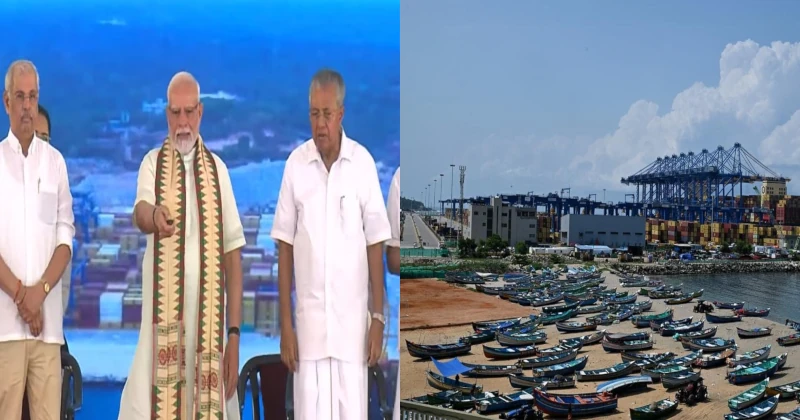
Prime Minister Narendra Modi on, May 2, dedicated the Vizhinjam International Deepwater Multipurpose Seaport to the nation, one of the most strategic infrastructure breakthroughs in independent Bharat’s history.
Valued at Rs 8,900 crore and strategically located on the southern tip of Kerala, Vizhinjam is India’s first semi-automated, deepwater, all-weather transshipment port and is poised to revolutionize South Asia’s maritime trade by cutting Bharat’s long-standing dependency on foreign transshipment hubs like Colombo, Singapore, and Dubai.
Developed under a visionary public-private partnership (PPP) model, the port is being constructed by Adani Vizhinjam Port Private Limited, with the project initiated on December 5, 2015. Built on a design, build, finance, operate, and transfer (DBFOT) basis, the port reflects a new era in Indian infrastructure—combining government vision, private innovation, and strategic foresight.
In his address during the inauguration, PM Modi said: “This is not just a port, it’s a strategic shield, an economic engine, and a global trade gateway. Vizhinjam is a testament to Viksit Bharat—self-reliant, future-ready, and globally competitive.”
PM Modi was joined at the ceremony by Kerala Governor Rajendra Vishwanath Arlekar, Chief Minister Pinarayi Vijayan, and several state cabinet ministers including V Sivankutty, G R Anil, and Ports Minister V N Vasavan, alongside Thiruvananthapuram Mayor Arya Rajendran.
Vizhinjam is not just another port. It is Bharat’s first semi-automated container port, equipped with state-of-the-art cargo handling systems, advanced cranes, and smart logistics tech that promise shorter vessel turnaround times and enhanced efficiency. Its natural draft depth of 20 meters unmatched in Bharat allows it to berth the world’s largest container ships without artificial dredging, slashing maintenance and operational costs.
This makes Vizhinjam a direct competitor to global ports, with automated berthing systems, high-capacity cranes, and real-time logistics tracking, putting it in the same league as Singapore and Rotterdam.
Situated just 10 nautical miles off the vital east-west global shipping axis, Vizhinjam is geographically gifted. It lies on the corridor connecting Europe, the Persian Gulf, and Southeast Asia, making it an ideal transshipment hub for international cargo movement. For decades, over 75 per cent of Bharat’s transshipped cargo passed through foreign ports—now, that balance is set to shift.
“The port will strengthen Bharat’s grip over maritime trade routes. It is a force multiplier for national logistics, trade diplomacy, and regional balance,” said a senior shipping ministry official.
Vizhinjam will integrate into Bharat’s Sagarmala Programme, bolstering coastal shipping, industrial clusters, and multimodal logistics. It will also serve as a critical maritime node in Bharat’s push for Blue Economy dominance, generating employment, boosting exports, and enhancing national security through port-side defense infrastructure.
Experts believe Vizhinjam will eventually become Bharat’s primary transshipment hub, serving not only Bharatiya cargo but also that of Bangladesh, Sri Lanka, and landlocked nations in Central Asia and Africa.
Vizhinjam’s emergence is seen as a direct blow to Bharat’s dependency on foreign ports. Over 3 million TEUs (twenty-foot equivalent units) of Bharatn cargo are currently transshipped via ports in Sri Lanka and elsewhere annually—an expensive logistical reliance that drains national wealth and leverage. With Vizhinjam, this cargo can now be handled domestically, saving billions and redirecting trade routes back into Indian control.
“Every container we bring back home is a strike for economic sovereignty,” a senior port official said. “Vizhinjam is not just a facility—it’s a declaration.”
PM Modi’s Kerala visit forms part of a broader infrastructure offensive. On May 2, 2025, he will visit Amaravati, Andhra Pradesh, to lay the foundation stone and inaugurate projects worth ₹58,000 crore, including the second wave of developmental works in the region, rekindling the vision first launched on October 22, 2015.














Comments