





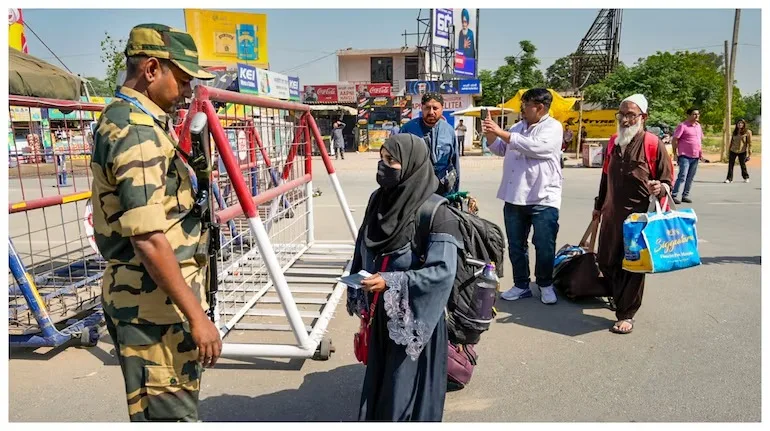
In a move prompted by grave national security concerns, the Government of India has cancelled all short-term visas issued to Pakistani nationals. This decision comes in the aftermath of the brutal terrorist attack in Pahalgam, Jammu and Kashmir, on April 22, 2025, in which 27 innocent tourists, mostly Hindus tragically lost their lives. The government’s action signals a zero-tolerance policy towards security lapses and illegal overstays, particularly from neighbouring Pakistan.
Nationwide crackdown launched on Pakistani nationals
Following the visa cancellation, Indian intelligence and police agencies swung into action with full force. The Intelligence Bureau (IB) and Local Intelligence Units (LIUs) initiated a massive hunt for Pakistani nationals residing across various states in India. These efforts are aimed at tracing individuals who might be staying illegally, overstaying their visas, or whose presence in India raises national security concerns.
Missing Pakistanis from 2007 Kanpur cricket series
In the midst of this intensified scrutiny, a startling revelation emerged regarding Pakistani nationals who had arrived in India nearly two decades ago. In 2007, during the India-Pakistan cricket series, several Pakistani fans had visited India, including Kanpur, Uttar Pradesh, to watch a match at the Green Park Stadium. Among them, 32 Pakistani nationals had entered the country on Exempted from Police Reporting (EPR) visas, a special provision that allowed them to travel across districts without the mandatory requirement of reporting to local police stations.
However, authorities recently discovered that 28 of these 32 individuals have been missing for the past 18 years. While four individuals were successfully traced and deported back to Pakistan, the majority remain unaccounted for. According to Additional Deputy Commissioner of Police (ADCP) Rajesh Srivastava from the LIU, the absence of mandatory police reporting under the EPR provision made it extremely difficult to monitor and trace their movements after they entered the country.
This serious lapse from the past has now resurfaced with alarming consequences, pushing authorities to tighten the surveillance and enforcement mechanisms further.
Intelligence Bureau hands over list of 5,000 Pakistanis to Delhi police
The situation in Delhi is equally concerning. Acting swiftly, the Intelligence Bureau (IB) handed over a list of approximately 5,000 Pakistani nationals to the Delhi Police for immediate action. This list, compiled in coordination with the Foreigners Regional Registration Office (FRRO), has been forwarded to the Special Branch, which has begun extensive verifications across various districts of the capital.
According to a senior police officer, areas like Central Delhi and North-East Delhi have notably high concentrations of Pakistani nationals. In Majnu Ka Tila alone, around 900 Pakistanis are believed to be residing, while another 600–700 are said to be living around the Signature Bridge area. The Delhi Police has received two lists, one containing 3,000 names and another with 2,000 names. While there may be some overlap between the two, thorough verification efforts are currently underway. Media reports also suggest that a number of these individuals might have already left the country following the government’s announcement.
Special exemptions for Pakistani Hindus holding Long-Term Visas
While the Indian government has ordered the departure of most Pakistani nationals, an important exemption has been made for persecuted Pakistani Hindus who have been residing in India. The Ministry of External Affairs (MEA) clarified that Pakistani Hindus living in India under Long-Term Visas (LTVs) would not be required to leave. Recognizing their status as refugees fleeing religious persecution, the government has allowed them to continue residing legally in India.
Apart from Pakistani Hindus on LTVs, all other categories, including diplomatic, official, medical, and short-term visas, have been revoked. In Kanpur specifically, there are about 50 Pakistani citizens on LTVs. Among them, 42 belong to Muslim families, while 8 are from Hindu families. These individuals arrived in India during the 1960s and 1990s, and many have established roots through intermarriages. Law enforcement agencies are, however, maintaining a close watch on all residents with Pakistani citizenship status to ensure compliance with legal norms.
Maharashtra identifies over 5,000 Pakistani nationals; 250 to be deported
In Maharashtra, state authorities have acted promptly in response to the Centre’s directives. According to reports, over 5,000 Pakistani nationals are currently living in different parts of the state under various visa categories, including LTVs, annual visa renewals, pending citizenship applications, and through marriages with Indian citizens.
Out of these, 250 Pakistani nationals have been identified for immediate deportation. The state government has initiated the formal process for their removal. However, a significant concern persists,107 Pakistani nationals have been declared untraceable, raising red flags over potential illegal residency and security threats. Additionally, 34 Pakistani nationals are reportedly living illegally in Maharashtra without any valid documents.
The distribution of Pakistani nationals across Maharashtra is as follows:
• Nagpur: 2,458 Pakistanis, with 25 untraceable.
• Thane: 1,106 Pakistanis, with 33 untraceable.
• Jalgaon: 393 Pakistanis.
• Pimpri-Chinchwad: 290 Pakistanis.
• Navi Mumbai: 239 Pakistanis, with 2 untraceable.
• Pune: 114 Pakistanis, with 9 untraceable and 24 living illegally.
These alarming figures have compelled the state administration to strengthen its efforts in tracking down and deporting illegal Pakistani residents.
Over 600 Pakistanis ordered to leave South India
The crackdown is not limited to northern and western India. In southern states as well, authorities are actively identifying and deporting Pakistani nationals.
According to a report by One India, over 600 Pakistani nationals currently residing in South India have been asked to leave. The breakdown is as follows:
• Kerala: 102 Pakistani nationals, with nearly half holding medical visas.
• Hyderabad: 208 Pakistani nationals, of whom 156 possess LTVs, 13 have short-term visas, and 39 have medical visas.
• Tamil Nadu: Approximately 180–200 Pakistani nationals.
A senior police official from Tamil Nadu noted that at any given time, 180–200 Pakistani nationals are present in the state. While those who arrived for medical emergencies are being allowed a temporary stay, all others have been asked to leave India as early as possible.
The Pahalgam terrorist attack has led to an urgent reassessment of India’s visa policies concerning Pakistani nationals. The Indian government is leaving no stone unturned in ensuring that any foreign presence on Indian soil is strictly regulated and monitored. The historical laxity in tracking individuals who entered under relaxed visa conditions has become a major security concern.
Except for persecuted Pakistani Hindus holding LTVs, the government has revoked all other categories of visas for Pakistani nationals and directed their deportation. The crackdown, led by central and state agencies, continues vigorously.
As India tightens its internal security apparatus, the message is clear: there will be no compromise when it comes to protecting the nation and its citizens from any form of terrorism.
















Comments