





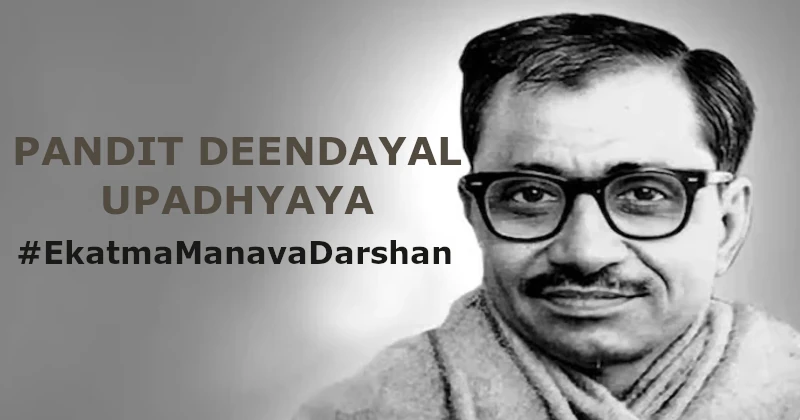
In an India struggling to find its ideological footing post-1947, where political leaders were reaching out to either Western capitalism or Soviet socialism to model the new nation’s policies, Pandit Deendayal Upadhyaya rose like a civilisational lighthouse from the banks of the Yamuna.
A visionary far ahead of his time, Deendayal Upadhyaya’s doctrine of ‘Integral Humanism’ (Ekatma Manava Darshan), laid out in four seminal lectures between April 22 and 25, 1965, was not merely a political ideology—it was the reassertion of India’s eternal identity as a living civilisation.
His lectures on Integral Humanism, now enshrined under Section 3 of the BJP Constitution, offered a culturally rooted, holistic alternative to divisive dualities—individual vs society, nature vs man, material vs spiritual, state vs religion.
“Vasudhaiva Kutumbakam—The world is one family,” he reminded a nation grappling with Western notions of nationalism and development.
What is Ekatma Manava Darshan?
Integral Humanism is based on the idea that man is a fourfold being—comprising body, mind, intellect, and soul. Any policy, economic system, or societal model that addresses only the physical or economic aspects of man is incomplete and destructive. “A person is not happy with separate happiness of these four. He needs integrated, holistic Ananda,” said Upadhyaya.
Likewise, society too has four components:
- Country (Rashtra)
- Culture (Sanskriti)
- People (Janata)
- Government (Sarkar)
All four must work together in harmony to ensure societal well-being. Without this integration, even the best governance becomes soulless.
Born on September 25, 1916, in Nagla Chandrabhan, Mathura district, Deendayal Upadhyaya’s early life was marked by personal tragedies—losing both parents before the age of seven. Raised by relatives, he emerged as a gold medallist and cleared the civil services examination—yet chose the path of service over success, dedicating himself to the cause of nation-building through the Rashtriya Swayamsevak Sangh (RSS).
He became a Pracharak in the 1930s, moving tirelessly across towns and villages, planting the seeds of cultural nationalism at a time when India’s political elite looked abroad for intellectual nourishment. His was a Bharatiya lens, not borrowed or tinted by colonialism.
Where Western individualism fragmented society and socialism suffocated the individual, Deendayal Upadhyaya proposed an integrative vision: the individual, society, nature, and the Divine are interconnected and interdependent. His thought was not reactionary nationalism, but a synthesis of Dharma and progress, where material prosperity (Artha), righteous desires (Kaam), and liberation (Moksha) are all grounded in the pursuit of Dharma.
Long before the slogan ‘Atmanirbhar Bharat’ gained currency, Deendayal Upadhyaya advocated for self-reliance grounded in Indian culture and spiritual wisdom. His call was clear: India must grow from within, not by mimicking the West, but by drawing from its own knowledge tradition.
“India is not a budding nation. We are an ancient, eternal civilisation. Our future lies not in borrowed ideologies but in our Dharma,” he insisted.
While Nehruvian socialism leaned on Soviet templates and others flirted with free-market capitalism, Deendayal Upadhyaya argued that development must go hand-in-hand with cultural rootedness. He warned: “By denying spirituality, man becomes a slave to the senses, seeking happiness and earning sorrow.”
In a country increasingly driven by identity politics and short-term populism, Pandit Ji’s “nation-first, last-person-first” model remains a moral compass. He insisted that statecraft must serve not just economic indices, but the total wellbeing of individuals and society—body, mind, intellect, and soul. The Chaturvidha Purusharthas—Dharma, Artha, Kama, Moksha—are not esoteric concepts, but pillars of human development policy.
He cautioned against hollow materialism:
“Dharmaviruddho Kāmo’ham – I am that desire which is not against Dharma,” quoting the Bhagavad Gita to stress that even desires must be culturally refined and spiritually aligned.
In post-1947 India, Western ideologies came with colonial hangovers. Nehru leaned on Fabian socialism; others found allure in American-style capitalism. But, as Deendayal Upadhyaya asked: “When we have rejected the political dominance of the West, why should we accept its intellectual slavery?”
The Western idea of a nation is a product of the 17th century; the Bharatiya idea of Rashtra is eternal, rooted in shared culture, Dharma, and spiritual continuity. “We are not a budding nation; we are an ancient and eternal one,” he reminded.
India was never merely a territory or economy—it was a living organism, a spiritual entity, described in the Upanishads as “Bharat is not just a nation but a Chaitanya (consciousness)”.
Unlike materialist systems that view development as GDP graphs and industrial outputs, Integral Humanism views development as elevation of the human condition—where employment, production, and distribution are aligned with Dharma and dignity. “Development is only that which goes along with our culture, society, and soul,” BJP India recently posted, reiterating Deendayal Upadhyaya’s foundational principle.
Environmental destruction, unchecked urbanisation, and hollow consumerism were pathologies he foresaw. Without spiritual grounding, material progress becomes a trap—prosperity without purpose.
Today, under Section 3 of the BJP’s Constitution, Integral Humanism is not just a historical artefact—it is the guiding ideology. First adopted by the Bharatiya Jana Sangh in 1965, and later enshrined in the Bharatiya Janata Party in 1985, it remains the soul of India’s Right-of-Centre politics, but rooted in spiritual Centre.
Key abhyas vargas (study camps)—Pune 1959, Gwalior 1964, and Sangh Shiksha Varg in 1964—helped crystallise these ideas into a policy framework that continues to inspire government action today, especially in areas like rural empowerment, cultural revival, and ecological responsibility.
As polarisation, identity wars, climate crises, and economic inequalities deepen worldwide, Integral Humanism offers a uniquely Bharatiya roadmap—where policy flows from philosophy, not populism, and where citizens are not just consumers, but custodians of culture and cosmos.
Pandit Deendayal Upadhyaya left this world in mysterious circumstances on February 11, 1968, but his thought lives on—not as ideology, but as Darshan—a civilisational vision. As Amit Malviya notes, “Integral Humanism is more than philosophy—it is India’s intellectual independence.”
“Na tu aham kānchana spṛhāmi, nāhi mama śaṅkā…”
(I have no desire for gold, no fear within me…)
In a time of external temptations and internal confusion, Pandit Deendayal Upadhyaya’s vision is India’s compass—pointing not outward, but inward, urging the nation to rediscover itself through Dharma, to reclaim its unity in diversity, and to walk the path of Ekatmata.











Comments